


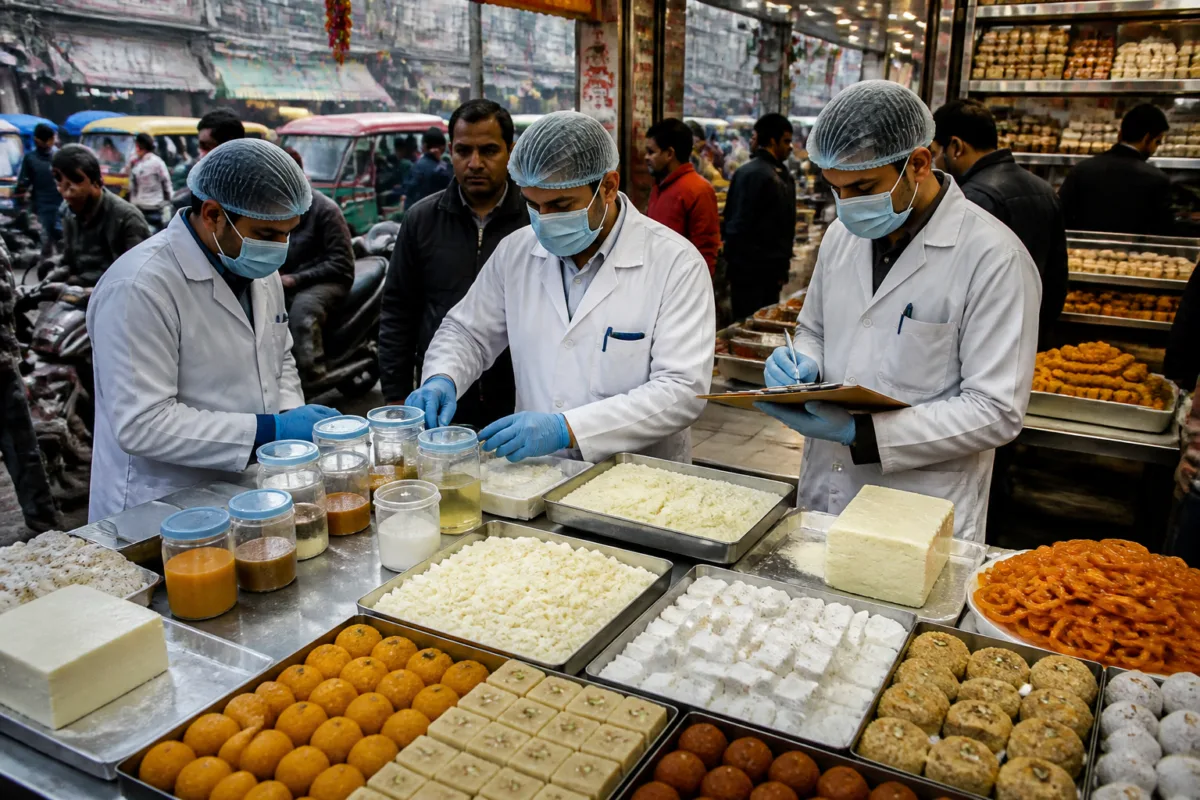
The latest inspections of khoya, paneer and other milk products across Delhi and neighbouring production centres reveal a food-safety problem that is larger than a questionable box of sweets. They show how festive food markets operate across city boundaries, how enforcement is organised, and why the distance between production, distribution and consumption makes adulteration difficult to control.
The immediate trigger was a series of inspections before the festive season. Uttar Pradesh’s Food Safety and Drug Administration alleged that units in Kanpur Dehat were using skimmed milk powder, refined soybean oil, detergents, talcum powder and hydrogen peroxide in the preparation of khoya. Officials recovered materials, destroyed prepared products and sent samples for laboratory testing. The allegations remain subject to those test results.
At the same time, Delhi’s food-safety teams destroyed more than 4,100 kg of suspected adulterated khoya and paneer over the previous month, according to the report. Samples of khoya, paneer, chhena and ghee were being collected from city markets. In neighbouring Mewat, officials seized and destroyed more than 10,000 kg of adulterated paneer after around 50 raids in identified production hubs.
These actions point to an urban system rather than isolated cases. The report identifies supply connections running through Jaipur, Mathura, Gurugram, Faridabad and Delhi. A product made in one district can therefore move through several markets before reaching a sweet shop or household. Enforcement at the point of sale may identify the final product, but the ingredients, processing unit and distribution network may lie elsewhere.
## How the khoya market becomes vulnerable
Khoya is a concentrated milk product made by rapidly drying milk or milk solids. FSSAI standards require it to contain at least 55% total solids and at least 27% milk fat on a dry-matter basis. The standards also specify that it must be free of added starch and added sugar. Properly made khoya has a mildly cooked, boiled-milk flavour and a soft, granular body.
Those requirements create a commercial incentive for substitution when milk fat and genuine milk solids are expensive. The report describes the alleged use of skimmed milk powder as a cheap milk-like base and refined or soybean oil as a substitute for milk fat. Starch can add bulk and density. Other substances were allegedly used to affect whiteness, smoothness or appearance.
This is important because adulteration is not necessarily one uniform recipe. The reported materials suggest a series of separate workarounds: one ingredient can imitate milk solids, another can provide fat, another can change texture, and another can alter colour. A finished product may consequently resemble khoya without meeting the composition or hygiene standards that define it.
At a unit in Badshahpur village in Rasoolabad, Kanpur Dehat, officials reportedly recovered 175 packets of skimmed milk powder in seven bags and about 15 litres of hydrogen peroxide. They also found saifolite and destroyed around 100 kg of prepared khoya. Samples of 50 litres of milk and 50 kg of khoya were collected for testing. At a second unit in Bhola Nagar, Jhinjhak, officials found refined soybean oil, skimmed milk powder and about 32 kg of prepared khoya.
The report attributes additional claims to Uttar Pradesh officials, who said titanium dioxide and other whitening agents, liquid glucose, neutralisers and surfactants were also being used in khoya and other dairy products. Those claims, like the allegations at the inspected units, require laboratory confirmation before they can be treated as established findings.
## The city is the final market, not always the point of origin
Delhi’s role in this chain is significant because it is both a large consumption market and a distribution node. Festive demand brings together manufacturers, wholesalers, transporters, retailers and consumers. The product may be made outside the city, stored in a wholesale market, processed again by a sweet manufacturer and sold under a retailer’s name.
That structure complicates accountability. A city inspection team can seize a suspicious product, destroy it and collect samples, but the inspection may not immediately reveal where the product originated or how widely it has circulated. Conversely, action at a production hub may prevent unsafe material from reaching several cities, but only if enforcement agencies can identify the routes and coordinate across jurisdictions.
The reported action in Kanpur illustrates the different layers of enforcement. Across Kanpur Dehat and Kanpur Nagar, 24 teams inspected units and collected 28 samples. Officials destroyed material with an estimated face value of Rs 1.50 lakh. At Hatiya Khoya Mandi, 14 samples were taken and about 430 kg of khoya valued at Rs 1.07 lakh was destroyed for unhygienic storage.
An FIR was registered at Rasoolabad police station under Sections 274 and 275 of the Bharatiya Nyaya Sanhita. The food-safety department also began action to suspend or cancel the registrations of three food business operators. These steps show that the response is not limited to removing products from circulation; it can also involve criminal proceedings and regulatory action against registered businesses.
The effectiveness of that system depends on what happens after seizure. Laboratory testing determines whether an allegation becomes an established violation. Registration or licensing action determines whether a business can continue operating. Real-time recording of inspections and outcomes determines whether authorities can track repeat offenders, recurring substances or links between production centres and urban markets.
## What the evidence says about risk
The available evidence does not support treating every festive sweet as dangerous. FSSAI’s pilot survey of milk products in and around Delhi, conducted from October 15 to November 7, 2019, tested 1,041 samples at the National Food Laboratory in Ghaziabad. The sample included 438 packed products and 603 loose products.
According to the regulator’s guidance note, the survey found no major chemical or microbiological safety issues, but it identified predominantly quality and hygiene problems. These occurred more often in loose products than in packed products. That distinction matters: the existence of enforcement cases does not mean that every product in the market is adulterated, but it does indicate that consumers face different levels of traceability and control depending on how a product is made and sold.
Health experts cited in the report caution that harmful starch, urea-mixed milk, caustic soda and non-approved colours can contribute to acute gastritis, diarrhoea, dysentery, dehydration and kidney inflammation. The health impact depends on the substance, dose and exposure, and the reported cases involving suspected products still require the relevant testing and legal process.
FSSAI’s consumer guidance recommends preferring packed products over loose ones because the probability of adulteration is higher in loose sales. It also describes a preliminary starch check: a small piece of khoya can be boiled in water, cooled and treated with a few drops of iodine solution. A blue colour indicates the possible presence of starch. FSSAI treats this as an initial indicator, not as laboratory proof.
The distinction between screening and proof is central to food governance. A home test may alert a consumer, but it cannot establish the full composition of a product or identify every possible contaminant. Only laboratory testing and the subsequent regulatory process can determine whether a sample breaches the applicable standard.
## Enforcement is becoming a data and coordination problem
FSSAI directed states and Union Territories on September 29 to intensify inspections and sampling during Navratri and Diwali. The directive covered milk products, sweets, snacks, edible oil, beverages and ghee. The Press Information Bureau has also noted that FSSAI runs special drives before and during festivals, prioritising products considered vulnerable to adulteration, including ghee, khoya, paneer and sweets.
The reported instructions to log inspections, samples and outcomes in real time on FoSCoS and FoSCoRIS are significant because the market is not confined to one municipal boundary. Data systems can help authorities connect a seized product with the business that supplied it, identify repeated failures and compare activity across districts. Their usefulness, however, depends on the completeness and accuracy of the entries and on whether agencies act on the information.
The geography described in the report also creates an institutional challenge. Delhi, Uttar Pradesh, Haryana and Rajasthan have different administrations and enforcement teams, while the commercial network crosses their borders. A production unit may be inspected by one state, transported through another and sold in a third. Effective control therefore requires more than seasonal raids at city shops; it requires communication between agencies responsible for production, transport, wholesale markets and retail sales.
The quantities reported in Delhi, Mewat and Kanpur show why this matters. More than 4,100 kg of suspected adulterated khoya and paneer was destroyed in Delhi over the previous month, while more than 10,000 kg of adulterated paneer was seized and destroyed in Mewat. In Kanpur, around 430 kg of khoya was destroyed at one market and about 100 kg at one inspected unit. These figures measure seized or destroyed material, not the total volume of unsafe product in circulation, but they demonstrate the scale of enforcement activity during a concentrated demand period.
## The larger urban question
Festive food safety is often presented as a matter of consumer caution, but the evidence points to a broader urban-governance issue. Cities depend on regional production systems that supply food, construction materials, labour and other essentials. The consumer sees a finished product at a retail counter; the regulator must reconstruct the chain behind it.
That chain combines informal and formal businesses, inter-state movement, temporary demand spikes and products that can be difficult to assess visually. It also creates an information gap between what a product looks like and what it contains. Packaging, registration, sampling and laboratory capacity are therefore not administrative details alone. They are the mechanisms through which urban consumers receive some assurance about products entering the market.
The current inspections confirm that authorities are acting and that suspected products are being removed. They do not, by themselves, establish how widespread each alleged adulterant is, which businesses are repeat offenders or how many products pass through the same supply routes. Those questions depend on laboratory results, enforcement records and further investigation.
For consumers, the immediate official guidance is to prefer packed products, treat home tests only as preliminary indicators and report concerns through FSSAI’s Food Safety Connect portal, WhatsApp number 9868686868, email address compliance@fssai.gov.in or toll-free number 1800112100. For the regulatory system, the next decisive evidence will be the test results from the seized samples and the recorded outcomes of the inspections already under way.

