


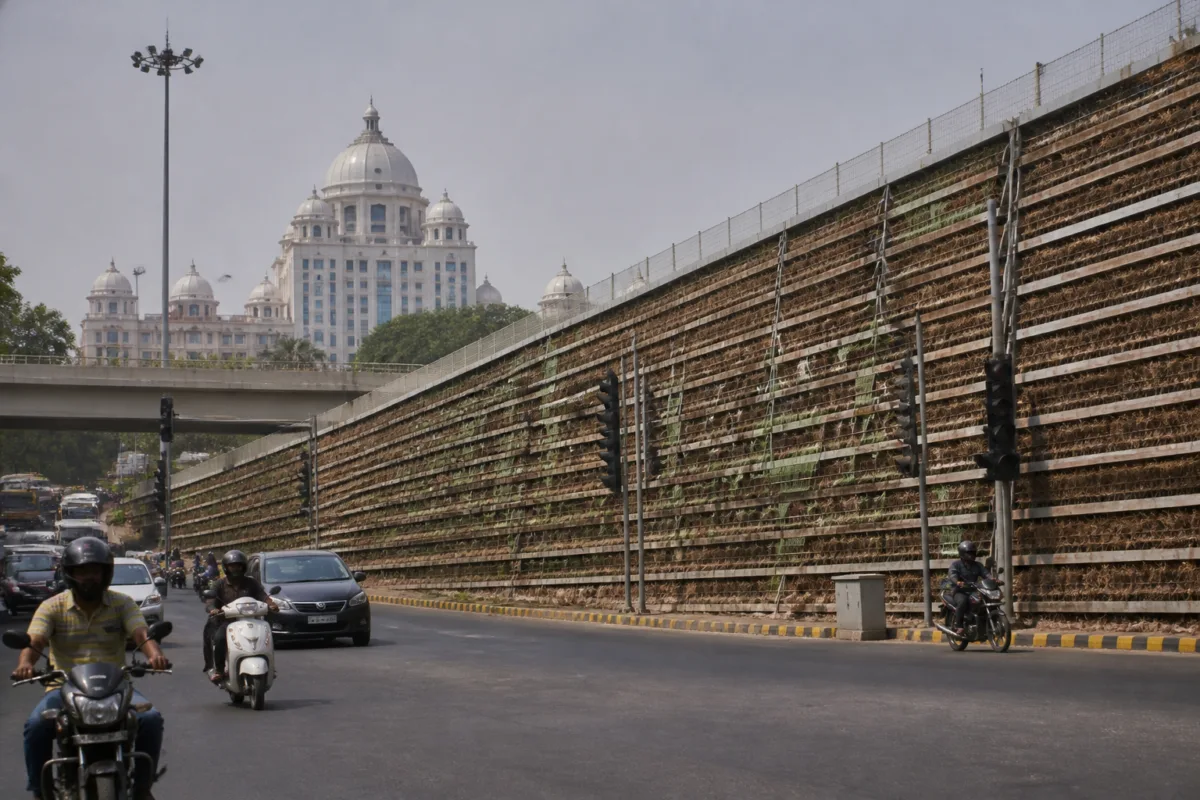
The collapse of Hyderabad’s Khairatabad vertical garden is more than the loss of a green landmark at a busy junction. It shows how an urban beautification project can lose its public value when the systems needed to operate and maintain it are not sustained. The garden, built by the Greater Hyderabad Municipal Corporation (GHMC) at a cost of more than Rs 32 lakh, once carried 14,000 plants arranged to spell “HYDERABAD”. The plants have now been removed after drying up, according to a senior GHMC Urban Biodiversity official quoted by Telangana Today.
The installation occupied a prominent position on the right side of the road for motorists travelling from the Telangana Secretariat and Khairatabad flyover. It was approximately 10 feet high and 260 feet long. When it was inaugurated in 2020, the structure was presented as a distinctive green intervention in a heavily built-up urban setting. Its scale, location and lettering also made it a visual city marker and a popular backdrop for photographs.
Its deterioration raises a basic but frequently overlooked question in urban infrastructure: what happens after a civic project is inaugurated? The available account indicates that the project’s physical construction was only one part of the expenditure. The garden also required daily watering, a functioning drip irrigation system, replacement planting and regular supervision. The failure of any of these elements could affect the appearance and survival of the installation, but the immediate explanation given by the GHMC official is a shortage of water.
The garden used 10 species, including Crossostephium chinense, duranta, amaranthus or iresine, alternanthera, vulcameria, buxus and tradescantia spathacea. These plants were arranged in different colours, including white, yellow and red, to form the large lettering. That design made the installation visually distinctive, but it also created a maintenance obligation that was different from that of a conventional roadside plantation. A vertical garden depends on irrigation reaching plants positioned across a constructed surface, rather than on rainfall and soil alone.
According to the report, the contractor appointed for the project was responsible for maintaining the greenery and watering the plants daily through a drip irrigation system. This detail is central to understanding the failure. The question is not only whether the plants received water, but also how the maintenance contract defined responsibility, how water availability was secured, whether the irrigation system remained functional and what monitoring was carried out when the plants began to deteriorate.
The reported removal of all 14,000 plants suggests that the problem was not limited to a few dead sections. It affected the installation as a whole. However, the supplied report does not establish when the water shortage began, how long the garden remained without adequate watering, whether the drip system failed mechanically or whether water was unavailable at the site, or whether the contractor faced any penalty. It also does not record a detailed response from the contractor or disclose the terms and duration of the maintenance agreement.
These unanswered details matter because a civic asset’s cost cannot be assessed only by its inauguration value. The GHMC spent over Rs 32 lakh to create the vertical garden in 2020. That figure represents the reported capital cost of setting up the framework and planting system, but the installation’s continued operation depended on recurring expenditure and administrative attention. Without those inputs, the initial investment could not deliver its intended public function for long.
The Khairatabad case therefore illustrates the difference between capital creation and asset management. Capital spending produces a visible structure. Asset management keeps that structure functional, safe and useful over time. In a vertical garden, asset management includes irrigation, plant health, pruning, replacement, cleaning, inspection and responsibility for responding to failures. The supplied information specifically identifies watering and maintenance as problems, but it does not indicate whether GHMC had a publicly reported performance record for the garden after its 2020 inauguration.
The location makes the decline especially visible. Khairatabad Junction is described as a bustling intersection used by thousands of daily commuters. A conventional garden in a less prominent location might deteriorate without becoming a daily reminder of administrative neglect. Here, the green wall stood beside major traffic movement and had been designed to function as a city-facing attraction. Its barren appearance is consequently experienced not just as a horticultural failure, but as a visible change in the quality of a public space.
This is also why beautification projects need to be evaluated differently from one-time visual interventions. A green wall can improve the appearance of a junction, but its environmental and civic value is conditional. The installation must remain alive, maintained and integrated into the city’s water and operations systems. If daily watering cannot be assured, the project’s design and location may not match the practical capacity available for its upkeep. The report does not establish whether such a feasibility assessment was conducted before construction.
The water issue is particularly important. The official explanation quoted in the report says that a shortage forced the removal of the plants. That does not by itself identify the broader cause of the shortage. The supplied material does not say whether the problem arose from a municipal supply constraint, a local connection issue, equipment failure, contractor inaction or another operational reason. It also does not state whether alternative water arrangements were considered or whether the garden was redesigned to reduce its water requirement.
Those distinctions affect accountability. If water was unavailable, the responsible agencies would need to clarify who was expected to secure it. If the irrigation system was defective, the maintenance arrangement would need to show who was responsible for repairs. If watering was not carried out despite availability, supervision and contract enforcement would become central. The present report identifies the outcome and the broad explanation, but not the administrative chain behind it.
The case also highlights the limits of inauguration-led civic planning. The garden was inaugurated in 2020 during the BRS regime, while the report describes its present condition under the current civic administration without attributing a detailed response to a particular political authority. The institutional responsibility lies with the municipal system that built, contracted and maintained the asset over time. A public project does not become someone else’s problem when the administration changes; its maintenance obligations continue across political terms.
For GHMC, the immediate operational question is whether the structure will be restored, redesigned or left unused. The report does not announce a restoration plan, a new tender, a replacement planting schedule or a timeline. Nor does it state whether the Rs 32 lakh framework remains usable after the plants were removed. These are important next steps because the physical installation may still represent a public asset even if its original planting has failed.
The larger lesson is not that every vertical garden is inherently unsuitable for Hyderabad. The supplied evidence does not support that conclusion. It does show, however, that such projects depend on a continuous chain of water, horticultural care, contractor performance and municipal oversight. A project that is visually successful at launch can become an expensive dead structure if that chain is not protected.
Khairatabad’s failed green wall leaves the city with a clearly documented gap between public investment and sustained service delivery. The facts currently available confirm the project’s original scale, cost, planting design and present deterioration, as well as the official explanation involving water shortage. What remains unclear is how the maintenance system failed, whether responsibility was enforced and what GHMC plans to do with the installation. Those answers will determine whether the episode becomes a temporary breakdown or another example of civic infrastructure being measured only at inauguration.

