


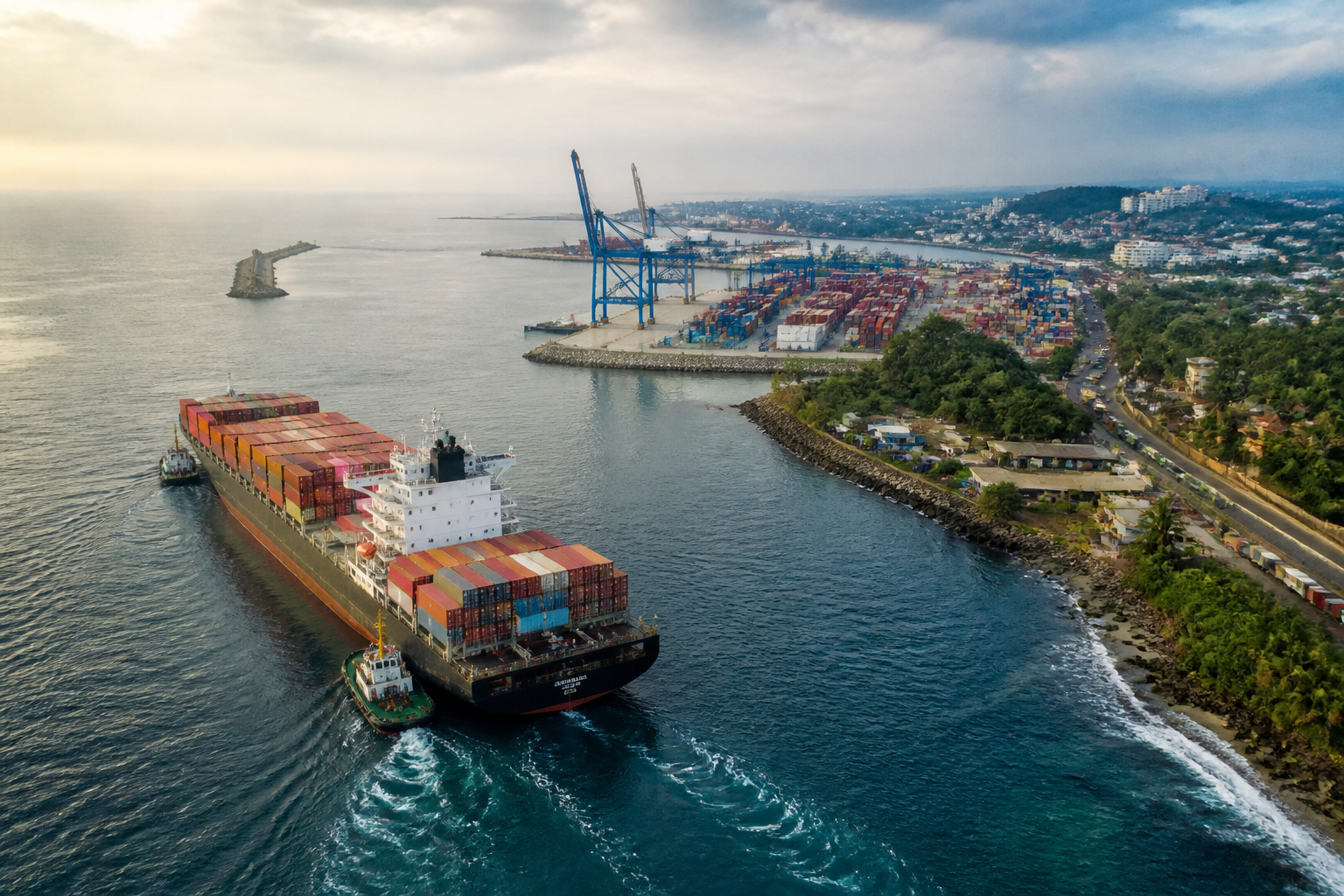
Kerala’s proposal to function as an integrated port city is more than a plan to expand maritime infrastructure. It is an attempt to reorganise how a densely populated state moves cargo, uses its coastline and distributes economic activity across regions. Chief Minister V D Satheesan has said the new UDF government is working to connect the state’s ports, shift a significant share of logistics from roads to the sea and build an economy around maritime trade, aviation, tourism and the blue economy.
The proposal is centred on Kerala’s roughly 600-kilometre coastline and the state’s network of ports rather than on Vizhinjam alone. Satheesan said the government had begun work with maritime and shipping experts to integrate the ports and develop a system in which Kerala operates as a single port city. The idea, as described by the Chief Minister, is to use the different coastal locations as parts of one logistics network instead of treating them as isolated facilities.
That approach matters because Kerala’s urban and industrial geography is unusually constrained. Satheesan identified high population density and restrictions linked to forests, paddy fields and coastal zones as obstacles to establishing new industries. In such a setting, expanding road-based freight movement can intensify congestion and compete with already limited urban land. The government’s stated objective of moving 50 per cent of logistics to the sea is therefore also a proposal for changing the physical burden placed on roads.
The available account does not establish how the 50 per cent target will be measured, which commodities would be shifted first, or what investments in coastal shipping, terminals, storage and last-mile connections would be required. Those details will determine whether the proposal becomes a functioning multimodal system or remains a broad development vision. A port network can reduce pressure on roads only when cargo can move reliably between ships, ports, warehouses, industrial areas and final destinations.
Vizhinjam is the most important existing anchor for the plan. Satheesan said the international port had begun export-import activities and was located about 10 nautical miles from an international shipping route, creating opportunities to connect it with other ports. The government intends to develop Kerala’s other ports alongside Vizhinjam, although the supplied account does not specify the sequence, investment size or operational model for that expansion.
The strategy also links port infrastructure to sectors beyond container movement. The Chief Minister referred to cruise tourism, the export of agricultural products and spices, value addition, the blue economy and the mineral sector. The government has announced a Southern Economic Corridor in the state budget, with port-based activities in Thiruvananthapuram, a mineral corridor in Kollam and blue economy activities in Alappuzha.
This regional framing is significant. It suggests that the proposed port strategy is intended to distribute economic functions along the coast rather than concentrate all activity around a single gateway. Under the stated plan, Thiruvananthapuram, Kollam and Alappuzha would perform different roles within a wider economic corridor. Whether those roles complement one another will depend on transport links, cargo specialisation, land availability, environmental permissions and the capacity of local administrations to support industrial activity.
The plan also rests on a second network: aviation. Satheesan said Kerala was seeking to become an aviation hub by using the presence of four international airports located relatively close to one another. Proposed measures include an international convention centre in Kochi, a maintenance, repair and overhaul facility, a pilot training institute in Kannur, helicopter training facilities and cargo and logistics services.
Taken together, the maritime and aviation proposals point to an attempt to build a statewide logistics platform. Ports could handle sea freight, airports could support time-sensitive cargo and passenger movement, and road and rail systems would remain necessary for distribution within the state. However, the account does not provide details of how these modes would be integrated, which agency would coordinate them or how competing infrastructure priorities would be resolved.
The institutional question is especially visible in the government’s handling of the proposed transfer of shares in Vizhinjam International Seaport to Mediterranean Shipping Company. Satheesan said the proposal was being examined to protect the state’s interests and prevent a monopoly. An empowered committee headed by the Chief Secretary is reviewing the proposal, and the state will consider its report after the Centre grants the necessary strategic clearance.
According to the Chief Minister, the concession agreement requires approval from the state government, which owns the port, as well as strategic clearance from the Union Ministry of Home Affairs. He said the state’s primary concerns were protecting its interests, preventing monopoly and ensuring common services. He also said the concession agreement already contained provisions intended to prevent monopolistic practices and protect common facilities.
The share-transfer issue shows that port development is not only a question of construction or cargo capacity. Ownership, concession rights, strategic clearance and access to common services can shape how a port affects the wider economy. A port may be physically connected to a shipping route but still have limited public value if control over essential services, facilities or access becomes concentrated. The government’s review will therefore be an important test of how it defines public interest within a privately operated infrastructure system.
The proposed network also faces the practical challenge of moving agricultural products and spices from production areas to ports in a form suitable for export. Satheesan referred to opportunities for value addition, but the supplied material does not identify the processing facilities, cold-chain infrastructure or logistics hubs required to realise them. These links matter because port-led development produces wider gains only when local producers and businesses can participate in the trade system rather than merely occupy land around a terminal.
The state’s plans for micro, small and medium enterprises and startups add another layer to the strategy. MSMEs could benefit from improved access to export logistics, while port-related services may create demand for warehousing, repair, freight management and processing. But the government has not yet provided, in the available account, a detailed framework showing how smaller firms will access land, finance, cargo services or procurement opportunities.
Environmental and land-use constraints will remain central. Kerala’s coastal regulations, paddy-field protections and forest restrictions are not peripheral obstacles; they define where infrastructure can be built and how urban expansion can take place. The port-city approach will have to operate within those limits while managing the effects of new terminals, roads, warehouses, industrial areas and tourism facilities. The supplied report does not include environmental assessments or project-specific clearances, so the consequences of the proposed expansion cannot yet be established.
The government’s stated development priorities extend beyond ports. Satheesan also referred to tourism, education, aviation, MSMEs and social measures implemented during the government’s first 100 days, including free travel for women on KSRTC buses and the creation of a Department for Senior Citizens. These initiatives are separate from the port strategy, but they indicate that the administration is presenting infrastructure, economic development and welfare as connected parts of its governing programme.
For Kerala, the larger urban question is whether a dispersed coastal network can support economic growth without multiplying congestion, land conflicts and administrative fragmentation. The proposal offers a way to think of ports, airports, rivers, roads and industrial areas as one system. Yet that system will require clear responsibilities between the state, the Union government, port authorities, private concessionaires and local administrations.
What is established so far is the government’s direction: connect the ports, increase maritime logistics, use Vizhinjam’s location, build regional economic corridors and develop complementary aviation and trade infrastructure. What remains unresolved are the financing model, project timelines, cargo targets, institutional coordination, environmental safeguards and the terms of the proposed Vizhinjam share transfer. Those details will determine whether Kerala’s port-city vision becomes an integrated urban-economic network or a collection of separately implemented projects.
