


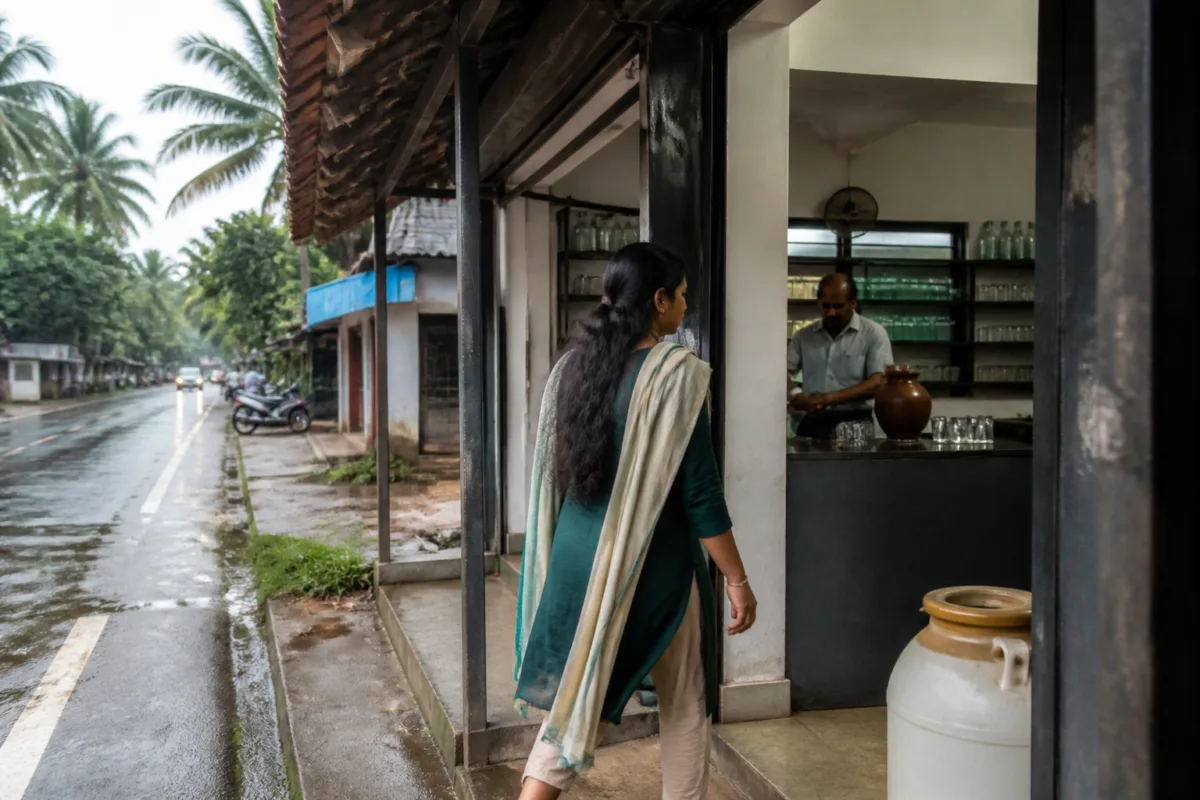
The Kerala High Court order permitting women to work in toddy shops has settled more than one employment dispute. It has challenged the assumption that a gendered image of an occupation can determine who is allowed to earn a livelihood within it. For Sophy Kunjipalu, a 49-year-old homemaker from Irinjalakuda in Thrissur, the issue was not symbolic. After her husband’s death in 2024, access to a job at a toddy shop became central to her family’s survival.
Kunjipalu’s case brings the relationship between livelihood, gender and regulation into view. Toddy shops operate within a formal administrative system overseen through the excise framework. Employment in and around these establishments is therefore not simply a private workplace question. It can also involve decisions by authorities about eligibility, succession and access to a regulated occupation.
According to her account to the Times of India, Kunjipalu applied for a position after her husband’s death but was rejected. She said she had no other source of income and needed the job to support her family, including two children who were still studying. She then spent two and a half years pursuing the matter through legal action and agitations supported by the INTUC.
The immediate significance of the High Court order is that it permits women to work in toddy shops. Kunjipalu welcomed the decision and argued that no profession should be denied to women solely because of their gender. In her formulation, the right to earn a livelihood should depend on ability rather than gender. That principle shifts the question from whether women belong in a particular workplace to whether the workplace can justify exclusion through objective employment requirements.
The details of Kunjipalu’s family history also show why access to such work cannot be treated as an abstract question. She said her father, Louis, had worked at a toddy shop and that, after his death, her mother, Alphonsa, took over his position at a toddy depot within the Irinjalakuda excise range. Kunjipalu was aware of the provision that allowed such succession and applied for the job after her husband’s death.
Her experience suggests that the dispute involved both gender and continuity of livelihood. A work opportunity that had been available within her family was not automatically accessible to her when circumstances changed. The rejection therefore became a question of who could inherit or obtain access to employment connected to a regulated establishment, and whether a woman could claim that opportunity on equal terms.
The case also exposes a recurring administrative problem: rules may appear neutral while their application reflects older assumptions about who is suitable for particular forms of work. The source report does not provide the full text of the High Court order, the precise statutory provisions examined by the court or the reasoning used to invalidate the restriction. It does, however, establish the practical conflict that brought the issue before the court and the broader principle affirmed by Kunjipalu after the order.
That limitation matters. The order’s precise legal scope, the categories of work covered and the duties now expected of excise authorities cannot be established from the available account alone. What can be established is that the court has permitted women to work in toddy shops and that the decision has been welcomed by a woman who spent years seeking access to such employment.
Kunjipalu’s demand now moves beyond formal permission. She has said that authorities must ensure a safe, secure and dignified working environment for women. This is an important institutional distinction. Removing a bar on entry does not by itself settle questions of workplace safety, harassment, hours, facilities, supervision or the treatment of women employees by co-workers and customers. The source does not record any new operating protocol issued by the authorities, but Kunjipalu’s statement identifies the implementation question that follows the judgment.
In that sense, the case has two stages. The first is recognition: whether women can legally seek work in an occupation from which they were being excluded. The second is administration: whether the relevant authorities and employers will make that right meaningful in daily working conditions. A court order can remove a formal restriction, but the durability of the change will depend on how applications are processed, how complaints are handled and whether safety is treated as a workplace responsibility rather than as a reason to exclude women.
The employment issue is also linked to the way families cope with economic shocks. Kunjipalu described the legal battle as a fight for survival after her husband’s death. Her children’s education was continuing, while the family had no other source of income identified in the report. In such circumstances, denying access to work has consequences beyond the applicant. It can affect household income, educational continuity and the ability of a family to remain economically secure.
This is where the case connects to the wider urban and regional economy. Livelihoods are often discussed through large projects, formal offices and high-growth sectors, while smaller regulated establishments receive less attention. Yet such workplaces support households and are embedded in the everyday economic life of towns such as Irinjalakuda. Employment rights in these settings are part of the built environment’s social infrastructure: they determine who can use the institutions, workplaces and commercial spaces through which local economies function.
The case also complicates the idea that gender equality is achieved only through access to conventionally designated occupations. Kunjipalu’s position is not that women should be offered a separate or specially created role. She sought access to an existing job. Her argument, as reported, is that the nature of the establishment should not automatically determine the gender of the worker. That makes the dispute a test of whether workplace equality applies across the full range of lawful occupations, including those shaped by tradition and social attitudes.
The involvement of the INTUC in supporting her agitations indicates that the dispute also acquired a collective labour dimension. The available report does not detail the union’s legal arguments or the scale of the protests, so their wider significance cannot be measured from the supplied material. Still, the support helped sustain a two-and-a-half-year campaign by an individual whose initial claim arose from a personal family crisis.
The court order may therefore become significant not because it creates a new category of employment, but because it prevents gender from functioning as an automatic filter at the point of entry. That distinction is central to the governance of work. Authorities can regulate premises, licences and operational conditions, but those powers must be separated from assumptions about whether women are inherently unsuitable for a workplace.
What happens next will determine whether the order remains a legal principle or becomes an administrative practice. The relevant authorities will need to apply the decision to employment applications and clarify the conditions under which women can work in toddy shops. The source report does not state whether such instructions have already been issued. It records Kunjipalu’s expectation that the authorities will ensure safety, security and dignity.
The evidence currently establishes a clear change in principle but leaves implementation details open. A Thrissur woman who was refused a job after her husband’s death fought for two and a half years and backed a High Court order permitting women to work in toddy shops. The larger question is whether equal access will now be reflected in workplace procedures, safeguards and everyday treatment. That is the measure by which the order’s practical impact will be judged.

