


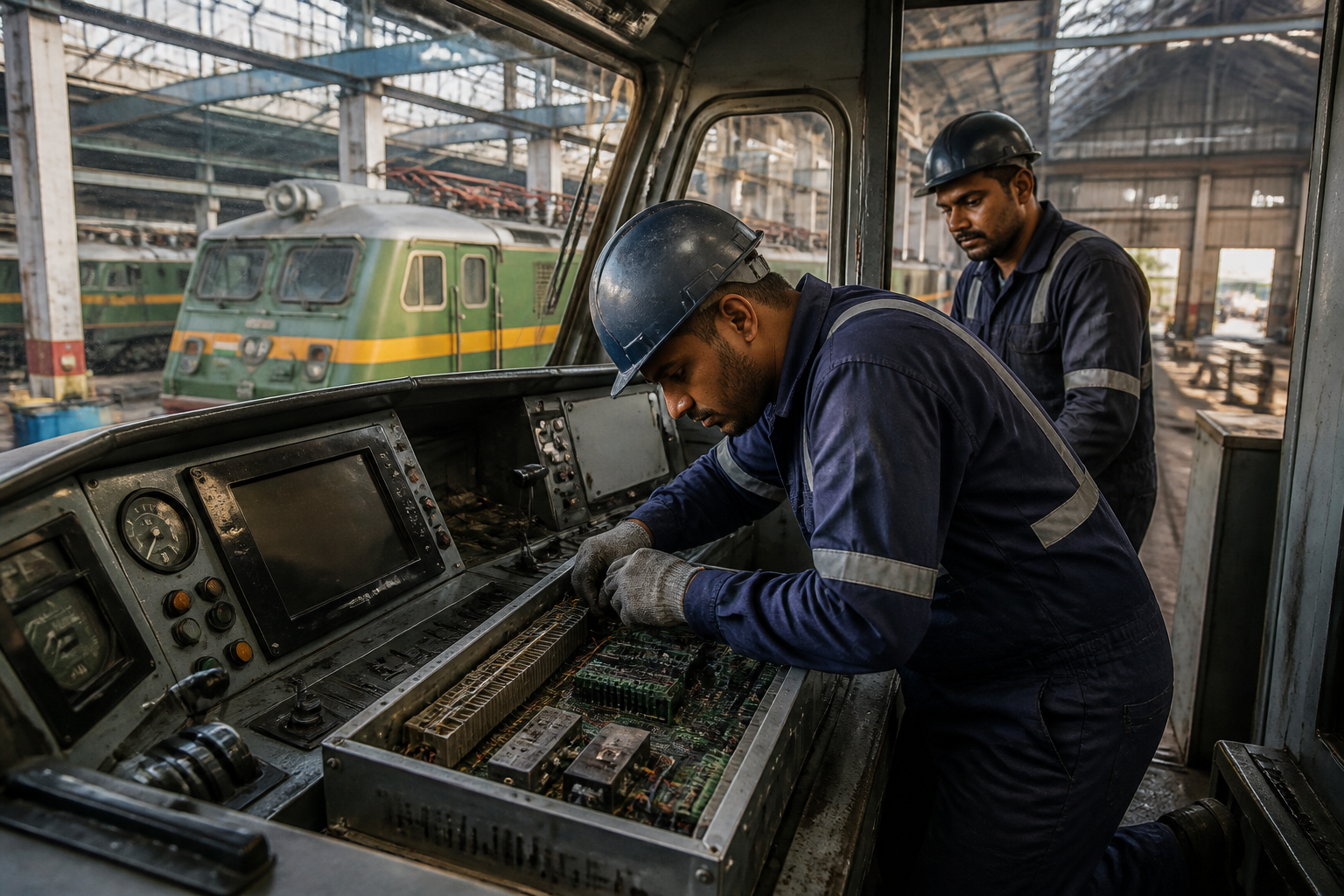
South Eastern Railway has begun deploying the Kavach train-protection system on electric locomotives at its Kharagpur Electric Loco Shed, alongside RFID tagging for conventional freight locomotives. The installations represent a shift from relying mainly on human response and fixed railway procedures towards using onboard and digital systems to support safer train operations, although the supplied report does not establish the wider coverage of Kavach across the railway zone.
According to a report by Sangbad Pratidin, 10 locomotives received operational Kavach installations between 25 July and 1 October. Work has been completed on two additional locomotives and those systems are expected to become operational shortly, while installation work is continuing on two more locomotives. The report does not provide the total number of locomotives based at the shed, the overall fleet size of South Eastern Railway, or a target date for fitting the system across a larger share of the fleet.
That distinction is important because train-protection technology works as part of a wider operating system rather than as an isolated device inside a locomotive. The report says Kavach can automatically apply the brakes in specified situations, prevent a train from passing a red signal and control excessive speed. It also provides signal-related information to the loco pilot through a display inside the locomotive cab. These functions are intended to add an automated layer of protection when a train approaches an operational limit or when speed and signal compliance become critical.
The report does not describe a single cause behind the installation programme or identify a specific accident that triggered it. Instead, it presents the work as part of South Eastern Railway’s effort to make train operations safer and more modern. That framing places the Kharagpur work within a broader institutional challenge for the railways: improving safety without removing the operational role of trained staff, and ensuring that new equipment is installed, activated, maintained and integrated into daily train working.
Kavach’s significance lies in the type of risk it is designed to address. A railway journey depends on multiple layers of control, including signalling, train speed management, communication and the actions of the loco pilot. The report attributes to Kavach the ability to intervene through automatic braking in specified circumstances and to communicate signal information through the cab display. In practical terms, that means the system is designed to support the human operator at moments when a delay in response or an excessive speed could increase risk.
However, the available information does not establish how often the system has intervened, how many routes or locomotives in South Eastern Railway already have compatible infrastructure, or what performance indicators will be used to assess the programme. It also does not state whether all locomotives working on the routes served by Kharagpur have access to the trackside and signalling elements needed for Kavach to function as intended. Those details are essential to judging the difference between fitting equipment on individual engines and achieving meaningful network-wide protection.
The second part of the programme involves RFID tags on conventional electric freight locomotives. Kharagpur Electric Loco Shed is described as the first shed in South Eastern Railway to begin fitting these tags on such locomotives. Two locomotives have already been tagged and work is under way on three more. Unlike Kavach, which the report links directly to train protection, RFID is presented as an identification and monitoring tool that can help track the location of locomotives digitally.
The two technologies therefore address different operational problems. Kavach is associated with safety interventions involving signals, braking and speed. RFID is associated with visibility of locomotive movements and location. Together, they show how railway modernisation increasingly involves both physical safety systems and digital information systems. One is intended to support decisions and interventions during train movement; the other is intended to improve knowledge of where rolling stock is within the operating network.
For freight operations, location visibility can be particularly relevant because locomotives move through complex networks and may be assigned across different services and locations. Yet the supplied report does not say what platform will receive the RFID data, who will monitor it, how frequently the information will be updated or whether the system will be linked to scheduling, maintenance or asset-management functions. It also does not provide a measured improvement in locomotive utilisation or turnaround time. The confirmed point is narrower: the tags are being introduced at Kharagpur and are intended to enable digital monitoring of locomotive locations.
The institutional setting matters. The work is being carried out at a loco shed, the operational facility responsible for locomotive-related activities, rather than being described as a public-facing station upgrade. That means passengers may not see the equipment directly, but they may be affected by the safety and operational systems supporting the trains on which they travel. The immediate implementation numbers are modest—10 operational Kavach installations, two completed and awaiting activation, and two more under installation—yet the significance of the programme depends on whether such work becomes a sustained and scalable process.
The timeline also shows why the announcement should not be read simply as a one-day technology launch. The report says the 10 Kavach systems were activated over the period from 25 July to 1 October, with further installations at different stages. This is an incremental deployment programme. Its effectiveness will depend not only on the number of locomotives fitted, but also on activation, testing, maintenance, staff familiarity and compatibility with the railway’s signalling environment. None of those wider implementation details is provided in the source material.
For passengers and freight users, the most immediate public-interest issue is safety. The report says the technology is expected to reduce accident risk by helping prevent red-signal violations and excessive speed in specified circumstances. That expectation is tied to the system’s stated functions, but the article does not provide independent safety results from the Kharagpur deployment. It would therefore be premature to describe the installation as proof of a measurable reduction in accidents. What can be established is that South Eastern Railway is adding an automated safety layer to a defined set of locomotives.
The programme also raises a question about how railway safety improvements are measured. Installation counts are easy to report, but they do not by themselves show operational effectiveness. A fuller assessment would require information on the number of compatible locomotives and routes, system activation rates, technical failures, maintenance arrangements, training, and the outcomes of automatic interventions. The supplied report does not provide these figures, so the present evidence supports a description of deployment rather than a conclusion about system performance.
South Eastern Railway’s stated expectation is that the use of Kavach and RFID will improve both train safety and operational management. The next milestones identified in the report are the activation of Kavach on two completed locomotives and the continuation of work on two others. For RFID, installation is continuing on three locomotives after two have already been tagged. These steps will indicate whether the initiative remains confined to a small initial group or expands into a broader operational system.
The Kharagpur deployment therefore offers a clear but limited signal about railway modernisation. It confirms that South Eastern Railway is combining automated train protection with digital locomotive tracking at one of its sheds. It does not yet establish the scale of network coverage, the performance of the systems or their measurable effect on safety and efficiency. Those are the facts that future updates will need to clarify as more locomotives are equipped and the technology moves from installation into routine operation.
