


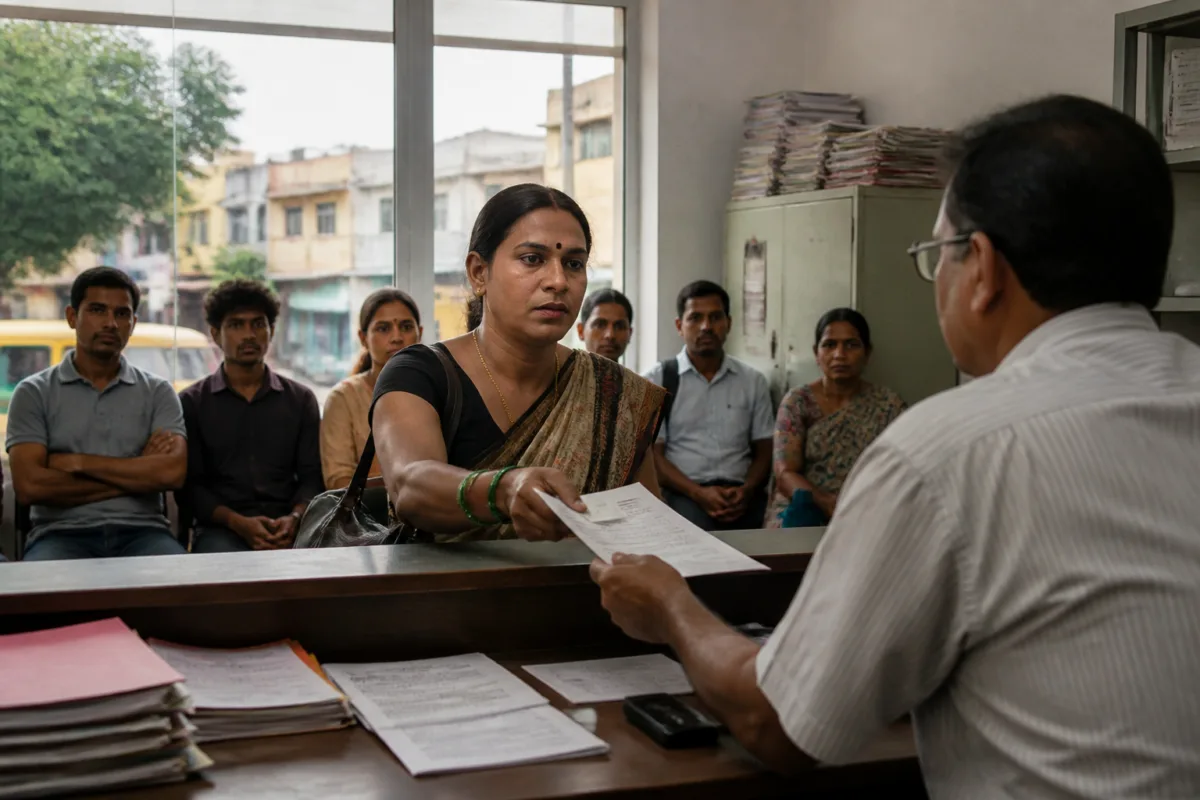
Karnataka’s third-gender voter count fell 43% during the special intensive revision of electoral rolls, from 4,995 to 2,841. The decline, reported by the Times of India, is not only an electoral statistic. It is evidence of how documentation requirements, repeated verification and weak institutional outreach can turn a routine administrative exercise into a barrier for citizens whose lives do not fit the assumptions built into official paperwork.
The scale of the reduction is especially significant because it was much sharper in several Bengaluru constituencies than across the state. Before the revision, Vijayanagar in BBMP South had Karnataka’s highest recorded concentration of third-gender voters, with 183 names. The number fell by 82.5% after the exercise. Mahadevapura, which had 115 voters, recorded a decline of 70.4%. Other areas with substantial earlier numbers included KR Pura in BBMP North, Byatarayanapura in BBMP Urban and CV Raman Nagar in BBMP North.
These constituency-level figures matter because voter registration is administered locally but experienced personally. A reduction in a statewide database can appear abstract. A fall of more than 70% in a particular constituency points to a process that may have affected people concentrated in specific neighbourhoods, shelters, rental homes and informal networks. The figures do not, by themselves, establish how many people were wrongly removed, how many failed to complete re-verification or how many moved away. They do, however, show that the impact was uneven and particularly severe in some urban constituencies.
The reported pattern also extends beyond Bengaluru. In north Karnataka, Kalaburagi, Raichur, Bijapur, Ballari and Koppal had sizeable third-gender populations before the revision. The declines varied considerably, from 6% in Siraguppa in Ballari to 56.7% in Kalaburagi. That variation suggests that the outcome was shaped not only by the existence of a formal verification exercise but also by local access to documents, officials, information and support.
The central problem identified by community members is documentation. Manjamma Jogathi told the Times of India that many transgender people had migrated to cities such as Bengaluru and Pune, lacked proof of long-term residence and had severed family ties. She said she was able to obtain a school certificate carrying her present name in brackets partly because of her public stature, but that several others did not have equivalent documents.
This is an important distinction in understanding administrative exclusion. A person may be continuously present in a city without possessing the specific set of documents that an institution accepts as proof of residence or identity. For transgender citizens who have left their family homes, discontinued formal education or changed names, the problem is not necessarily an absence of a lived address. It is a mismatch between lived residence and documentary proof.
Jogathi suggested that certification by a district commissioner or a zilla panchayat chief executive officer could have been accepted as an alternative form of residence proof. Whether such a mechanism is legally or administratively available is not established in the supplied report. Her account nevertheless identifies the gap that the revision exposed: when standard documents are treated as the primary route to inclusion, citizens with disrupted family, educational or housing histories face a higher burden than those whose records have remained continuous.
The issue is also one of administrative communication. Rakshitha M, a transgender activist from Bengaluru, said many community members did not know about their rights and understood the revision to be mandatory. She described obtaining a name-change certificate, transfer certificate, marks card, Aadhaar and PAN card to complete the process, while asking how many others could approach officials and respond to questions about their gender identity.
Her account shows that access does not depend only on whether documents exist. It can also depend on whether a citizen knows which documents will be accepted, can travel repeatedly to an office, is confident speaking to officials and can challenge an inappropriate question. These requirements favour people with time, literacy, institutional familiarity and social support. They disadvantage citizens who are already more likely to live outside stable family and employment systems.
Chandini, from Peenya, described repeated visits by officials to check documents and said the process made her feel discriminated against despite having voted for several years. Her experience adds a ground-level dimension to the decline. A person may technically remain eligible to vote but withdraw from a process that feels intrusive, repetitive or humiliating. The administrative result is the same as a documentation failure: the voter is absent from the revised list or unable to complete the required steps.
The wider context is a reported reduction of almost 18% in Karnataka’s total voter count during the revision. The third-gender decline was therefore more than twice as large in percentage terms. The comparison does not prove that all third-gender voters were removed for the same reason, nor does it establish that the exercise specifically targeted the community. It does show that the community’s registration was more vulnerable to the process than the overall electorate.
That vulnerability is connected to the way urban governance records people. Electoral rolls, identity documents and residence proofs are usually maintained through separate systems, each with its own requirements. Citizens who move between cities, live in rented accommodation, lack family documentation or have changed their names must make these systems recognise the same person consistently. When they do not, a person’s presence in the city can become difficult to prove even when the person has lived there for years.
Bengaluru’s role in the data is particularly relevant. The city attracts migrants and offers employment, community networks and relative anonymity, but it also produces housing insecurity and frequent movement between rented premises. The source report does not provide data on the housing conditions of the affected voters. Community accounts, however, link migration, lack of family support and incomplete documentation to the difficulty of remaining registered. For urban administration, this raises a broader question about whether civic systems are designed for stable, document-rich households rather than mobile residents.
The institutional responsibility is distributed. Electoral authorities oversee the roll revision and verification process. Local officials interact with voters and examine documents. Community organisations and activists often provide the information and support that public systems do not consistently reach. The experiences reported from Bengaluru suggest that a technically standard process can have unequal effects when these layers do not work together.
A more inclusive administrative approach would require clear evidence on how the decline occurred: how many names were deleted, how many applications were rejected, what reasons were recorded, how many voters were unable to produce accepted documents and whether any constituency-level outreach was directed at transgender communities. The supplied report does not provide those administrative breakdowns. Without them, it is not possible to determine the exact share of removals caused by migration, duplicate records, non-response, document gaps or other factors.
That uncertainty should not obscure what the available evidence does establish. The largest declines occurred in constituencies that previously had sizeable third-gender voter populations. Community members independently described documentation burdens, repeated checks, information gaps and a lack of family support. The problem was therefore not simply a numerical fall in a voter category. It was a failure of the registration process to accommodate citizens whose identity, residence and family records may not follow conventional administrative patterns.
For Bengaluru and other Indian cities, the larger urban question is whether civic participation can keep pace with the realities of migration and social exclusion. Cities depend on mobile populations, yet many public systems still ask residents to demonstrate continuity through documents that are easiest to obtain when family, education, housing and employment histories are stable. The voter-roll data offers a measurable warning about what happens when that assumption is not tested.
The next step is to establish what happened to the 2,154 third-gender voters no longer counted in Karnataka’s revised total and whether correction or appeal mechanisms are accessible to them. Until the electoral authorities publish that explanation, the 43% decline remains both a recorded administrative outcome and a warning that paperwork can determine who is visible to the city’s democracy.

