


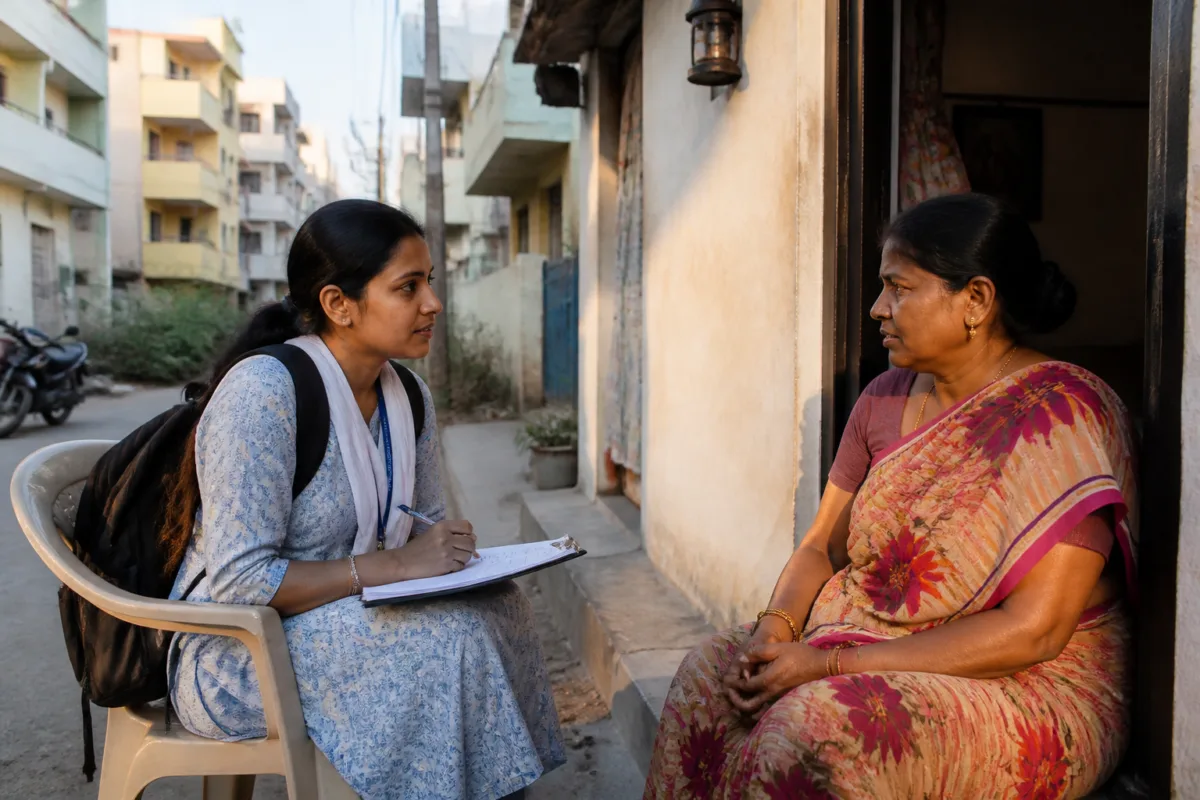
Karnataka’s decision to spend Rs 14 crore on K-Monitor marks a shift in how the state says it wants to judge welfare schemes: not only by whether benefits were distributed, but by whether they changed beneficiaries’ educational, social and economic lives. The proposed exercise will identify around one lakh beneficiaries and collect 60,000 responses through a randomised survey and field study, covering the Congress government’s five guarantee schemes along with other state programmes.
The announcement by Parliamentary Affairs Minister Krishna Byre Gowda places measurement at the centre of welfare administration. The government says K-Monitor will assess the reach, effectiveness and outcomes of schemes, identify leakages and implementation gaps, and recommend changes to scheme design and delivery. It also plans to develop an “efficiency index” so policymakers can compare programmes and prioritise those that generate greater public benefit.
That distinction matters because the first question in a welfare programme is usually administrative: did the benefit reach the intended recipient? K-Monitor proposes to ask a second question: what happened after the benefit reached that person? In the supplied account, the example of sewing machine distribution schemes illustrates the difference. Counting the number of machines delivered would measure implementation. Examining whether the assistance changed a recipient’s life would attempt to measure impact.
The exercise therefore creates a framework for examining welfare as a service-delivery system rather than as a list of announcements. Its proposed evidence base will depend on identifying beneficiaries, selecting respondents through a randomised process and recording their responses in the field. The government has not, in the supplied announcement, disclosed the survey design, the method for measuring outcomes, the institutions that will conduct the study or the timeline for publication of the final report. Those details will determine how far the exercise can move from an administrative review to a credible assessment of public value.
### What K-Monitor is designed to measure
The initiative is expected to cover welfare programmes implemented by Karnataka, including Gruha Lakshmi, Gruha Jyothi, Anna Bhagya, Shakti and Yuva Nidhi. These programmes address different forms of household and individual support. Gruha Lakshmi provides Rs 2,000 a month to women heads of families; Gruha Jyothi provides up to 200 units of free household electricity; Anna Bhagya provides 10 kg of free food grains per beneficiary; Shakti provides zero-cost public bus travel for women residents; and Yuva Nidhi provides temporary monthly unemployment allowances of up to Rs 3,000 for recent graduates and diploma holders.
Because the schemes provide different benefits to different groups, a single measure of “efficiency” would have to accommodate distinct objectives. A cash transfer, an electricity subsidy, food support, free bus travel and an unemployment allowance do not operate through the same delivery chain or affect households in the same way. The announcement establishes that the government wants a comparative index, but it does not specify how the index will account for these differences.
The proposed beneficiary exercise could nevertheless give the administration a common starting point. It would allow the state to examine whether eligible people received the assistance, whether delivery problems prevented access, and whether beneficiaries reported educational, social or economic changes. The minister said the study would assess implementation shortcomings and recommend corrective measures. That places the exercise between monitoring and policy redesign: it is intended both to locate failures in delivery and to inform changes in the schemes themselves.
The scale announced is significant within the exercise’s own terms. Around one lakh beneficiaries are to be identified, while 60,000 responses will be collected through a randomised survey and field study. The Rs 14 crore allocation gives the exercise a defined public cost and makes the eventual report important not only as an assessment of schemes but also as an assessment of the state’s willingness to pay for evidence about them.
### The governance question behind the efficiency index
The proposed efficiency index raises a basic institutional question: what should governments count when they evaluate spending? A programme can be assessed through its coverage, the speed of delivery, the number of recipients or the financial amount disbursed. K-Monitor is being presented as an attempt to go further by examining outcomes and the lived effects of assistance.
The difference between these measures is central to public administration. A scheme may reach its listed beneficiaries and still face implementation gaps that reduce its usefulness. Conversely, a programme may produce benefits that are not captured by a simple count of transactions. The government says K-Monitor will help distinguish between these possibilities by examining whether schemes are reaching intended beneficiaries, identifying leakages and studying their educational, social and economic impact.
For the index to support comparisons, however, the state will need to define what “greater public benefit” means for each programme. The announcement does not provide those definitions. Nor does it state how responses will be verified, how non-response will be treated or how the findings will separate problems in scheme design from problems in implementation. These are not peripheral technical matters; they affect what the final report can legitimately conclude.
The randomised survey and field study are intended to create a structured evidence base, but the credibility of that evidence will depend on the process used to generate it. The supplied announcement confirms the number of proposed beneficiaries and responses, but not the sampling framework or the questions that will be asked. Until those details are released, the public can understand the purpose and scale of K-Monitor, but not yet assess the strength of its methodology.
### Five guarantees, one evaluation framework
The inclusion of the five guarantee schemes makes K-Monitor particularly consequential for Karnataka’s welfare administration. The programmes are aimed primarily at low-income households, women and educated youth, but they provide support through different channels. Gruha Lakshmi and Yuva Nidhi involve monthly cash assistance, Gruha Jyothi reduces household electricity costs, Anna Bhagya provides food grains, and Shakti changes the cost of public bus travel for women residents.
The proposed evaluation may therefore reveal different types of delivery gaps. For a cash benefit, the central concern may be whether the intended person receives the payment. For electricity support, the relevant question may involve the household’s access to the benefit. For food grains, the study may examine whether the promised quantity reaches each beneficiary. For bus travel, the question may relate to how women use the concession. For an unemployment allowance, the assessment may focus on the experience of recent graduates and diploma holders receiving temporary support.
The supplied material does not provide findings on any of these questions. K-Monitor is an announced exercise, not a completed evaluation. Its importance at this stage lies in the decision to create a common monitoring mechanism and in the stated intention to use its findings to recommend corrective measures and improvements in scheme design and delivery.
That distinction is essential. The announcement does not establish that the schemes are efficient or inefficient, that leakages exist at a particular scale, or that any specific programme should be expanded or reduced. It establishes that the government wants to investigate those questions. The eventual report will be the point at which the administration’s claims about impact can be tested against the evidence collected.
### What remains to be established
Several details will determine whether K-Monitor becomes a durable governance tool or remains a one-time assessment. The government has said the exercise will culminate in a report, but the supplied account does not specify its release date, the agency responsible for conducting the study, the criteria for the efficiency index or whether the underlying findings will be made public.
The selection of around one lakh beneficiaries and 60,000 responses also creates a requirement for clarity about representation. The announcement does not state how beneficiaries will be distributed across schemes, locations or demographic groups. Without that information, it is not possible to determine how the final results will compare the experiences of different categories of recipients.
The next stage will therefore be administrative as much as analytical. Karnataka will have to translate its stated objective into a survey design, a field process and a reporting framework. It will also have to show how findings will lead to changes in implementation or scheme design. The minister said the study would help identify programmes that are truly beneficial and pro-people, but the evidence for that conclusion will only emerge after the exercise is conducted and its report is published.
K-Monitor’s immediate significance is clear: Karnataka is creating a Rs 14 crore mechanism to examine whether welfare spending produces outcomes beyond delivery records. What remains uncertain is how the state will define impact, compare unlike schemes and act on the findings. Those details will determine whether the proposed efficiency index becomes a meaningful instrument of accountability or simply another layer of programme reporting.

