


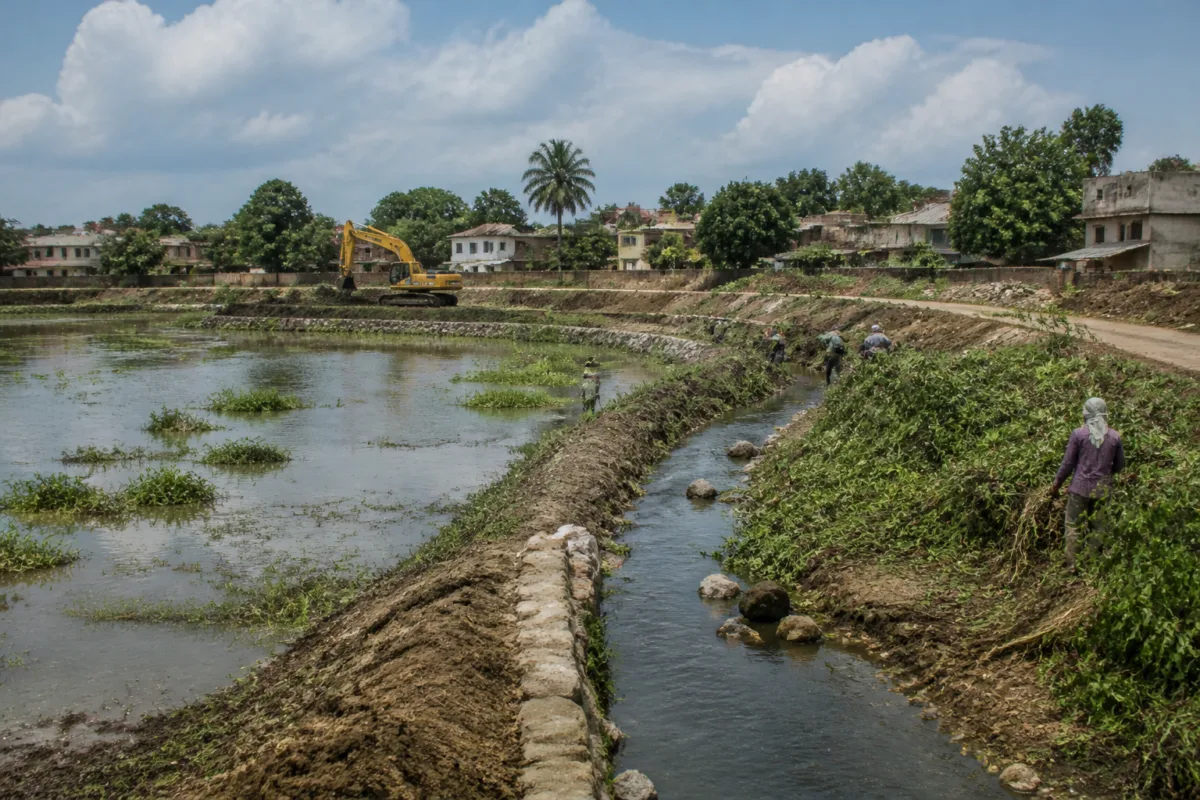
Karnataka has announced a special task force to remove encroachments from 4,828 rural lakes covering 11,671 acres, making lake restoration a central part of a wider ₹16,000-crore rural development programme.
Rural Development and Panchayat Raj Minister Eshwar B Khandre announced the plan at an event in Bengaluru on Friday for the launch of works under the Chief Minister’s Rural Road Connectivity Scheme and the Chief Minister’s Rural Development Scheme. His announcement covers lakes under the possession and maintenance of gram panchayats.
According to figures presented by Khandre, Karnataka has 32,504 lakes across the jurisdiction of 5,927 gram panchayats. Encroachments had been identified across 11,498 lakes and 26,873 acres. The government has cleared encroachments from 6,670 lakes covering 15,201 acres, leaving 4,828 lakes and 11,671 acres to be addressed, he said.
The reported figures contain a one-acre difference when the cleared area is subtracted from the originally reported encroached area. That discrepancy does not alter the scale of the remaining task, but a public inventory of lake boundaries, encroachment status and completed clearances would help residents track implementation.
Khandre linked the removal of encroachments with desilting lakes and clearing obstructions in rajakaluves and stormwater drains. He said the measures would help lakes fill during the monsoon and improve groundwater levels. The announcement therefore extends beyond the recovery of public land: it also places water storage, drainage connectivity and groundwater recharge within the same rural infrastructure agenda.
The minister also outlined ₹10,000 crore for rural infrastructure and road development. Of this, ₹7,000 crore is to be used to improve damaged bituminous roads and ₹3,000 crore for resurfacing important existing rural roads. The state has about 199,458 km of rural roads, he said, with some stretches damaged by rain and traffic. Roads will be prioritised according to their condition, and the works will carry a three-year maintenance responsibility.
A further ₹6,000 crore has been allocated for quality concrete roads and drains in village habitation areas and for new rural roads not covered by the existing rural road programme. The figures indicate that lake and drainage restoration is being presented alongside road construction rather than as a separate water-management programme. This creates a practical implementation requirement: road upgrades and drainage works will need to avoid blocking natural flows into or out of village lakes.
The government has prescribed three inspections for road works—twice while construction is under way and once after completion. District panchayat chief executive officers and taluk panchayat executive officers have been instructed to conduct physical inspections of 10% of the works in their respective areas. Inspection reports are to be uploaded with bills on the NGSK software, according to Khandre.
Khandre also said Karnataka was undertaking water budgeting by estimating future requirements for households, industries, schools, colleges and hospitals over the next 30 years, and by preparing short-, medium- and long-term plans based on available surface water. He said work on delayed single-village and multi-village drinking-water projects under the Jal Jeevan Mission had been accelerated.
The announcement comes as the minister described water stress in rural Karnataka, saying 217 taluks had been declared drought-affected and many rural lakes had dried up. He appealed to citizens to use water sparingly and called for scientific management of wet, dry and hazardous waste, along with a complete ban on single-use plastic.
The task force’s effectiveness will depend on how quickly its mandate is translated into verified lake-wise action. The immediate public-interest questions are which lakes will be taken up first, how boundaries and ownership records will be established, how affected drains will be restored, and whether inspection and payment data will be made accessible. The government’s existing figures establish the scale of the challenge; transparent implementation records will determine whether the programme produces durable water and infrastructure benefits.

