


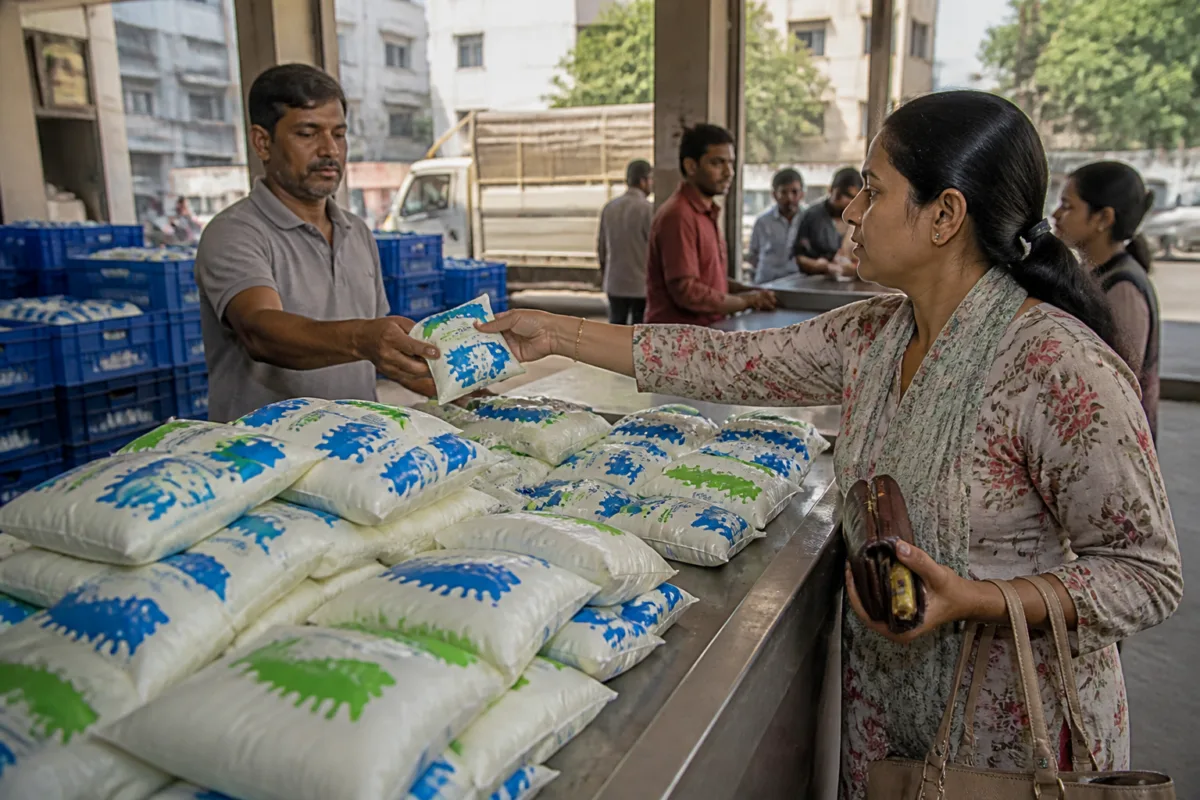
Karnataka’s milk price hike is being presented as support for dairy farmers, but its deeper significance lies in how drought, falling procurement and inter-state price differences are reshaping the economics of a product consumed daily in urban households. From November 1, the retail price of Nandini milk is expected to rise from Rs 46 to Rs 54 per litre after the state Cabinet approved an Rs 8 increase.
The decision makes the latest revision the steepest in Karnataka’s history, according to Parliamentary Affairs Minister Krishna Byre Gowda, as reported by The Indian Express. It also shows the pressure facing the Karnataka Co-operative Milk Producers’ Federation Limited, or KMF, which operates the Nandini brand. The increase is not being allocated entirely to the federation or retailers: Rs 7 per litre will go directly to producers, while Rs 1 will go to milk unions.
That division is important because the price increase is designed to address two connected problems. Dairy farmers have been facing higher input costs and drought-related distress, while the state’s milk procurement has fallen by nearly 10 lakh litres a day. A sustained decline in procurement affects not only producer income but also the volume of milk available for processing and distribution through the cooperative system.
The government’s calculation is that a higher consumer price can stabilise the supply base by improving what farmers receive. Gowda said farmers were earlier getting Rs 35 per litre. After the increase, their payment will rise to Rs 42 per litre. The existing government incentive of Rs 5 per litre will continue, taking their total realisation to Rs 47 per litre.
This is a different figure from the retail price. The consumer will pay Rs 54 for a litre of Nandini milk, but the producer’s realisation, including the government incentive, will be Rs 47. The gap reflects the other costs and institutional layers in the dairy chain, including milk unions and the cooperative system. The Cabinet’s decision therefore represents not just a retail-price revision but an attempt to redistribute more of the final price towards producers.
The immediate public impact will be felt in household budgets. The increase adds Rs 8 to every litre purchased, before the effect of higher prices for other dairy products is included. The source report does not specify the revised prices of those products, but Cooperation Minister Laxman Savadi acknowledged that they too would rise.
For urban consumers, milk is a particularly visible cost because it is purchased frequently and forms part of regular household consumption. The increase will affect families differently depending on their daily use, but the policy debate is not limited to affordability. It also concerns whether the existing price is sufficient to keep farmers supplying milk through a cooperative network under worsening production conditions.
Karnataka’s ministers have argued that the state’s prices were unusually low compared with other major milk markets. Gowda cited retail prices of around Rs 59 per litre in Delhi and Maharashtra, Rs 57 in Gujarat, Rs 56 in Rajasthan and Kerala, and Rs 64 in Telangana. Against these figures, Karnataka’s earlier price of Rs 46 was below the national average of around Rs 57, according to the minister.
These comparisons provide the political and economic justification for the increase, but they do not by themselves establish that prices are identical in product composition, packaging, subsidies or distribution costs across states. What they do show is the pressure created by a regional price gap. Karnataka’s government said farmers and milk unions had argued that producers could receive better returns elsewhere while local consumers continued to pay less.
That gap also creates a supply-chain concern. Savadi said that if prices were not raised, Karnataka-produced milk could be sold in neighbouring states at higher rates, potentially triggering shortages within the state. The argument links producer incentives to local availability: if farmers can obtain better returns outside Karnataka, the cooperative system may find it harder to retain procurement within the state.
The reported fall of nearly 10 lakh litres in daily procurement adds weight to that concern. The source attributes the decline to drought conditions, pointing to a supply problem that cannot be addressed only through retail pricing. A price increase may improve farmer realisation, but the report does not establish how quickly procurement will recover or whether the increase will fully offset rising input costs and water-related stress.
The sequence of recent KMF revisions suggests that the state has been adjusting prices repeatedly rather than resolving a one-time imbalance. Before the latest announcement, a Rs 4 increase in March 2025 was the largest revision. That followed a Rs 2 increase in June 2024 through an increase in packet quantity, and Rs 3 increases in both July 2023 and November 2022.
The pattern indicates that milk pricing has become a recurring administrative issue. Each revision has to balance at least three interests: the farmer seeking a higher return, the cooperative system seeking financial stability and the consumer seeking an affordable daily essential. The November decision places the greatest direct burden on consumers so far, while assigning most of the increase to producers.
The institutional structure matters here. KMF is a cooperative federation, and the state government is using the retail price and its own incentive payment to influence the flow of money through that system. The Rs 5 government incentive means producer income is not determined only by the price paid at the point of procurement. Public funds are already part of the support mechanism, while the latest decision increases the consumer-funded component.
This creates a policy trade-off. A higher retail price may help protect procurement and improve farmer income, but it can also make milk less affordable for households. A larger government subsidy could reduce the immediate burden on consumers, but the supplied report does not state whether the Cabinet considered such an alternative or what fiscal implications it would have. The available evidence establishes the allocation of the Rs 8 increase, not the full cost of the wider support framework.
The drought dimension makes the question more complex. Dairy production depends on the availability and cost of feed, water and other inputs. The source report states that farmers are facing rising input costs and drought-related distress, and that procurement has declined. It does not provide a breakdown of those costs or identify how much of the procurement fall comes from reduced production, farmer movement, local shortages or other factors. Those gaps matter because a price revision can address income only if the underlying production system remains viable.
The state’s decision also highlights the tension between a cooperative dairy network and a competitive regional market. KMF is expected to supply Karnataka consumers, but ministers warned that low local prices could encourage milk to move to neighbouring states. In that sense, the price of milk is not only a consumer-policy issue. It is also a question of how a state-level cooperative manages procurement, processing and distribution when neighbouring markets offer different returns.
For Bengaluru and other urban centres, the issue is experienced at the retail counter, but the cause lies across a much wider chain. Household demand, farmer production, cooperative procurement, government incentives, drought conditions and inter-state price differences are connected through the final price of a litre of milk. The Cabinet decision makes that connection visible without resolving all of its underlying pressures.
The evidence currently confirms four points: Karnataka is raising Nandini milk prices by Rs 8 per litre from November 1; Rs 7 of the increase will go to producers and Rs 1 to milk unions; the existing Rs 5 government incentive will continue; and daily procurement has fallen by nearly 10 lakh litres amid drought conditions. It also confirms that the state has raised prices several times since November 2022.
What remains uncertain is whether the revision will restore procurement, how other dairy-product prices will change and whether the higher producer realisation will offset the production pressures cited by the government. The next test for Karnataka’s dairy system will be whether the new price structure can support farmer participation while preserving reliable supply for consumers who will now pay substantially more for a daily staple.

