


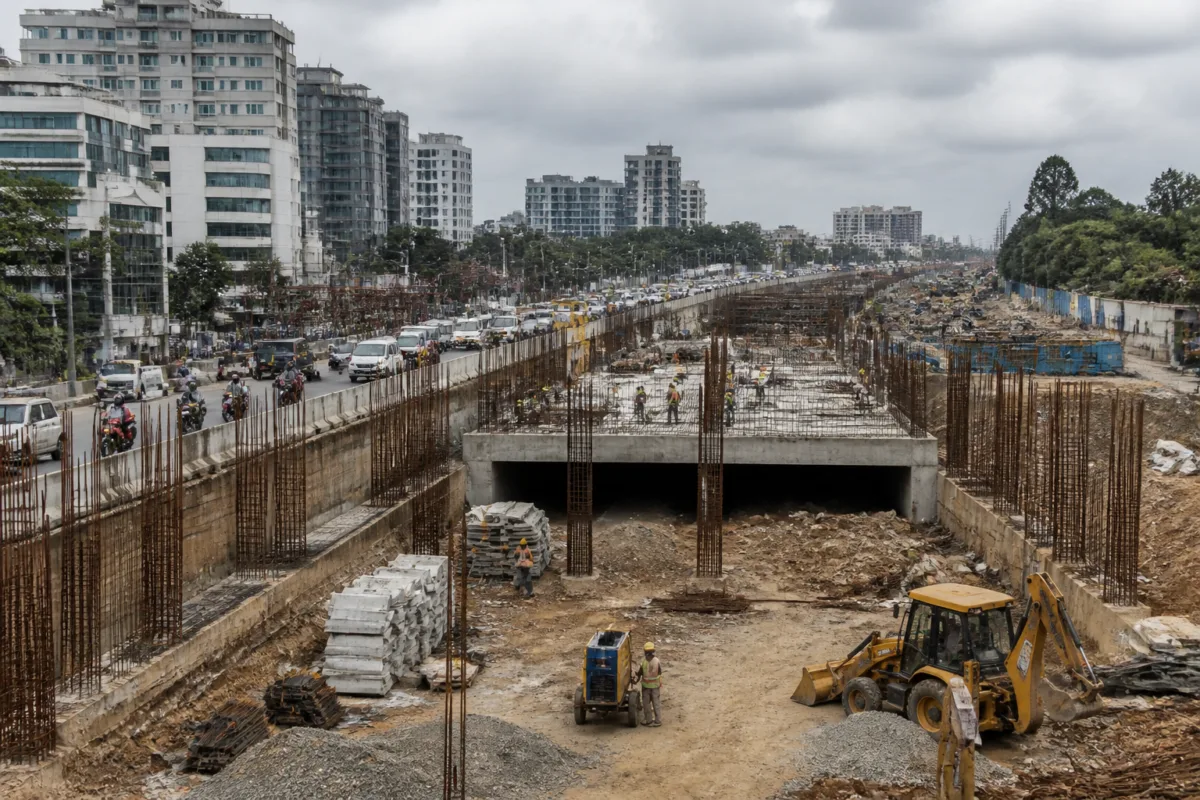
Karnataka’s reported Rs 38,000 crore backlog in payments to contractors is not merely a dispute between the government and its vendors. It exposes a deeper weakness in how public works are planned, budgeted, tendered and paid for. The state is now considering changes to tender eligibility norms after contractors demanded that new works be taken up only after outstanding bills are cleared.
The issue came into focus at a meeting between Chief Minister DK Shivakumar and the Karnataka State Contractors’ Association. The association asked the government to settle pending bills, bring transparency to payment schedules and stop inviting tenders for works without budgetary allocation. It also sought an end to alleged interference by legislators in tendering and the abolition of the package system, which it said had excluded small and medium contractors.
The chief minister said some demands had been agreed to, although he did not disclose the details. He attributed the current problem to a high number of works taken up by previous BJP governments under former chief ministers BS Yediyurappa and Basavaraj Bommai without allocating funds. “Currently, we are bringing this under control,” Shivakumar said, according to the report.
That explanation points to the central institutional problem: a tender is not the same thing as a funded project. When departments invite bids without adequate budgetary provision, the government can create a formal contract without creating a reliable payment pathway. Contractors may complete work, raise bills and then wait for funds to move through departmental and finance systems. The result is a backlog that affects both the contractor and the physical delivery of infrastructure.
For citizens, the consequences are indirect but significant. A contractor facing delayed payments may slow work, avoid new bids, reduce the number of workers deployed or seek to recover financial costs through other parts of a project. The supplied report does not establish the extent to which pending bills have delayed specific roads, buildings or civic works. It does, however, show that the payment crisis is large enough to have become a state-level governance issue and a condition attached to future tendering.
The proposed relaxation of eligibility rules also raises a question about access to public procurement. Under the existing norms cited in the report, contractors must have an annual turnover equivalent to 50% of the tender value in three of the previous five years. The association has asked the government to assess turnover over 10 years instead, arguing that the Covid-19 pandemic affected business and made it difficult for many contractors to meet the current requirement.
The finance department has agreed to reconsider the clause, officials said. A longer assessment period could allow more firms to qualify, particularly contractors whose recent turnover was weakened by the pandemic or by delayed government payments. But the change would also alter how the state measures financial capacity before awarding a project. The report does not provide details of any proposed replacement safeguards, revised thresholds or department-wise eligibility framework.
That missing detail matters because tender eligibility performs two functions at once. It determines who can compete, but it is also intended to indicate whether a bidder has the financial and operational capacity to complete the work. Relaxing the turnover requirement may widen participation, but the government will still need to establish how it will assess capacity, cash flow and past performance. The available report does not say whether such safeguards have been finalised.
The contractors’ demand to end the package system highlights a second layer of the procurement problem. According to the association, packaging works in a way that excludes small and medium contractors. Larger packages may simplify administration for departments, but they can also raise the financial and operational threshold for participation. Smaller firms may be capable of executing individual works but unable to bid for a combined package of much greater value.
The association has also alleged that about 70% of legislators in Karnataka interfere in tendering. This is a claim made by the association and has not been independently established in the supplied material. Its significance lies in what it says about the boundary between elected representatives and procurement officials. Tendering requires defined technical criteria, documented evaluation and an auditable award process. If political intervention affects those steps, the formal procurement system becomes less predictable for bidders and less transparent for the public.
The government’s reported response is partly administrative. The chief minister has asked the finance department, financial adviser LK Atheeq and Additional Chief Secretary to the Chief Minister Tushar Giri Nath to work towards resolving the contractors’ crisis. The government has also agreed to clear Public Works Department and Greater Bengaluru Authority bills according to seniority and is considering extending that system to other departments.
A seniority-based payment system could provide contractors with greater clarity than discretionary or opaque bill processing. It would also create an administrative sequence for dealing with arrears. However, the report does not specify the total value of PWD and Greater Bengaluru Authority liabilities within the larger Rs 38,000 crore figure, the available annual allocation or the timeline for clearing the backlog. Without those details, it is not possible to assess how quickly the proposed arrangement could reduce the outstanding amount.
The demand that new works be approved only after existing bills are cleared is therefore more than a request for immediate relief. It challenges the state’s model of announcing and tendering infrastructure before the financial obligations from earlier works have been settled. If accepted broadly, the demand could impose greater fiscal discipline on departments by requiring them to match new project commitments with available funds and outstanding liabilities.
At the same time, pausing new works until all pending bills are cleared could affect the state’s infrastructure pipeline if the backlog is large and settlement takes time. The supplied report does not indicate whether the government plans a complete pause, a department-wise cap or a prioritised release of funds. The distinction will determine whether the policy becomes a short-term control on unfunded commitments or a wider disruption to planned development works.
The Karnataka episode also shows why procurement reform cannot be separated from payment reform. Changing tender norms may help more contractors compete, but it will not solve a system in which awarded works are not backed by timely funds. Similarly, clearing arrears without addressing the process that generated them could provide temporary relief while leaving the state exposed to another accumulation of unpaid bills.
The immediate evidence confirms three developments: the contractors’ association has placed the Rs 38,000 crore dues issue before the chief minister; the government is considering changes to turnover-based tender eligibility; and payment by seniority has been agreed for PWD and Greater Bengaluru Authority bills, with wider adoption under consideration. The details still to be established include the department-wise liability, the funding schedule, the final tender rules and the mechanism for preventing new works from being sanctioned without budgetary support.
Those details will determine whether Karnataka’s response becomes a genuine restructuring of public-works governance or only a settlement of the current confrontation. For now, the dispute has made one structural weakness visible: infrastructure delivery depends not only on awarding contracts, but also on maintaining a credible chain from budget allocation to completed work and timely payment.

