


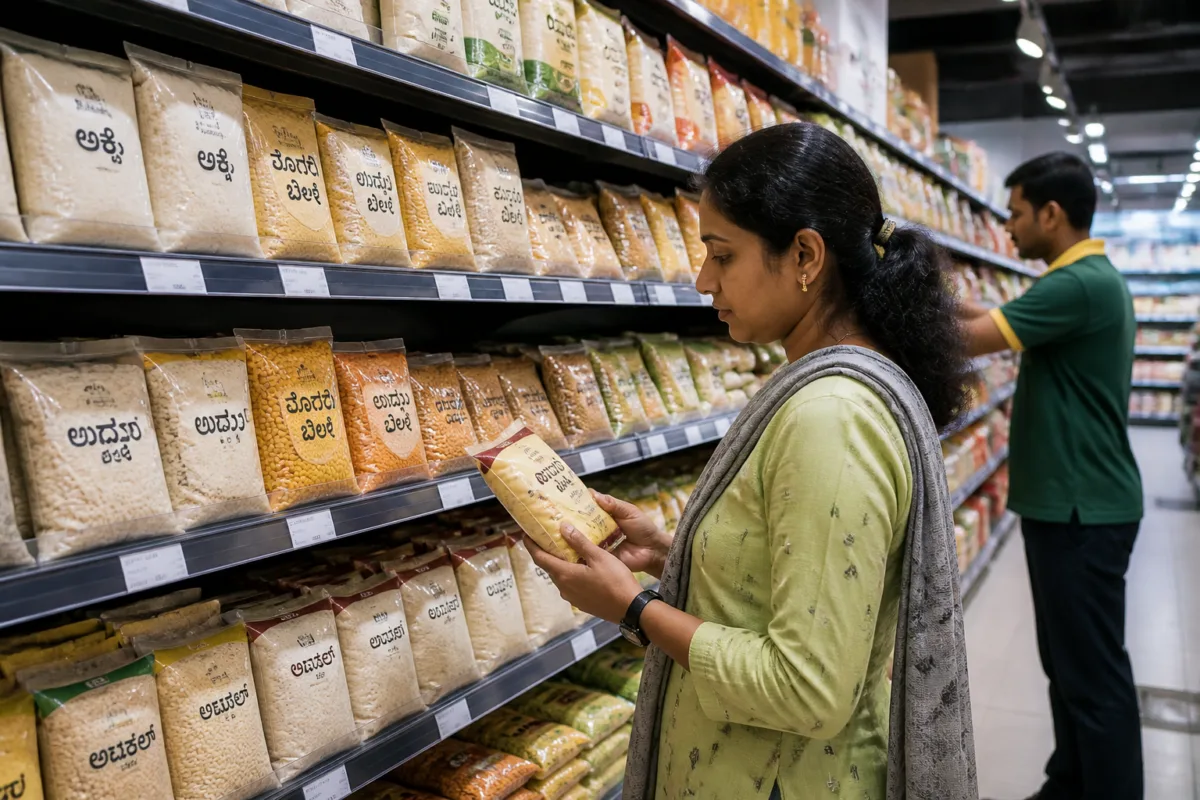
The Kannada Development Authority’s proposed order to retain Kannada names for everyday essentials in shops, e-commerce platforms and agricultural produce market committees is not only a language intervention. It is also a question about who can participate fully in Karnataka’s commercial life, and whether the language used by public-facing businesses reflects the people and producers they serve.
The issue was highlighted in a report published as Karnataka marked its 71st Rajyotsava. The report described Kannada words such as akki for rice, togari bele for pigeon pea, avalakki for flattened rice, rave for semolina and hittu for flour being replaced in commercial and household usage by terms such as rice, tur dal, poha and sooji. The change is visible in supermarkets, shopping malls, kitchens and online searches, according to the report.
On its own, a change in product terminology may appear minor. A shopper can often identify a product through packaging, images or familiarity with multiple languages. But the commercial label is also an access point. It determines how products are searched for, displayed, advertised and discussed. When a familiar local term disappears from that chain, the effect is not limited to vocabulary. It can make a consumer less confident about identifying an item, particularly when the product is being purchased in an unfamiliar retail environment or through a digital platform.
This is the institutional question behind the proposed intervention: should businesses operating in Karnataka’s physical and digital marketplaces be expected to provide Kannada terminology alongside Hindi or English? The report does not present the issue as a demand to remove other languages. Instead, the named residents and the Kannada Development Authority frame it as a question of recognition and equal access.
Hari Prasad Nadig, an entrepreneur and technology consultant from Bengaluru, said consumers in Karnataka buy agricultural produce grown by the state’s farmers and sold by traders operating in Karnataka, while the language used to identify those goods may belong to a different linguistic landscape. He also pointed to a contrast in commercial behaviour: businesses often use local festivals and traditions in marketing, but may not use local names for the products being sold.
Mahantesh M Patil, secretary and former national youth president of the All India Veerashaiva-Lingayat Mahasabha, said the issue was not opposition to Hindi or English but a demand that every language receive due respect. His concern, as reported, is that Kannada-speaking consumers should not have to remember another language’s terminology to identify ordinary groceries in Karnataka.
The concern extends beyond older consumers. Thejesh GN, an independent technologist and open-data enthusiast, said children and younger people may recognise terms such as tur dal while becoming unfamiliar with togari bele. He also noted that people may search online for poha without realising that earlier generations referred to the same food as avalakki. That observation links language retention to the design of modern information systems: what appears on a shelf, what is indexed by an online marketplace and what a customer types into a search box all influence which words remain in circulation.
The report does not provide data showing how widely Kannada labels have declined, nor does it quantify the number of shops, e-commerce platforms or agricultural market committees that currently use only Hindi or English terminology. It also does not establish whether the reported pattern is uniform across Karnataka or concentrated in particular types of urban retail spaces. These gaps matter because a language policy covering supermarkets, malls, online commerce and agricultural markets would operate across very different commercial systems.
A supermarket label is controlled by a retailer or supplier. An e-commerce listing may be created through a central catalogue, a seller dashboard or a platform’s search system. An agricultural market committee has a different administrative structure and may use records, notices and auction systems that are not designed in the same way as consumer packaging. A government direction would therefore need to reach several layers of commercial communication rather than simply require a change to shop signage.
Purushothama Bilimale, chairperson of the Kannada Development Authority, acknowledged the reported trend and said a Kannadiga visiting a supermarket or mall may be unable to buy goods because of linguistic differences. He said the situation could be corrected through a government order and that the KDA would formally issue an order within a day or two to retain Kannada names for everyday essentials in commercial establishments, e-shopping platforms and agricultural produce market committees.
That statement makes the proposed order the immediate administrative development, but the report does not include the text of the order, its legal basis, enforcement mechanism, compliance deadline or the department responsible for implementation. It is therefore not yet possible to assess how the proposal would work in practice. The distinction is important: an announcement of intent and an enforceable government direction are different stages of policy.
The institutional spread of the proposed measure also raises questions about coordination. The Kannada Development Authority is responsible for promoting Kannada, while commercial establishments, online marketplaces and agricultural markets operate under different ownership and regulatory arrangements. The report does not specify whether the proposed direction would be advisory or mandatory, whether it would require bilingual labels, or whether non-compliant businesses would face penalties. Those details will determine whether the intervention becomes a visible change in daily commerce or remains a symbolic instruction.
There is also a practical design issue. The strongest version of the proposal, based on the comments cited in the report, is not a replacement of Hindi or English but the addition and retention of Kannada terminology. That approach could allow consumers to connect local words with nationally or internationally familiar terms. For example, a product listing could present the Kannada name alongside the English or Hindi equivalent, enabling search, recognition and language continuity at the same time. Whether the forthcoming order adopts such a format is not established in the supplied report.
The economic context is equally relevant. The products under discussion are ordinary agricultural and household essentials, not niche cultural objects. They move through farms, traders, markets, shops and digital platforms before reaching consumers. Language is present at every stage through labels, invoices, catalogues, advertisements and customer interactions. If Kannada is absent from these points, its decline in daily use is connected to the organisation of the supply chain and the retail interface, not only to changing household habits.
At the same time, the report provides no evidence that businesses are deliberately excluding Kannada or that consumers are uniformly unable to understand the alternative terms. It records concerns from named individuals and an acknowledgement from the KDA, but it does not include a survey, audit of labels, platform data or responses from retailers and e-commerce companies. The scale of the problem therefore remains to be established.
The larger urban question is how cities preserve accessibility and local identity while their markets become more standardised and digitally mediated. Bengaluru’s consumers increasingly encounter products through organised retail and online search, where naming conventions may be determined far from the neighbourhood in which a purchase is made. A local language can disappear from that process without any formal decision to remove it; repeated use of other terms may be enough.
The proposed KDA order places that gradual change before the administration as a matter of public-facing governance. Its significance will depend on what happens next: whether the order is issued as stated, what establishments and platforms it covers, how Kannada terminology is selected and translated, and whether compliance is monitored. Until those details become available, the evidence confirms a clear concern about Kannada’s reduced visibility in everyday commerce, but not yet the scale or measurable impact of that decline.

