


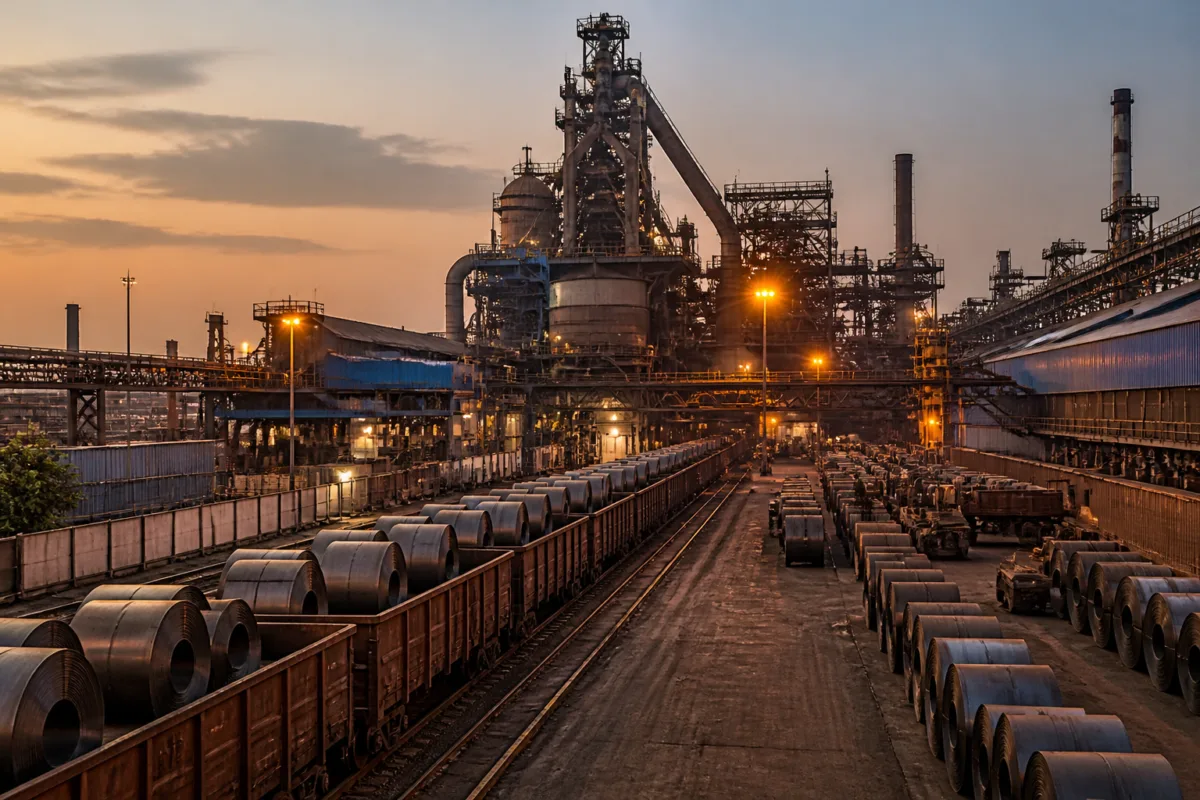
JSW Steel’s expectation of stronger second-half volumes is more than a company-specific recovery story. It reflects the close link between India’s infrastructure spending cycle and the steel industry’s ability to absorb higher input costs, expand capacity and finance long-term investment. The company expects steel consumption to rise from about 85 million tonnes in the first half to approximately 92 million tonnes in the second half, taking full-year demand to around 177 million tonnes.
The outlook comes after a difficult first quarter and a stronger September quarter. Jayant Acharya, Joint Managing Director and CEO of JSW Steel, attributed the improvement to better demand in August and September, weaker monsoon conditions, a pickup in public capital expenditure, stronger sales volumes and improved operational efficiency. The company also drew down 2.10 lakh tonnes of inventory accumulated in the first quarter.
For the built environment, the significance lies in where steel demand is coming from. Roads, railways, housing, automobiles, appliances and other investment-linked sectors all consume steel, although the supplied material does not provide a separate demand split for each category. Acharya said infrastructure spending, public capital expenditure and private investment remain supportive, while investments in roads and railways are improving connectivity and logistics efficiency. This places steel consumption within a wider cycle of construction, transport expansion and industrial activity.
The company’s performance also illustrates why higher volumes do not automatically translate into stronger margins. JSW Steel said costs increased by about ₹1,300 per tonne during the quarter, while net realisations declined by ₹500 per tonne. Together, those movements reduced margins by ₹1,800 per tonne from the previous quarter. The cost pressure came from coking coal, iron ore, ferroalloys, zinc and energy.
Coking coal prices are expected to have an estimated $25 impact in the third quarter. JSW Steel said price increases implemented in the previous quarter and in October could help offset some of that pressure. Larger blast furnaces, operating efficiencies and lower fixed costs per tonne are also expected to support margins. The company’s expectation is therefore based on a combination of higher sales volumes and operational scale rather than on steel prices alone.
### Steel demand is tied to the public investment cycle
The company’s forecast of approximately 177 million tonnes of full-year steel demand places the second half at the centre of the annual consumption pattern. The expected increase from 85 million tonnes in the first half to 92 million tonnes in the second half is described as seasonally stronger demand. Prices, however, could remain range-bound, according to Acharya, particularly if input costs continue to rise.
This distinction matters for infrastructure procurement. Higher steel consumption can indicate that projects are moving from announcement to execution, but a rise in demand can also increase the cost pressure faced by contractors, developers and public agencies. The interview establishes the demand and input-cost movements but does not quantify their impact on individual road, railway, housing or urban infrastructure projects.
Public capital expenditure is identified as one of the factors supporting demand. That makes government spending an important transmission channel between budgets and the physical urban environment. Steel is embedded in bridges, stations, industrial buildings, residential structures, utility systems and transport infrastructure. When public investment accelerates, steel producers may see stronger volumes, while project authorities and contractors must manage exposure to commodity-price changes.
The supplied material does not identify specific projects or government departments driving the increase. It does, however, connect improving infrastructure spending with better connectivity and logistics efficiency. That connection is important because transport infrastructure affects not only construction demand but also the movement of raw materials and finished products across the country.
### Imports add another layer of uncertainty
Domestic steel pricing is also influenced by trade flows. JSW Steel said imports and exports were broadly balanced in the first half, although finished steel imports increased. More than 60 per cent of imports came from free trade agreement countries, which the company said warrants monitoring to ensure there is no significant trade diversion.
The issue is relevant to the construction supply chain because domestic producers’ ability to raise prices depends partly on the availability of imported steel. If imports increase, domestic price increases may face resistance. If imports are constrained or input costs rise sharply, buyers may face higher procurement costs. The interview does not establish that either outcome has occurred at a scale that would alter project viability, but it identifies trade diversion as a factor requiring attention.
Acharya also said China’s direct exports could moderate over the medium term as domestic production adjusts, while indirect exports through engineering goods and manufactured products are increasing. These comments indicate that steel markets are affected not only by direct shipments of the commodity but also by steel embedded in manufactured products. For Indian infrastructure and construction buyers, that creates a wider competitive environment than domestic production alone.
### A large capex programme depends on balance-sheet capacity
JSW Steel has announced a total capital expenditure outlay of ₹1.48 lakh crore as of October 1, to be spent over five to six years. The company estimates annual spending of ₹25,000-30,000 crore. Capital expenditure exceeded ₹11,100 crore in the first half and was largely funded through internal accruals.
The company expects to fund most of the wider programme through internal accruals, although it may borrow more in years when growth accelerates. It reported debt of about ₹44,000 crore, net debt-to-EBITDA of 1.28 times and net debt-to-equity of 0.39 times. It also said it repaid more than ₹29,000 crore of debt in the first half, much of it foreign-currency debt, and prepaid a $500-million bond in October that was due in April next year.
These figures frame the capex programme as a question of financing as well as steelmaking capacity. Large-scale investment by a major producer can support supply expansion and operational improvements, but its pace depends on cash generation, leverage and the timing of growth. JSW Steel said its cash generation was improving as operations scaled up and that its balance sheet provided sufficient headroom. Those are company statements, not an independent assessment of the programme’s financial sustainability.
For cities and infrastructure agencies, the industrial investment cycle is relevant because material availability and price stability affect project delivery. The source does not link the announced capex to particular plants, corridors or urban projects. It does show that the steel sector is preparing to invest at a scale that is aligned with an expectation of sustained domestic demand.
### Decarbonisation is becoming an operating and cost issue
The company’s climate strategy is also closely connected to its industrial expansion. JSW Steel has committed to net zero by 2050. It said more than 1 GW of renewable energy capacity is operational, with another 1.5 GW under development. The company is also deploying blast furnace technologies including oxygen lancing, dehumidification and top-gas recovery to reduce coal consumption.
The significance of these measures is not limited to emissions reporting. JSW Steel said energy efficiency, process improvements and greater circularity would lower both emissions and costs. That places decarbonisation within the same operational framework as productivity and margin protection. The material does not provide emissions-intensity figures, interim targets or a breakdown of the renewable capacity’s contribution to production, so the progress of the net-zero pathway cannot be independently assessed from the interview alone.
European carbon measures add pressure to the export model. Acharya said the Carbon Border Adjustment Mechanism, higher safeguard duties and reduced quotas would make exports to Europe more challenging. JSW Steel intends to serve the European market within available quotas, but India remains its primary market, accounting for 87-90 per cent of its business.
This domestic focus reduces the company’s direct dependence on European exports, according to the interview, but it also reinforces the importance of India’s construction, infrastructure and manufacturing demand. If domestic consumption remains strong, it can provide an alternative market as overseas trade becomes more regulated. The supplied evidence does not establish whether domestic demand will fully offset export constraints.
The central evidence is therefore mixed but clear in its broad direction. JSW Steel expects higher second-half volumes, supported by public capital expenditure, infrastructure activity and resilient demand from sectors including housing. At the same time, rising input costs, imports, trade measures and the financing requirements of a ₹1.48 lakh crore capex programme create constraints around that growth.
For the urban economy, the company’s outlook points to a material supply chain being shaped by the same forces that govern infrastructure delivery: public spending, project execution, commodity prices, logistics, financing and environmental regulation. What remains uncertain is how these factors will translate into project-level costs and timelines. The next indicators to monitor are second-half volumes, the movement of input costs, imports from free trade agreement countries, capex deployment and the company’s progress on renewable energy and blast furnace efficiency measures.

