


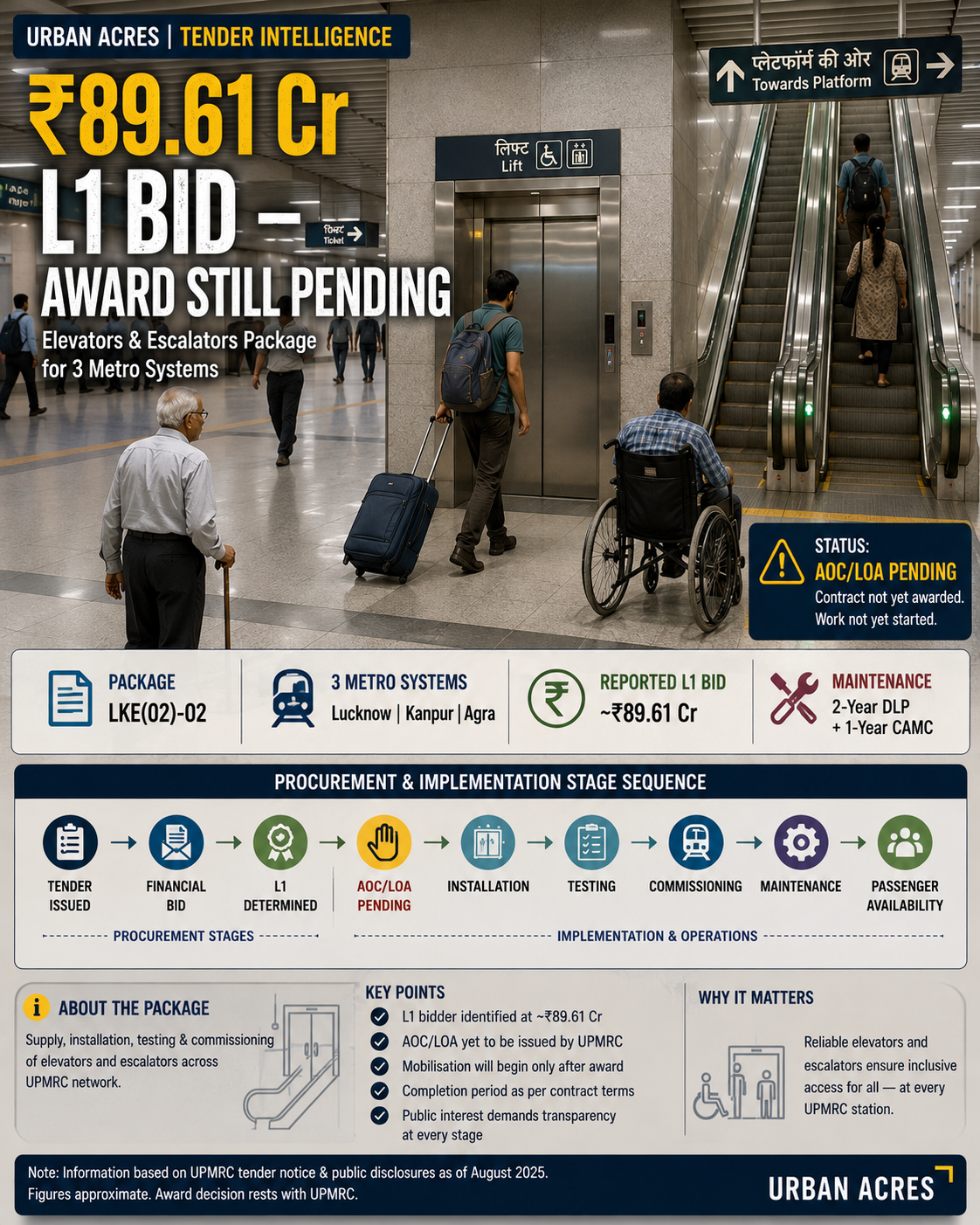
A three-city procurement covering elevators and escalators for Lucknow, Kanpur and Agra Metro has moved through financial evaluation, with Johnson Lifts reported as the sole L1 bidder at about ₹89.61 crore. The crucial qualification is that the available official procurement record does not yet establish that UPMRC has formally awarded the contract.
Uttar Pradesh Metro Rail Corporation’s procurement of station elevators and escalators across its Lucknow, Kanpur and Agra Metro projects has advanced to the financial-bid stage, with Johnson Lifts Pvt Ltd emerging as the only reported bidder and lowest bidder.
The development concerns Tender LKE(02)-02, published by UPMRC on 12 May 2026. The official Government eProcurement record describes a substantially broader scope than a simple equipment order: design, manufacture, supply, installation, testing and commissioning of heavy-duty machine-room-less elevators and escalators, followed by maintenance during a two-year defect-liability period and one additional year of comprehensive annual maintenance.
Tender-tracking records indicate that the technical evaluation was completed on 21 August and financial bids were opened on 24 August. Johnson Lifts was the sole participant reaching that stage and is reported to have submitted an L1 offer of approximately ₹89.61 crore. Those same records, however, continue to show the actual award as pending.
That procurement distinction matters because a lowest financial bid is not itself a contract.
An L1 determination normally precedes the procuring authority’s final approval and publication of the Award of Contract or Letter of Acceptance. Metro Rail News reported on 26 August that UPMRC had awarded Johnson the ₹89.61-crore contract, but Urban Acres could not corroborate that stage from the official tender record reviewed on 27 August.
Until the AOC or LOA is available, ₹89.61 crore should consequently be treated as the reported L1 bid, not an established final contract value.
One bidder does not automatically invalidate the tender
Johnson’s reported status as the only bidder raises a legitimate procurement question, but not a presumption of irregularity.
The Union Finance Ministry’s General Financial Rules state that a single bid may still constitute a valid procurement where the tender was satisfactorily advertised, sufficient bidding time was provided, qualification conditions were not unduly restrictive and the proposed price is reasonable against market values. An open tender producing one effective offer is treated as a single-tender contract for procurement purposes.
The relevant accountability question for UPMRC is therefore not simply “Why was there one bidder?”
It is whether those three tests were satisfied and recorded before any award was approved.
Earlier reporting placed UPMRC’s approximate package estimate at ₹109.59 crore. Against that figure, a ₹89.61-crore offer would be approximately ₹19.98 crore, or 18.2%, lower.
That difference may strengthen a price-reasonableness case, but it cannot by itself substitute for one. The authority still needs to evaluate technical compliance, lifecycle costs and the appropriateness of the price against the actual specification and market.
The equipment is part of the passenger-accessibility chain
Elevators and escalators are often treated as minor station equipment beside tunnelling, viaducts, rolling stock and signalling. For passengers, however, they are part of the basic service chain:
Street / concourse → lift or escalator → paid area → platform → train
Failure at one vertical-transport interface can materially reduce accessibility for elderly passengers, passengers with disabilities, people travelling with children or luggage and anyone unable to use stairs comfortably.
That is why the maintenance terms matter as much as installation.
LKE(02)-02 does not end at commissioning. It includes maintenance throughout a two-year defect-liability period and another year under a comprehensive annual maintenance contract.
Urban Acres should therefore judge delivery not by the number of machines eventually installed but by measurable equipment availability, repair time, preventive-maintenance compliance and passenger access.
This is not Johnson’s first UPMRC deployment
The latest package should also not be presented as Johnson Lifts’ first involvement with UPMRC.
Johnson previously obtained lift and escalator work for the Kanpur and Agra Metro projects. Reporting from 2021 recorded installation of Johnson equipment on Kanpur Metro’s priority corridor and identified the company as supplier for the two projects.
The new procurement is significant because it brings Lucknow, Kanpur and Agra into a combined contemporary package and extends the relationship into another lifecycle contract.
But that history makes performance data more—not less—relevant.
Before accepting another large package, UPMRC is in a position to evaluate the actual reliability of earlier Johnson installations: outages, mean time to repair, spare-parts availability, preventive-maintenance compliance and passenger complaints.
None of that performance information was visible in the sources reviewed for the latest tender.
The next document matters more than the headline
The immediate milestone is straightforward.
If UPMRC approves Johnson’s offer, the authority should publish the AOC or Letter of Acceptance identifying the accepted value, scope, schedule and contractor.
Only then should Urban Acres describe LKE(02)-02 as an awarded contract.
After that, the reporting question changes again—from procurement to delivery.
The public-interest measure will not be whether UPMRC purchased another set of lifts and escalators. It will be whether each installation becomes available when its station requires it, remains operational through the passenger day and is restored quickly after failures.
An L1 bid is a procurement milestone. Accessible, dependable station movement is the service outcome.
