


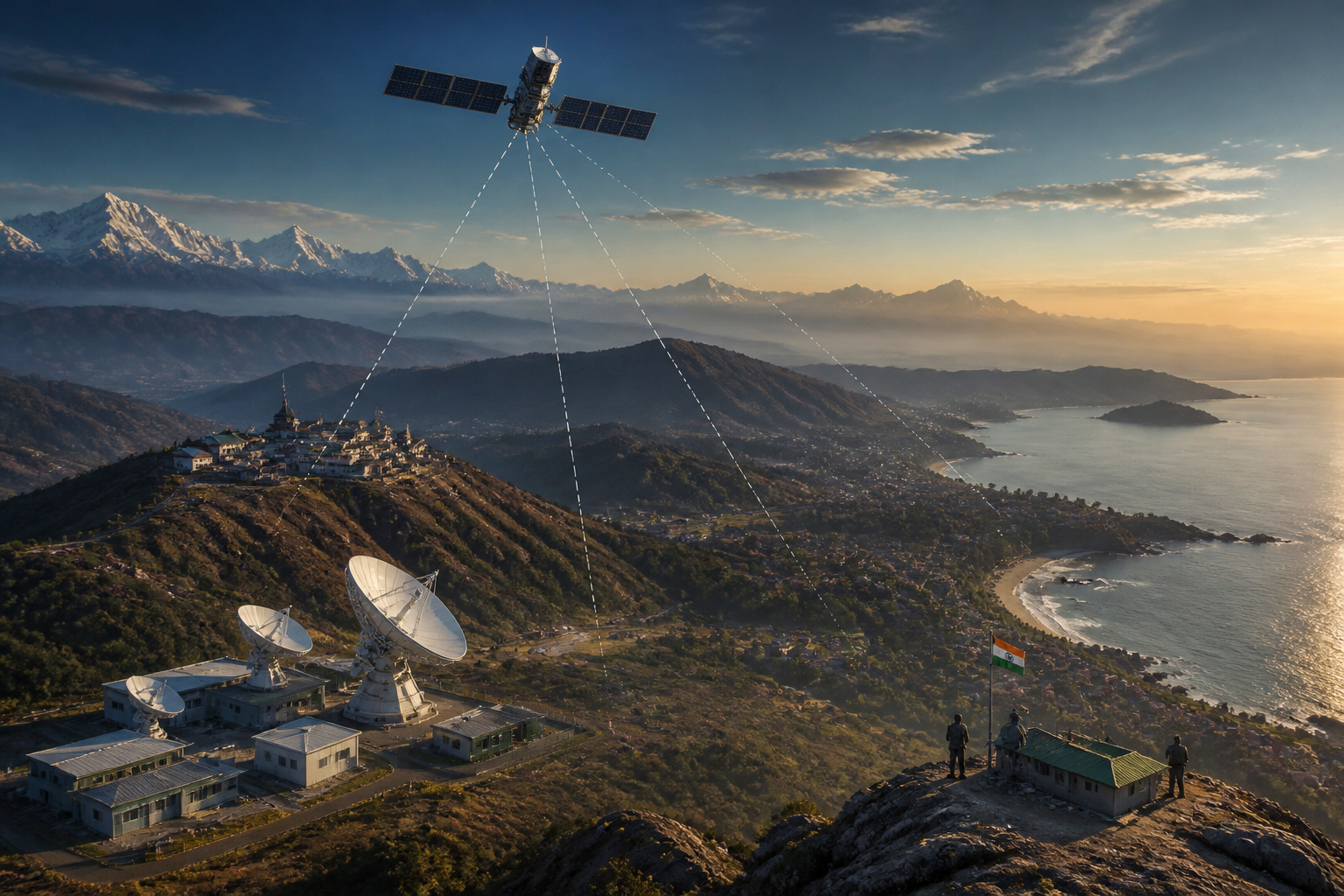
Jio has showcased a proposed satellite connectivity network involving around 1,600 Low Earth Orbit satellites and 23 ground stations across India, targeting areas where mobile towers and fibre networks are difficult to deploy.
The initiative, presented at India Mobile Congress 2026 in Delhi, is being described by Jio as “Sovereign Satellite Connectivity”. The company said the plan is intended to extend coverage across remote villages, island territories, maritime regions and border outposts while integrating space-based infrastructure with its existing terrestrial network.
The proposed constellation would use LEO satellites, which would connect with ground stations placed across India. According to the plan displayed at the event, the 23 stations would link the satellite network to terrestrial telecommunications infrastructure and support the movement of data between space-based and ground-based systems.
Jio’s stated objective is to retain control in India across the connectivity value chain, including design, engineering, integration, testing, launch, deployment and operations. The company’s display presented a vision of coverage across India’s landmass and maritime areas, with connectivity potentially reaching more than 600,000 villages.
The proposed applications extend beyond consumer internet access. Jio identified enterprise connectivity, remote industrial and other sites, aviation, maritime services, government operations, defence and disaster response as potential use cases. The plan also refers to Direct-to-Device calling for rural areas, which could allow compatible devices to connect through the satellite network in locations without conventional terrestrial coverage.
The proposal comes as India Mobile Congress 2026 focuses on the theme “Scale Without Boundaries”. Prime Minister Narendra Modi inaugurated the 10th edition of the event in Delhi on Thursday. Jio’s presentation links that theme to the expansion of connectivity beyond the physical reach of towers, fibre routes and other ground infrastructure.
For residents of remote villages and geographically isolated areas, the proposed network could address connectivity gaps that are difficult to resolve through conventional infrastructure alone. Island territories, maritime users and border locations face distinct deployment challenges because of terrain, distance and the cost of extending terrestrial networks.
However, the satellite constellation and ground-station network remain proposed plans. The material displayed by Jio does not establish an operational launch date, deployment schedule, service pricing or the number of users who would initially be covered. It also does not specify how the proposed network would be phased or integrated with existing services.
Jio’s presentation indicates that the company is preparing to combine terrestrial and space-based networks, with the proposed 1,600 satellites and 23 ground stations forming the infrastructure outlined at India Mobile Congress 2026.
