


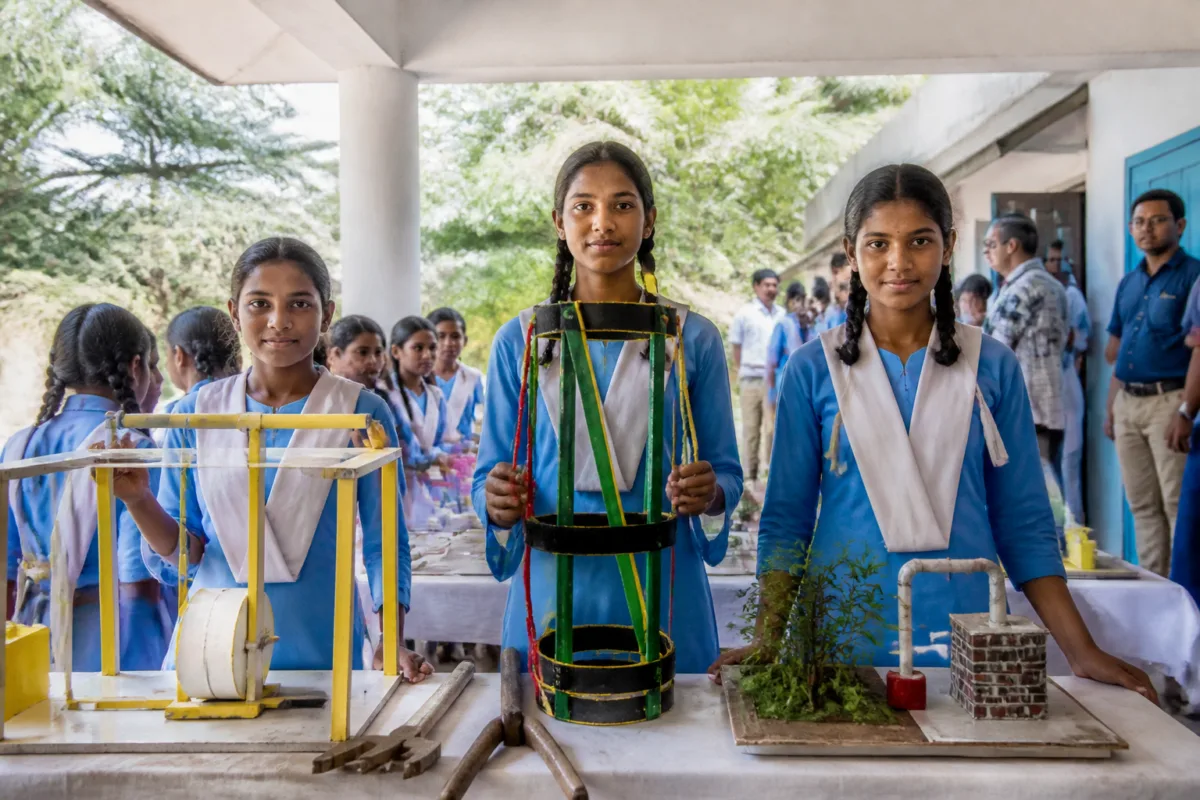
Jharkhand’s school innovation record is revealing a side of rural public education that is often missed when government schools are discussed mainly through the lens of shortages. Students from districts including Chatra, Gumla, Latehar, Simdega and Lohardaga have developed prototypes aimed at practical problems around water, farming, mobility, safety and everyday access. According to a report by Live Hindustan, students from the state have remained among the country’s top 60 participants in the national INSPIRE Awards-MANAK programme for five consecutive years.
The significance of these projects is not simply that students have won recognition. Their ideas are rooted in the conditions around them. A student from Chatra developed a device intended to cut casing pipes in deep, dry borewells. A student from Gumla designed climbing equipment for harvesting from trees. Other projects listed in the report include a rural cooler using wind energy, a device for people with visual disabilities, plastic-mixed concrete, an SMS-based agricultural system, an air-pollution control model and a multipurpose stove.
Taken together, the projects show how innovation emerges when school learning is connected to the physical environment in which students live. The rural school is not only a place where a national curriculum is delivered. It can also become an observation point for local infrastructure gaps: unreliable water sources, difficult agricultural work, unsafe access to trees, inadequate equipment and the absence of affordable tools.
That connection matters because many development problems are experienced first at the household and village level. A dry borewell is not merely a technical failure. It can increase the distance people travel for water and raise the cost of maintaining a water source. Difficulty in climbing trees is not merely a farm inconvenience. In communities where livelihoods depend on palm, date and similar trees, it can affect income and expose workers to injury. The students’ projects do not, by themselves, establish that these problems have been solved at scale. They do show that local experience can generate design questions that formal systems may otherwise overlook.
The most prominent example in the report is the smart borewell pipe cutter developed by Deepak Kumar of Plus Two Ganga Smarak High School in Gidhaur, Chatra. The project secured 10th place nationally in this year’s INSPIRE Awards-MANAK competition, according to the report. Deepak said the device can cut casing pipes installed at depths of between 250 and 280 feet in deep-boring structures. The stated objective is to help increase the capacity of dry borewells and potentially restore access to water.
The project began with a problem that was familiar to the student’s family and community. Deepak told the publication that water scarcity motivated the idea. His grandfather, farmer Baijnath Dangi, encouraged him, while mentor teacher Vipin Kumar provided technical support. This combination is important: the project involved both a user-level understanding of a rural service gap and an adult who could help convert that understanding into a working model.
The report does not provide engineering test results, installation records or evidence of the device being deployed in operational borewells. It therefore cannot establish how effective or safe the cutter would be in field conditions. But it does establish the type of problem students are attempting to address and the role that school-based mentorship can play in translating observation into prototyping.
A second example comes from Gumla. Nisha Rani Ekka, a student of Barwe High School in Chainpur, presented an “Equipment for Climbing: Areca Nut Tree” project. She said farmers in villages around Chainpur depend substantially on trees such as palm and date trees, while climbing straight or thorny trunks to collect produce can be difficult and sometimes dangerous. Her device was designed around easier access to these trees.
Nisha’s mentor, teacher Nand Kishore Prasad, said the project won first place at the state level in 2024 and received appreciation during its national presentation this year. The account is significant because it places safety within the innovation agenda. Rural infrastructure is often discussed through roads, water systems and buildings, but tools that reduce occupational risk can be equally important to how local economies function.
The range of projects listed by the report also points to a broad understanding of innovation. The ideas include a rural cooler and wind-energy model by Nishu Kumari, banana-silk fibre extraction from plant waste by Anisha Parveen, a blind-helping gadget by Prithvi Raj, a baby-food model by Pushpa Kumari, a scorpion robot by Sarfaraz Ansari, plastic-mixed concrete by Prashansa Kumari, an SMS-based agriculture project by Kumari Lakshmi, a multipurpose bicycle by Indrajeet Singh, a food siren by Nageshwar Mahto, an air-pollution control model by Hemant Paswan, a multipurpose stove by Ankita Singh, an adjustable sliding bench-desk by Anushka Kashyap and a smart bridge by Kiran Kumari.
These prototypes should not be treated as equivalent to tested public infrastructure or market-ready products. Their value at this stage lies in identifying needs and developing a scientific approach to them. The list also suggests that student innovation is not confined to a single subject. It crosses agriculture, accessibility, construction materials, household energy, environmental management, mobility and public safety.
The reported participation figures provide another part of the picture. Jharkhand’s representation among national-level participants is listed as 12 in 2017-18, 20 in 2018-19, 11 in 2019-20, eight in 2020-21, 14 in 2021-22, 14 in 2022-23, 15 in 2023-24 and 15 in 2024-25. The first year in the source text appears as “2027-18”, which is chronologically inconsistent with the sequence and has not been treated here as a reliable year label. Even with that limitation, the figures show participation fluctuating between eight and 20 across the reported period rather than following a simple upward line.
The report says more than two dozen students from the state have suggested local solutions through innovation in recent years, while state students have remained in the national top 60 for five consecutive years. This distinction is useful. Participation numbers measure how many projects reach a national stage; sustained top-60 representation indicates repeated recognition. Neither metric alone measures the quality of school laboratories, the number of students who are excluded from such opportunities or whether prototypes survive after competitions. They do, however, indicate that rural government schools are producing ideas that can compete nationally when students receive support.
The institutional framework behind this pipeline is the INSPIRE Awards-MANAK scheme, described in the report as a major programme of the Union government’s Department of Science and Technology and the National Innovation Foundation. Its stated purpose is to develop scientific thinking, creativity and a culture of innovation among school students. That framework provides a route through which a student’s local observation can move from the classroom to a state-level presentation and then to national evaluation.
The report also refers to skills competitions and exhibitions where students present working models, prototypes and entrepreneurship-related ideas in areas such as agriculture, electronics, information technology and health. STEM and ICT laboratories have reportedly been established in schools to build practical understanding of science, technology, engineering and mathematics. These facilities are presented as part of the support structure available to government-school students.
The presence of laboratories, however, is only one part of the institutional chain. The projects described in the report also depend on teachers who can mentor students, families who can recognise a problem as worth investigating, and platforms that allow prototypes to be seen outside the school. Deepak’s project involved support from his grandfather and a teacher. Nisha’s project was connected to a teacher who could help guide it through state and national stages. The examples indicate that equipment alone does not create an innovation system; people and pathways determine whether equipment is used meaningfully.
The reported cooperation involving CBSE schools adds another layer. Jaya Chauhan, identified as the CBSE city coordinator and principal of DPS Ranchi, said CBSE schools work with the government on several projects in which government-school students also participate. She said government-school students are specifically invited to innovation activities, allowing private-school students to learn from the practical understanding and ideas of students from rural and resource-constrained backgrounds.
This matters because the innovation ecosystem around a city or state is often divided by school type. Government schools may have close contact with problems that private institutions study from a distance, while private schools may have greater access to equipment or organised platforms. Collaboration can create exchange between these forms of knowledge. The report does not provide data on the number of such joint projects or their outcomes, so the scale of this cooperation remains unclear. Its stated purpose, however, is to widen participation and expose students to different ways of identifying problems.
The larger urban and infrastructure question is whether public systems can recognise the value of solutions that originate outside formal laboratories and established technology institutions. Water scarcity, agricultural safety, accessibility, waste reuse and low-cost construction are not separate from the built environment. They shape how villages connect to services, how households earn incomes and how communities maintain basic infrastructure.
For policymakers, the reported record also raises questions about what happens after a prototype receives recognition. The supplied report documents awards, rankings, mentoring and institutional support, but it does not establish whether the borewell cutter has been field-tested, whether the tree-climbing device has undergone safety certification or whether any of the listed ideas have received funding for further development. Those next steps are essential if school innovation is to move beyond exhibition and become a usable public or household solution.
What the evidence confirms is narrower but still important. Students in Jharkhand’s rural government schools are repeatedly reaching national recognition through projects grounded in local problems. Their work has been supported by teachers, family members, government programmes, laboratories, exhibitions and some cross-school collaboration. What remains unestablished is the extent to which these prototypes are being tested, manufactured, adopted or integrated into public programmes. The future value of this innovation pipeline will depend on whether institutions can build that bridge without losing the local knowledge that produced the ideas in the first place.

