


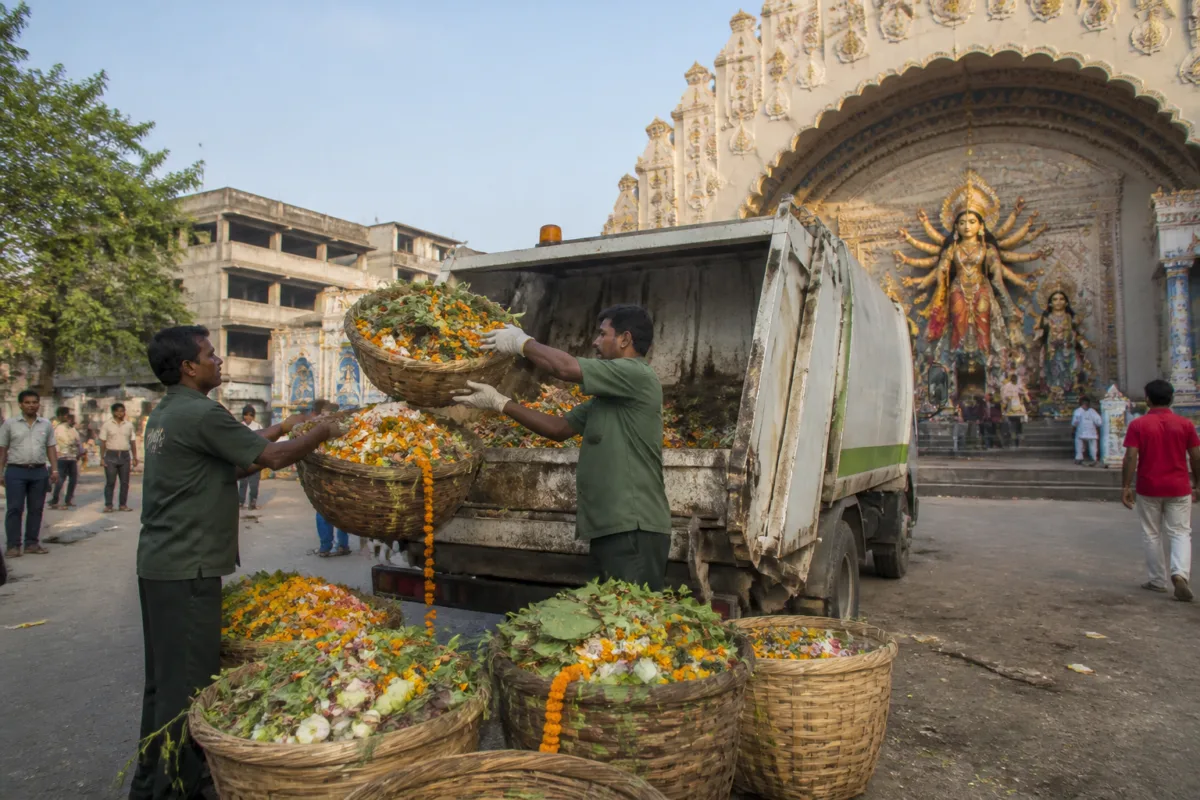
Jamshedpur’s flower waste drive has begun ahead of Durga Puja, with the Jamshedpur Notified Area Committee deploying 10 dedicated vehicles to collect floral offerings from pandals and temples and convert the biodegradable material into compost.
The initiative has been launched under the Swachh Pandal Competition to prevent flowers, bel leaves and other organic offerings from being dumped in open spaces or water bodies. East Singhbhum deputy commissioner Rajiv Ranjan flagged off the vehicles on Friday, and the collection operation became active on Saturday, according to a report by the Times of India.
JNAC officials said all 87 Durga Puja pandals within its jurisdiction have been GPS-tagged. Each vehicle will cover multiple pandals, allowing the civic body to coordinate collection across the festival network rather than relying only on individual committees to arrange disposal.
The collected floral waste will be processed into compost. This separates it from other festival waste, including bhog containers, leaf plates and artificial garlands, which will be collected separately and taken to designated disposal sites near the immersion ghats.
The distinction is significant for municipal operations because the waste generated at festival venues is not uniform. Floral offerings and other biodegradable material can be processed differently from plastic containers, artificial decorations and other non-compostable items. JNAC’s separate collection arrangements are intended to ensure that these streams do not get mixed during the peak period of religious activity.
JNAC municipal commissioner Yogendra Prasad urged puja committees to segregate floral waste and hand it over to the collection vehicles. He said the initiative would help keep pandals cleaner and promote eco-friendly waste management during the festive season.
The GPS-tagging of the pandals gives the collection drive a defined operational map. It also enables the civic body to assign multiple locations to each vehicle, an approach that JNAC officials said would support collection efficiency during the festival. The report did not specify the total quantity of waste expected to be generated, the vehicle capacity or the composting facility where the floral material will be processed.
For residents and visitors, the immediate focus will be on cleaner puja sites and the prevention of organic waste entering public spaces and water bodies. For the municipal administration, the drive creates a temporary collection and segregation system covering every identified pandal within the notified area.
The arrangements also place a responsibility on puja committees to separate floral offerings from other waste before handing them over. JNAC’s next operational step is to continue vehicle-based collection from the 87 GPS-tagged pandals and route the material into composting or designated disposal streams during the Durga Puja period.

