


Jamia Millia Islamia’s 18-day students’ union protest has moved beyond a campus demonstration and into the university’s core public functions. The cancellation of Foundation Day celebrations, the suspension of in-person teaching and the decision to conduct examinations online show how an unresolved governance dispute can quickly disrupt the academic and civic life of a large urban institution.
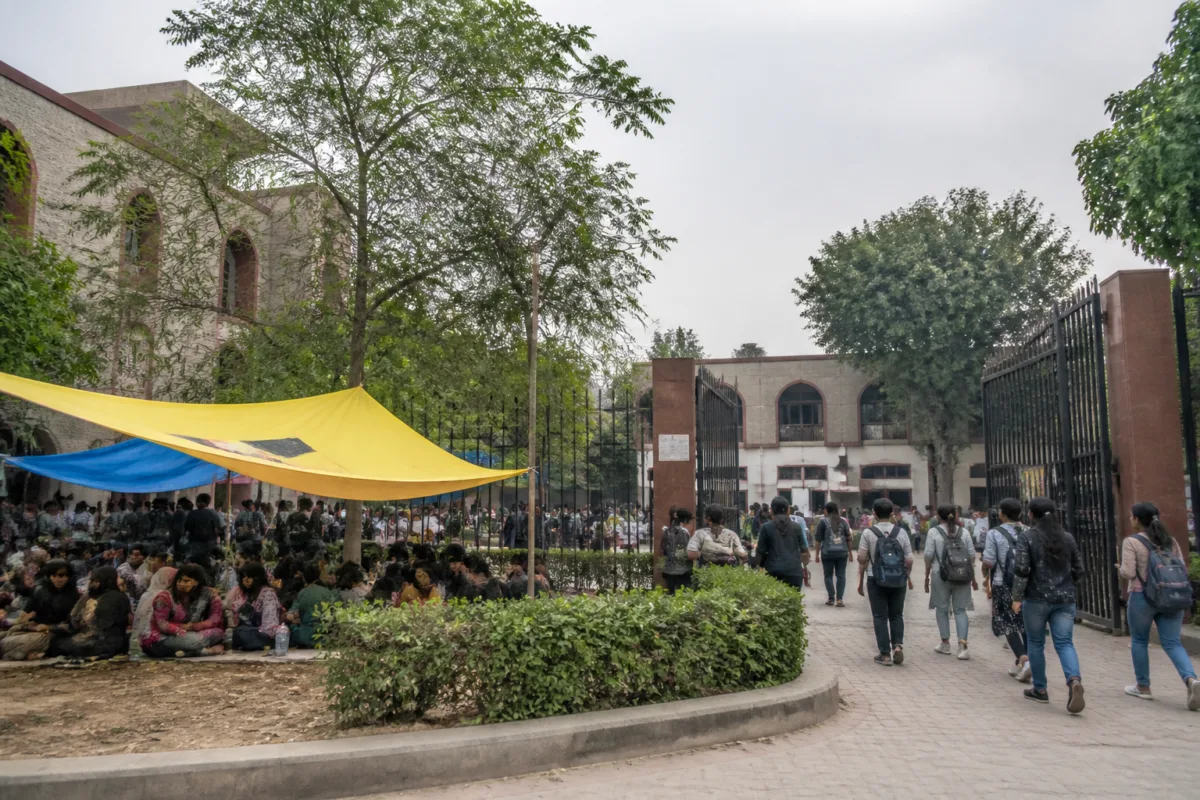
More than 100 students were still camping inside the Gulistan-e-Ghalib compound and the Political Science building on the university’s 106th Foundation Day. The university had cancelled the celebrations and the Talimi Mela, scheduled from October 29 to November 1, citing the protests. Outside the campus, police announcements asked people not to gather, while prohibitory orders under Section 163 remained in force.
The immediate dispute concerns the restoration of the students’ union. Students have been protesting for 18 days and, on Foundation Day, organised their own flag hoisting, speeches, the national anthem, an address by hunger strikers and a press conference. A mass hunger strike was also planned. The protest therefore combined a demand about student representation with a direct challenge to the university’s decision to suspend its normal public ceremonies.
That collision is significant because Foundation Day is not simply an internal calendar event. Jamia was founded on October 29, 1920, in Aligarh during the Non-Cooperation Movement. Its annual programme usually includes an NCC guard of honour, flag hoisting and an address by a chief guest. The Talimi Mela that follows presents the university’s cultural and educational heritage and typically draws thousands of people from the institution and nearby neighbourhoods.
The cancellation has consequently affected more than the students who are occupying the protest sites. It has removed a major public-facing event from the neighbourhood’s calendar, altered movement around the campus and left parts of the university unusually empty. The source report describes students leaving hostels with bags and trolleys, while small groups remained under yellow and blue tents near the Ghalib statue. The broken gate near the hostels also became a visible point of continued movement into and out of the campus.
The university’s response has been to shift academic operations online. An order from the Registrar’s office said odd-semester teaching would continue online until November 24. Practical classes, fieldwork, project viva and minor project viva were scheduled online from November 25 to 30. Theory end-semester examinations were scheduled online from December 1 to 24, followed by winter vacation from December 25 to January 12. Even-semester classes were scheduled to resume on January 13, 2027.
This timetable shows the dispute’s institutional consequences more clearly than the cancelled ceremony alone. Moving lectures online can preserve some forms of teaching, but the university’s own schedule distinguishes between theory and activities that normally require practical, field-based or project-based engagement. Students quoted in the report specifically questioned how science and architecture students would complete practical requirements online. The supplied material does not establish whether alternative facilities or assessment arrangements have been provided.
The academic shift also changes how access to the university is organised. A campus is not only a collection of classrooms; it is a physical system that brings together laboratories, studios, libraries, hostels, public grounds, administrative offices and routes used by students and residents. When teaching and assessment move online, the burden of maintaining continuity shifts from the institution’s shared infrastructure to individual students and faculty members. The report does not provide data on internet access, device availability or the effect of the change on different groups of students, so the distribution of that burden remains unclear.
The decision to extend online classes was presented by the university as a response to conditions that were “not conducive for academic environment”. That phrasing places campus stability at the centre of the administration’s operating decision. Yet the protest itself indicates that stability is not the same as resolution. Students remained at protest sites, and the university’s measures altered teaching and examination arrangements without resolving the demand they were raising.
A meeting between a university administration delegation and the protesters on the morning of Foundation Day offered a possible institutional channel. Students said the professors had listened to their demands and taken them to the Vice-Chancellor. Haneena, a law student, described the interaction as hopeful but added that students would wait to see what emerged from it. The supplied report does not record a formal decision by the Vice-Chancellor or a publicly announced settlement.
That gap between dialogue and decision is central to the current situation. The administration has issued operational orders with specific dates, but the protest’s central demand remains unresolved in the available account. As a result, the university has been able to set a temporary academic timetable without restoring the normal relationship between students and the institution’s representative structures.
The episode also demonstrates how quickly campus governance can become a question of urban management. Police announcements and prohibitory orders shape who can gather outside the university. The cancellation of a programme that usually draws people from the institution and surrounding neighbourhood changes the public use of the campus. Hostels, gates, roads and nearby public spaces become part of the dispute because the university’s functioning is tied to movement through and around its premises.
The Foundation Day cancellation further removes a symbolic setting in which the university presents its heritage to students, staff and the public. Students described the event as part of their heritage, while the administration treated the protest situation as a reason to put celebrations on hold. These positions reveal two competing institutional priorities: preserving the campus’s regular public calendar and preventing a gathering from adding to an already unsettled situation.
The available evidence does not establish the origin of the dispute over the students’ union, the precise administrative position on its restoration or the legal framework governing the union. It also does not establish whether the online academic schedule will remain unchanged after November 24 or whether the examination arrangements will be revised. Those are important limits on what can be concluded from the current report.
What is established is the scale of the operational response. The protest has entered its 18th day; more than 100 students were camping at two locations; Foundation Day celebrations were cancelled; the Talimi Mela was called off; restrictions on gathering were in force outside; and teaching, practical work and examinations were moved online according to a schedule extending into January 2027.
For an urban university, this is not a minor interruption. It is a test of how institutions manage disagreement while keeping education, public access and basic administrative continuity functioning. Jamia’s next steps will determine whether the current online timetable becomes a short-term arrangement during a protest or the framework for a longer disruption. The immediate milestones are the administration’s response to the students’ demands, the November 24 end date for online teaching, the examination schedule beginning December 1 and the planned resumption of even-semester classes on January 13, 2027.

