


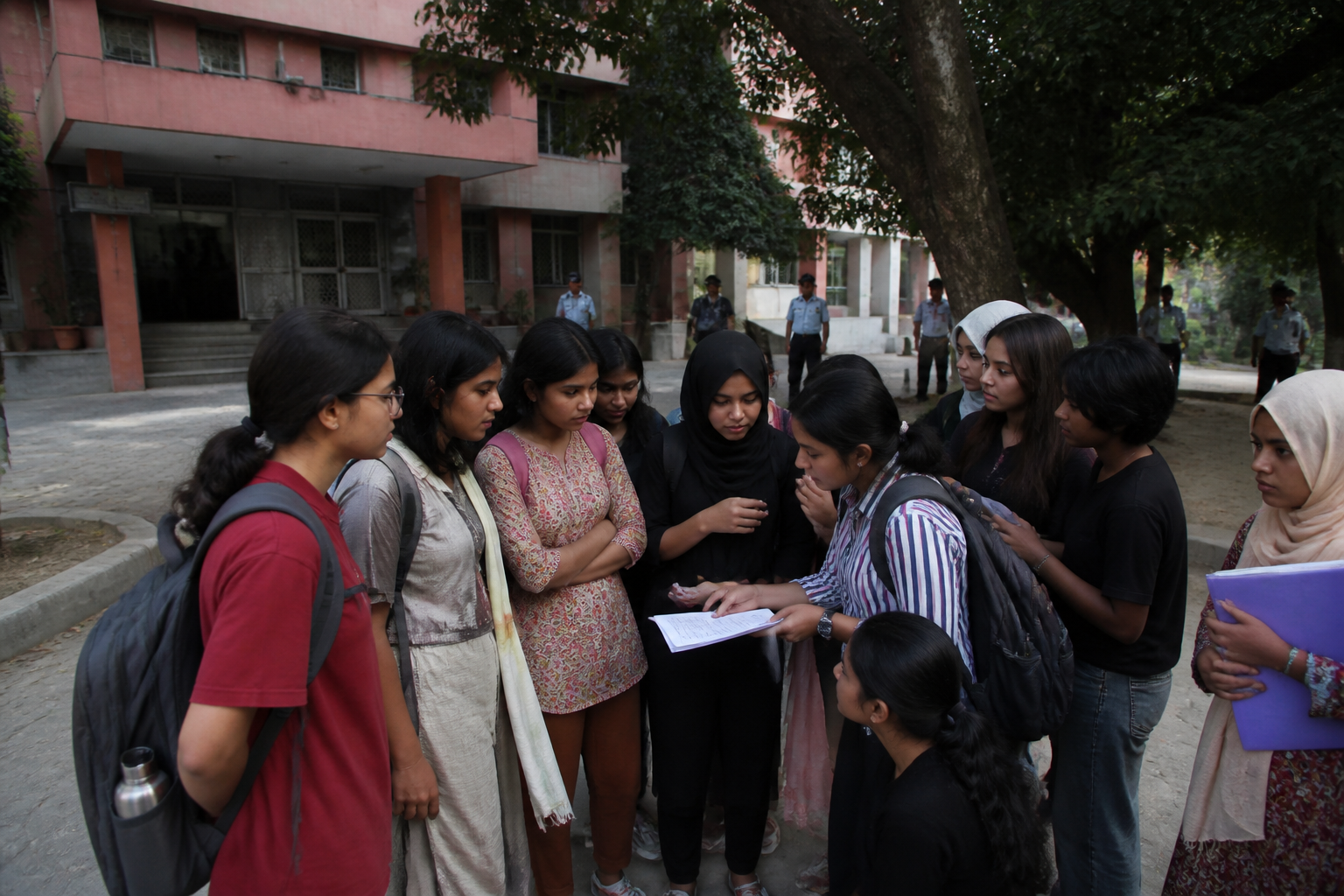
Jamia hostel evictions have turned a routine question of hostel eligibility into a wider dispute over student housing, institutional discretion and access to education. At least five women students of Jamia Millia Islamia received eviction notices between September 18 and September 30, after protests over the quality of food served in the hostel mess began on September 10. The students say the removals were connected to those protests. The university denies this and says the students did not meet the minimum marks requirement under its hostel rules.
The disagreement is not only about whether a 55% threshold was correctly applied. It is also about what hostel accommodation represents for students who live far from Delhi, have limited alternatives and depend on campus housing for safety and continuity of study. One student’s petition before the Delhi High Court states that she lives about 1,560 km from home, has no family in the Delhi-NCR region and relies on the university hostel for more than convenience.
That makes the dispute an important example of how educational infrastructure operates as part of the urban housing system. A university hostel is a controlled and limited form of accommodation, but for students from outside the city it can determine whether higher education remains practically accessible. When a student loses a room, the immediate consequence is not merely a change of address. It can involve finding affordable accommodation, managing travel, dealing with safety concerns and preserving the ability to attend classes.
The available account shows that the conflict has developed through several linked events. Students began protesting on September 10 over the quality of food in the hostel mess. Two women students received notices on September 18, while three others received similar notices on September 30. A protest followed on September 28. After that protest, another student was temporarily suspended from classes and issued a show-cause notice for protesting outside the designated protest site. No further protests have been held since, according to the report.
The university’s position is that the evictions form part of its annual hostel process. A university spokesperson said the students had scored less than 55% and were therefore asked to leave under established guidelines. The spokesperson described the system as fair and merit-based, citing the scarcity of hostel places. The administration also denied the students’ allegation that other students with marks below 55% had been allowed to remain in hostels.
The students’ account raises a different question: whether a formally neutral eligibility rule is being applied consistently and whether the timing of the notices created a perception that hostel access was being used in response to protest activity. The supplied report does not establish that the evictions were retaliatory. It does, however, document a direct dispute between the university’s stated reason and the students’ understanding of why they were removed.
That distinction matters because hostel allocation involves two separate administrative functions. The first is capacity management: deciding who can occupy a limited number of rooms. The second is disciplinary and institutional management: deciding how students may protest, what conduct requires a show-cause notice and how disputes are handled. When both processes affect the same students during the same period, the institution must make the basis for each decision clear. Otherwise, a capacity rule can be viewed as a disciplinary measure, even when the university maintains that it is not.
The case of Habeeba illustrates the difficulty. She said her hostel accommodation had been renewed and that she had paid the fee in July. Her September eviction notice cited failure to secure the required 55% in the previous semester. She attributed her lower marks to an illness and said she had informed the administration. Her hostel fee had not been refunded, and she was asked to submit an application for a refund.
Habeeba later approached the Delhi High Court, seeking to challenge the eviction notices and restore her hostel accommodation. During the hearing on Monday, the university told the court that there were no vacancies and that she did not qualify on merit. According to her lawyer, the university was asked to consider granting her hostel accommodation. The account does not state the final outcome of that consideration, leaving the immediate status of her accommodation unresolved.
The reported manner of removal has added another layer to the dispute. Habeeba alleged that she was forcibly removed from the hostel on September 25. She said her roommate had been told to move because the room would be sealed, and that her belongings were placed in garbage bags and taken outside. She also alleged that security guards dragged and manhandled her. The university denied the allegation of manhandling. These competing accounts have not been independently resolved in the supplied material.
The institutional issue is therefore larger than the marks criterion itself. A rule can be clear on paper while still producing difficult questions in practice. What happens when a student’s academic performance is affected by illness? How is a renewal decision communicated when fees have already been paid? Is there an appeal or review mechanism before a room is sealed? How are personal belongings handled during removal? The report identifies the first two questions through the student’s account, but does not provide details of any broader university appeal procedure or hostel eviction protocol.
Scarcity is central to the university’s explanation. The spokesperson said hostels are scarce and that a merit-based system is fair. Scarcity makes allocation rules necessary, but it also increases the consequences of each administrative decision. A student who loses a room in a city with expensive or distant rental options may face a significantly different burden from a student who has family accommodation nearby. In this case, Habeeba’s petition specifically places distance from home and the absence of family support in Delhi-NCR before the court.
This is a recurring challenge in urban educational infrastructure: institutions often treat accommodation as a campus service, while students experience it as essential urban support. The university’s rules may focus on marks and vacancies. Students may assess the same room through safety, affordability, travel time and continuity of study. Both perspectives can exist at once, but the administrative process must explain how they are balanced, if they are considered at all.
The protest over mess food also shows how infrastructure disputes can become governance disputes. Food quality is a daily operational issue, but the response to complaints depends on representation, designated protest spaces and the institution’s tolerance for public disagreement. The reported suspension and show-cause notice after the September 28 protest demonstrate that access to campus space and the right to raise grievances became part of the conflict. The university’s stated concern was that the student protested outside the designated site; the report does not provide further details of the rule or the alleged violation.
The Delhi High Court’s involvement places the dispute within a formal review process. The court has been asked to examine the eviction notices and the consequences for a student who says her accommodation was renewed and paid for before the notices were issued. The university has maintained that there were no vacancies and that the student did not meet the merit requirement. The court’s reported direction that the university consider granting accommodation keeps the question of immediate relief open, but the available account does not record a final ruling on the underlying policy.
What the evidence confirms is limited but significant. Five women students received eviction notices in September. The university attributes the action to the 55% academic criterion and hostel scarcity. Students link it to protests over mess food and allege unequal application of the rule. One student has pursued legal relief, while the university has denied manhandling and rejected the retaliation claim. The report does not establish whether the eligibility rule was applied selectively, whether the evictions were disciplinary in effect or whether the students’ allegations about unequal treatment can be substantiated.
The larger urban question is how institutions allocate scarce accommodation when the formal measure of eligibility does not capture a student’s dependence on that housing. Jamia’s dispute shows that hostel rooms are not isolated from the city around them. They are part of the practical infrastructure that allows students from distant locations to study in Delhi. The next developments to watch are the university’s consideration of Habeeba’s accommodation, the court proceedings and any clarification of how the 55% rule, fee refunds, medical circumstances and protest-related actions are handled under hostel policy.

