


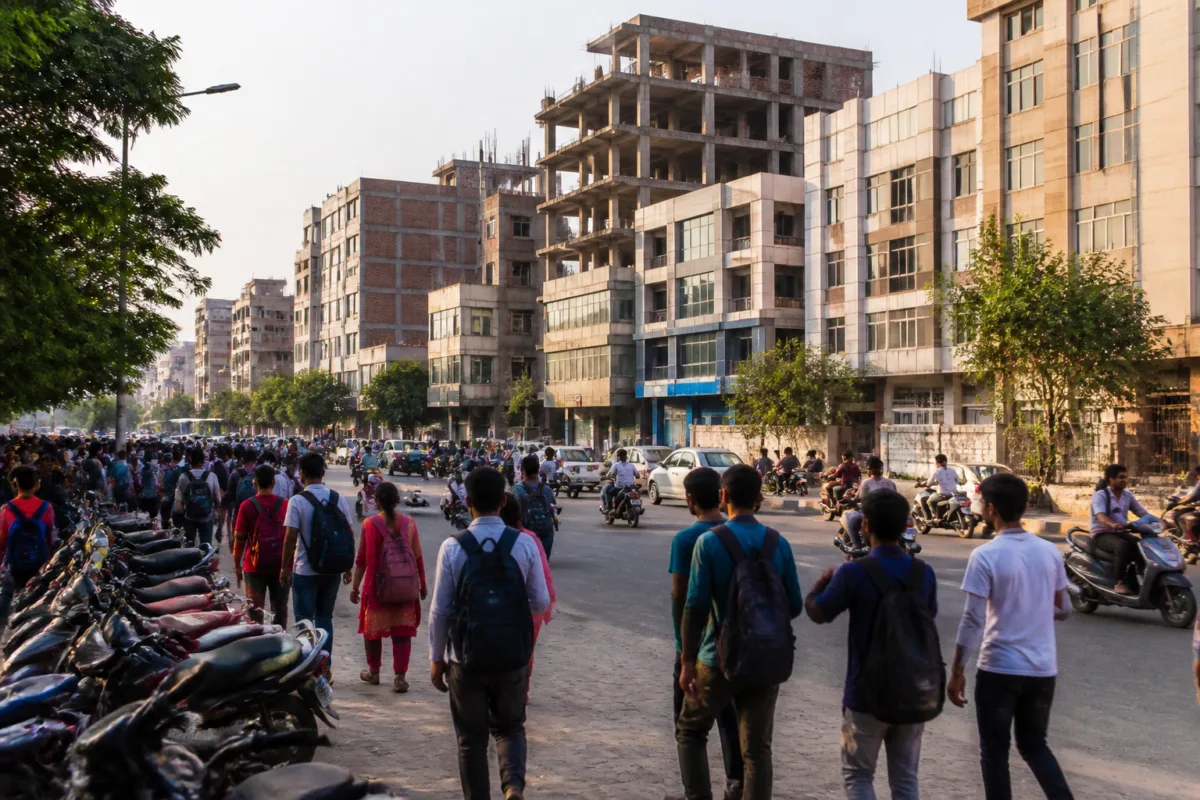
The relocation of Jaipur’s coaching centres is exposing a gap between administrative compliance and a workable urban solution. The Jaipur Development Authority says 18 of 32 identified coaching bodies have moved out of the affected area, while operators say only two have shifted to the designated Pratap Nagar hub and that most have moved to 80 Feet Road in Mahesh Nagar instead.
The disagreement is not merely about a relocation count. It raises a more consequential question about how cities move concentrated educational and commercial activity: can authorities achieve the formal removal of institutions from one location without creating a financially viable, properly serviced and enforceable alternative?
According to the report, JDA began assessing the relocation status on October 21. DIG (Enforcement) Anand Sharma said 18 of the 32 coaching bodies had already relocated. He also said the remaining operators had cooperated with the authority and requested time until after Diwali. Sharma described the exercise as collaborative and said coercive action had not been required.
Coaching-centre operators dispute that account. They said only two centres had moved to the Pratap Nagar hub, while most others had shifted to 80 Feet Road in Mahesh Nagar. The conflicting figures indicate that the two sides may be using different definitions of relocation. For JDA, a centre may be considered to have moved if it has left the original area. For operators, relocation may mean shifting to the designated hub, where the authority expects the activity to be concentrated.
That distinction matters because dispersal and planned relocation produce different urban outcomes. If institutions leave the original coaching hub but settle along another road, the immediate enforcement objective may be achieved in one area while congestion, parking pressure, traffic conflicts and demand for commercial premises emerge elsewhere. The supplied report does not provide traffic or enrolment data for either location, but the operators’ account suggests that Mahesh Nagar has become an alternative destination.
The central obstacle identified by the operators is cost. They said high auction prices for properties in the Pratap Nagar hub made relocation financially unviable. This points to a basic implementation problem: a designated zone does not automatically become a usable zone. For a coaching centre, the availability of premises must be matched by rent or purchase costs, floor space, accessibility and the ability to accommodate staff and students. If any of those conditions fail, operators have an incentive to find cheaper premises elsewhere.
One operator described the Pratap Nagar site as a problem rather than a solution, saying JDA had moved the centres out of one place without providing an affordable alternative. The statement is an operator’s assessment, not an independently established finding, but it identifies the affordability test that the relocation policy must meet. An authority can control land use through notices and sealing, yet it cannot ensure durable compliance unless the designated destination works economically for the institutions being moved.
The dispute also reflects the importance of distinguishing between smaller and larger establishments. Operators alleged that JDA had presented relocation figures after sealing smaller coaching centres with fewer than 100 students, while larger institutes with more than 1,000 students continued to operate in the area. This allegation has not been independently established in the supplied material. If accurate, however, it would suggest that the headline relocation number may not capture the scale of activity removed from the area. Counting institutions alone can obscure the difference between a small centre and a major operator serving a much larger student population.
The report further places the relocation within directions from the Supreme Court. Operators said they were compelled to move under the apex court’s directions but argued that JDA and the Rajasthan Housing Board could have developed a coordinated solution. The supplied material does not provide the text or scope of the court’s directions, so the precise legal obligations of each institution cannot be determined here. It does establish that the relocation is taking place within a judicially relevant framework rather than as an isolated local administrative exercise.
That institutional division is significant. JDA is responsible for development authority functions and enforcement in the area described in the report, while the Rajasthan Housing Board is identified as a potential land or premises partner. The operators’ argument is that a relocation hub requires coordination between these bodies, particularly where premises are to be made available for rent or purchase. Without such coordination, the authority enforcing the move may not control the affordability or allocation conditions at the destination.
A specific allegation in the report concerns a property at the Pratap Nagar coaching hub. A source claimed that the Rajasthan Housing Board had rented the property to the National Forensic Sciences University while repeatedly denying similar requests from coaching operators seeking rented premises there. This claim is attributed to a source and is not independently confirmed in the supplied material. It nevertheless highlights a potential allocation conflict: a site designated or promoted as a coaching destination may not have enough premises available for the institutions expected to relocate there.
The episode also shows why relocation plans require more than a map and a deadline. A successful shift depends on the relationship between land supply, institutional demand and the cost of occupying the new area. The report provides one clear numerical contrast: JDA’s assessment covers 32 coaching bodies, of which it says 18 have relocated. Operators, however, identify only two moves to Pratap Nagar. The difference is large enough to affect how the policy is evaluated, yet the supplied material does not explain the assessment methodology, the addresses counted by JDA or whether relocation was verified through leases, functioning classrooms or student capacity.
That missing information is important for public accountability. A relocation audit would need to establish at least where each institution moved, whether it is still operating, how many students it serves and whether the destination is the officially designated hub. It would also need to clarify whether centres that were sealed, temporarily closed or shifted to another neighbourhood are included in the same category. The article does not report that such a detailed public register has been released.
The shift towards Mahesh Nagar, as described by operators, also raises the question of whether enforcement is simply redistributing land-use pressure. The report says operators warned that similar disputes could eventually emerge there. That is a warning from stakeholders, not a prediction that can be treated as fact. But it identifies the risk inherent in moving activity without resolving the underlying demand for accessible and affordable premises. If the new location lacks adequate planning or enforcement arrangements, the city may see a repeat of the same conflict in a different neighbourhood.
For students and families, the implications are practical even though the report does not provide direct accounts from them. Changes in location can affect daily travel, access to classes and the concentration of supporting services. For operators, the question is whether the designated hub allows them to continue functioning at sustainable costs. For authorities, the test is whether the move is legally compliant, measurable and durable rather than temporary displacement.
The Jaipur case therefore sits at the intersection of land-use enforcement and urban accommodation. Authorities may have a valid reason to regulate a concentrated activity, but regulation becomes difficult to sustain when the replacement location is expensive or unavailable. Conversely, operators’ commercial concerns do not by themselves settle whether the original area was suitable for continued use. The evidence supplied here confirms a sharp dispute over what relocation means and whether Pratap Nagar is economically usable; it does not establish which side’s full count is correct.
The next stage will depend on how JDA documents the remaining relocations and whether the authority, the Rajasthan Housing Board and coaching operators produce a coordinated arrangement for premises at Pratap Nagar. The issues to watch are the final verified number of centres moved, the treatment of larger institutes, the availability and pricing of hub properties, and whether Mahesh Nagar becomes the next site of administrative conflict.

