


Tamil Nadu’s position as India’s second-largest salt producer has not translated into reliable household access to adequately iodised salt. According to figures cited by state health minister K G Arunraj, only 62% of households in the state used adequately iodised salt in the 2018-19 India iodine survey, compared with a national average of 76%. The gap points to a public-health problem that extends beyond production: what matters is whether iodine survives the supply chain, reaches households and is retained during cooking.
The figures were presented at an event organised for iodine deficiency disorders prevention day at Justice Basheer Ahmed Sayeed College for Women. Arunraj said Tamil Nadu had the lowest share of households using adequately iodised salt among states in the survey cited by the state. “We cannot accept iodine deficiency in the land that produces the salt,” he said.
The contradiction between production and consumption is central to the issue. Salt production provides the raw material, but iodisation depends on processing, testing, packaging, distribution and household handling. The report indicates that many families buy loose, unbranded rock salt. Such salt may not provide the same assurance of iodine content as a packaged product subject to labelling and compliance requirements. The state’s challenge is therefore not simply to produce salt, but to maintain a functioning chain of quality control from production stage to kitchen.
Household storage and cooking practices add another layer to the problem. Arunraj said some families store salt in open containers exposed to sunlight and moisture, add it early during cooking and boil it for long periods. These practices can allow iodine to escape before the food is consumed. This makes the effectiveness of iodisation partly dependent on consumer behaviour, as well as on whether salt reaches the household with adequate iodine in the first place.
The available district-level evidence suggests that the problem is uneven rather than confined to one location. In sample analysis conducted between April 2025 and March 2026, the proportion of adequately iodised salt varied between 70% and 88% in districts including Thanjavur, Tirunelveli, Virudhunagar, Kallakurichi, Thoothukudi and Tiruvarur. At least 2% of salt samples in Thoothukudi, a major salt-producing area, were found to contain no iodine. The range indicates that state-level averages can conceal substantial local differences in compliance and household access.
The same evidence also shows why production geography cannot be used as a proxy for public-health protection. Thoothukudi’s salt-producing identity has not eliminated the possibility of inadequately iodised or non-iodised salt reaching consumers. The presence of samples with nil iodine content raises questions about where quality control is failing: at manufacture, during storage and transport, in retail distribution, or through the purchase of loose salt. The supplied report does not establish the precise point of failure, but it identifies a chain that requires monitoring at more than one stage.
Tamil Nadu’s food-safety rules specify that salt for human consumption must contain 30 milligrams of iodine per kilogram at the production stage and at least 15 milligrams per kilogram at the household level. These two thresholds recognise that iodine content can decline between production and consumption. Compliance therefore cannot be assessed only at factories or salt pans. It also has to be checked in shops and homes, where storage conditions and product handling influence what consumers finally use.
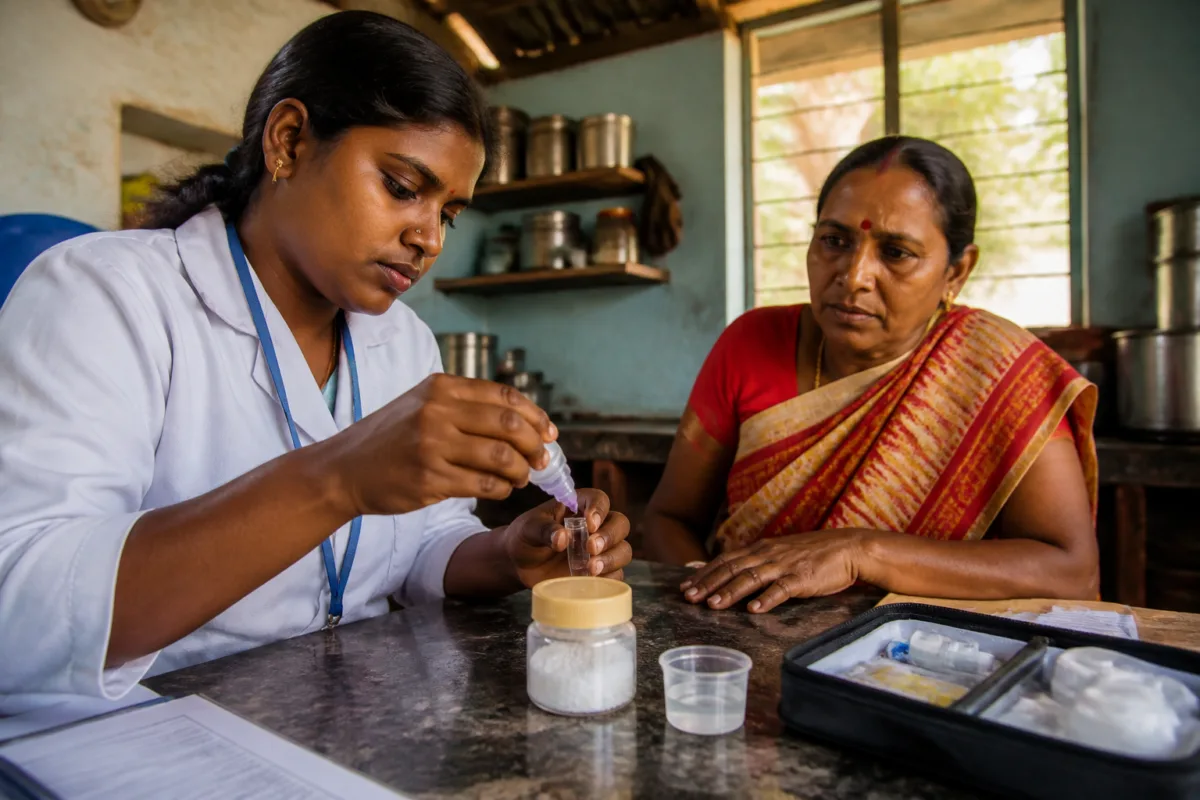
The public-health department has assigned village health nurses a role in testing cooking salt in households. The department also tests schoolchildren for goitre in every district. Data released in parts on Monday showed goitre among 9% of schoolchildren screened in Ramanathapuram in 2024-25. Villupuram recorded a similar share in 2018-19, while Madurai reported 6% in 2022-23 and Pudukottai 5% in 2024-25. Officials classify all four districts as high risk for goitre.
These figures show that surveillance is spread across two different levels. Household salt testing examines the immediate input into diets, while school screening looks for one visible consequence of prolonged iodine deficiency. The measures are related but not interchangeable. A district may require both stronger product testing and health screening, particularly where the share of children with goitre is high or where household salt samples show inadequate iodine.
The health implications explain why the state’s salt campaign has consequences beyond nutrition messaging. Iodine is required by the thyroid gland to produce hormones that regulate growth and metabolism and support developing brain function, according to director of public health Dr A Somasundaram. The risks are especially significant during pregnancy because a foetus depends entirely on the mother’s supply. The report says severe deficiency can cause goitre, miscarriage, stillbirth and lasting intellectual impairment in children, while mild deficiency has been linked to lower verbal scores and weaker reading skills.
At the same time, Tamil Nadu is asking residents to reduce their overall salt intake. Arunraj said the state’s campaign seeks to prevent hypertension, heart disease, stroke and kidney damage, and advised people to consume less than 5 grams of salt a day. His instruction was specific: use less than 5 grams, but ensure that the salt used is iodised. The policy challenge is to communicate both messages without allowing one to undermine the other. Reducing salt quantity does not remove the need for adequate iodine in the salt that remains in the diet.
The reported rural consumption figure adds urgency to that balancing act. A recent study by a city-based medical institution found that rural residents consume about 13 grams of salt a day, while one-third of households use salt with too little iodine. The reported consumption level is more than twice the state’s advised daily limit. However, the evidence supplied does not provide the study’s sample size, methodology or geographic coverage, so the figure should be treated as an indicator of risk rather than a complete estimate for all rural households in Tamil Nadu.
The state’s institutional response combines regulation, testing, health surveillance and public communication. The food-safety department initiates action against manufacturers for violations, and Arunraj said enforcement would continue with greater intensity. Village health nurses test salt in homes, while the public-health department screens schoolchildren for goitre. These functions place responsibility across multiple administrative systems rather than within a single department.
That division of responsibility also creates the possibility of gaps. Food-safety officials may identify a manufacturing violation, while health workers encounter inadequately iodised salt in a household and school screening identifies a high-goitre area. Unless these findings are connected, each agency may see only one part of the problem. The supplied report does not describe a unified state dashboard or a district-level system linking these datasets. It does, however, show that Tamil Nadu is collecting information at production, household and population levels.
The larger urban and regional governance question is how a state converts a widely available commodity into a dependable public service. Salt moves through production areas, manufacturers, distributors, retailers and households, including rural and urban markets. Its health value depends on standards that are invisible to most consumers. Unlike a road or water pipeline, the system fails without an obvious physical breakdown; the failure appears through laboratory results, dietary practices and health outcomes.
The evidence confirms three separate concerns: Tamil Nadu’s reported household use of adequately iodised salt was below the national average in the 2018-19 survey; recent district samples still show variation, including salt with nil iodine in Thoothukudi; and some districts continue to report goitre among screened schoolchildren. What remains unclear from the supplied information is how much of the deficiency is caused by manufacturing, distribution, storage or cooking practices. The next important developments are the state’s enforcement actions, the continuation of household testing and whether future surveys show improvement in iodine adequacy while salt consumption falls.

