


The Rs 2,000 fine imposed on a resident for using drinking water to wash a floor is a small enforcement action, but the numbers behind it point to a much larger challenge for Indore. The city is facing a 27% rainfall deficit, its reported water demand is already higher than effective daily deliveries, and a major supply expansion is not expected before 2029.
The incident occurred in Ward 79, near Seven-Step Garden on RR CAT Road, where Mayor Pushyamitra Bhargava came across a resident hosing down a floor during a morning walk. The mayor was visiting neighbourhoods in Indore Municipal Corporation’s Zone 21 while urging residents to use water carefully. According to IMC chief sanitation inspector Manish Singh, the resident continued using a gushing pipe after being advised against it.
The resident, identified on the fine slip as Monu Mishra, said he was trying to help a freshly cemented patch of flooring cure. IMC officials advised him to stop using drinking water for that purpose and to cover the cemented area with wet jute bags instead. The material retains moisture and helps dissipate the heat generated during curing, according to the civic officials cited in the report.
The penalty came barely a day after the municipal corporation issued a warning against water wastage. The enforcement action therefore serves two purposes for the civic body: it penalises a visible instance of misuse and signals that conservation appeals may be accompanied by on-the-spot action. But the city’s wider water position shows why household behaviour is only one part of the problem.
Indore received 633.1 mm of rainfall during the recent monsoon, against a normal level of 868.1 mm. The shortfall has prompted the IMC to seek a Rs 50 crore relief package from the state government. Mayor Bhargava has appealed to residents to conserve every drop and suggested reusing wastewater from RO purifiers for watering plants and washing vehicles and clothes.
Those appeals are being made against a substantial gap between reported demand and effective supply. Indore’s population is estimated at between 35 lakh and 40 lakh. Domestic consumption alone is placed at about 620 million litres per day, based on average per capita use of 155 litres. The IMC sources around 440 MLD in bulk from Narmada pipeline phases and Yashwant Sagar, but leakages in the distribution network reportedly reduce actual delivery to between 300 MLD and 320 MLD.
That difference is central to understanding Indore’s water stress. A city can add source capacity and still fail to deliver the same quantity to households if the distribution system loses a significant share before water reaches consumers. In this case, the reported effective delivery is between 300 MLD and 320 MLD, against domestic demand of about 620 MLD. The figures indicate that the immediate problem is not limited to rainfall or individual wastage; it also includes the condition and performance of the network that moves water across the city.
The distinction matters for urban governance. Conservation campaigns can reduce discretionary use, but they cannot by themselves repair leaking pipelines or close a structural supply deficit. Similarly, additional bulk water can improve availability only if the city has the distribution capacity to carry it efficiently. The figures supplied in the report place these three elements—source water, network performance and consumption demand—at the centre of Indore’s water planning.
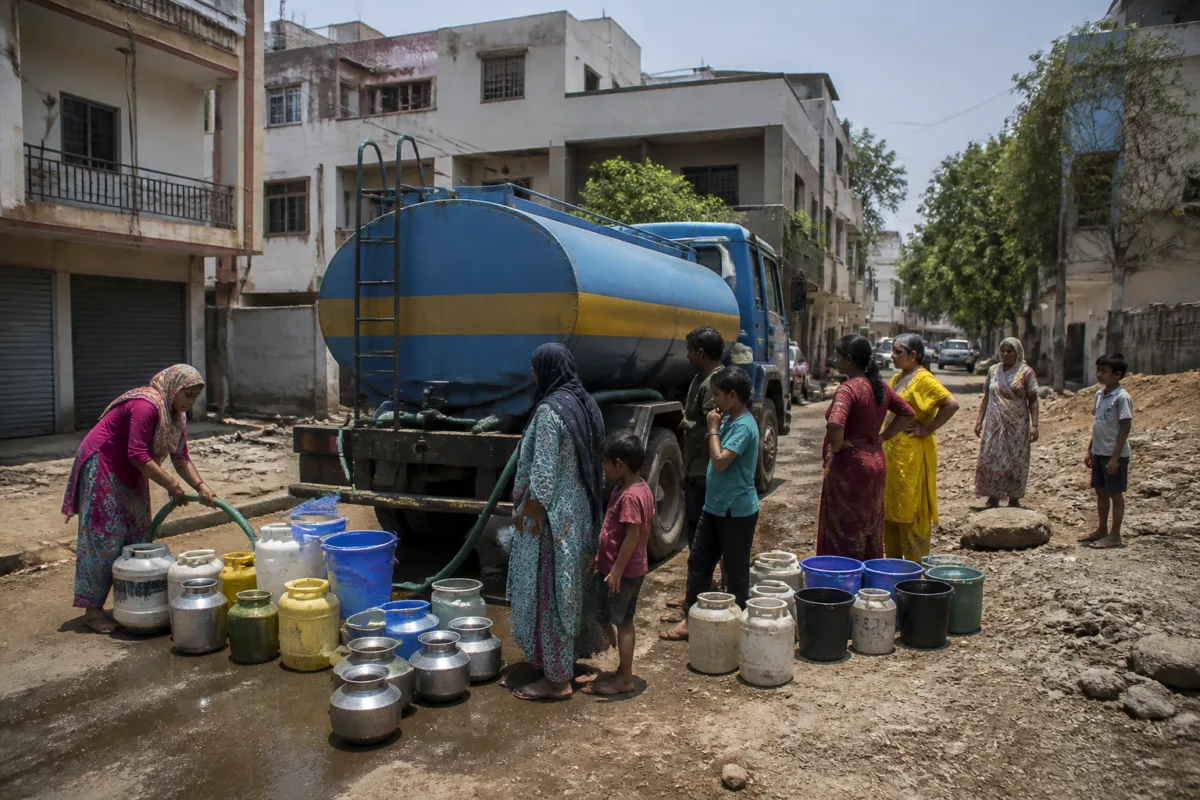
The IMC has begun repairing around 6,000 tubewells and plans to procure 100 new water tankers as part of its preparations for the coming summer. It is also working to replenish Yashwant Sagar through the Malwa-Gambhir and Narmada lines. These measures combine local groundwater assets, emergency distribution capacity and efforts to strengthen the city’s reservoirs or supply sources.
Each measure addresses a different time horizon. Tubewell repairs may improve local or supplementary availability. Tankers can provide mobile supply where the regular network is inadequate, although the report does not establish how much additional water they will deliver or how they will be deployed. Replenishing Yashwant Sagar is intended to support the city’s source system. None of these steps, however, removes the reported distribution losses or replaces the need for long-term augmentation.
The longer-term response is the Narmada Phase-IV project, which the IMC has begun implementing. The project is expected to raise the city’s total supply to roughly 900 MLD. Of that, about 620 MLD is intended for domestic needs and the remaining 280 MLD for commercial users. The project is not expected to be completed before 2029.
This timeline creates an interim governance problem. Indore must manage several summers before the planned increase becomes available. During that period, the city will have to rely on conservation, repairs, tankers, reservoir replenishment and the performance of its existing supply network. The report does not provide a detailed project cost, construction schedule or milestone plan for Phase IV, so the available evidence cannot establish how quickly each component will be completed or whether the 2029 target will change.
The distribution figures also raise a question about how urban water performance is measured. Bulk supply entering a city’s system is not the same as water reaching homes, institutions and businesses. If the IMC sources 440 MLD but effective delivery is only 300-320 MLD, then reporting only the source-side number would conceal the service gap experienced by consumers. For residents, the relevant measure is not how much water is drawn into the system, but how reliably and equitably it reaches the point of use.
The reported per capita calculation provides another important context. Average domestic use of 155 litres per person per day, applied to a population of 35 lakh to 40 lakh, produces a large aggregate requirement. That demand is generated across millions of daily activities, from drinking and cooking to cleaning and sanitation. A fine for washing a floor addresses one visible use, while the city’s planning challenge involves managing demand across a much larger and more complex urban system.
The incident also shows how municipal enforcement is being used to translate a general conservation message into a public rule. The IMC’s advice on wet jute bags offers a practical alternative for curing cement without using potable water. Such alternatives can help distinguish between necessary water use and avoidable use, but the report does not indicate the scale of enforcement across the city, the number of penalties issued or the legal provision under which the fine was imposed.
The state’s role is also becoming important. The IMC has sought a Rs 50 crore relief package in response to the rainfall deficit. Whether that request is approved, and how the funds would be allocated, is not established in the supplied report. The request nevertheless illustrates that urban water security is not managed by municipal action alone. It depends on state support, source infrastructure, local assets, network maintenance and household behaviour operating together.
Indore’s immediate water problem therefore has two visible faces. One is individual consumption, represented by a resident using a pipe to wash a floor despite a conservation appeal. The other is institutional capacity, represented by a reported shortfall between bulk supply and effective delivery and by the wait for a major project that may not be completed before 2029. Focusing only on either face would leave the urban system incompletely understood.
What the available evidence confirms is that Indore is entering a period in which water conservation and infrastructure management will have to work together. The city has recorded rainfall below normal, reported demand exceeding effective delivery, and a pipeline project with a multi-year completion horizon. The next developments to monitor are the state’s response to the relief request, progress on tubewell repairs and tanker procurement, efforts to replenish Yashwant Sagar, the reduction of network leakages and milestones on Narmada Phase IV.

