


India’s decline in extreme poverty from 27.1% in 2011 to 2.6% in 2023 is one of the country’s most consequential economic shifts, but the numbers also reveal a harder urban question: whether welfare gains can be converted into stable, productive jobs and better access to opportunity. The World Bank findings, reported by the Times of India, show that poverty has fallen rapidly across rural and urban India, while the remaining poor are increasingly concentrated in regions and households with weaker access to education, assets, stable work and higher incomes.
The headline figure needs to be read alongside the poverty line being used. The World Bank’s international extreme poverty threshold is $3 per person per day in 2021 purchasing power parity terms. Against that measure, India’s extreme poverty rate fell from 27.1% to 2.6% between 2011 and 2023. The proportion of people living below the lower-middle-income-country threshold of $4.20 a day fell from 57.7% to 16.1% during the same period. The World Bank estimates that this represented an exit from poverty for about 496 million people.
These are not interchangeable measures. A person who crosses the extreme poverty line may still have insecure earnings, limited savings, poor housing, weak access to healthcare or high exposure to a sudden loss of work. The lower-middle-income threshold therefore provides a wider picture of economic vulnerability. The latest figures show that India has made a substantial advance against extreme deprivation, but that a large population remains close to the poverty line and may not have achieved economic security.
The multidimensional picture also records significant improvement. The Oxford Poverty and Human Development Initiative’s Multidimensional Poverty Index puts India’s poverty rate at 16.4% in 2019-21, down from 53.8% in 2005-06. The World Bank’s multidimensional measure placed it at 15.5% in 2022-23. These measures look beyond income and attempt to capture deprivation across several dimensions. Their decline indicates that improvements have not been confined entirely to money income, although the supplied evidence does not establish that progress has been uniform across all services or regions.
The drivers identified in the report combine household income, employment and state support. The World Bank attributes the reduction to strong consumption growth, rising employment, particularly among women, and expanded social transfers, including food subsidies. Experts cited by the Times of India also point to the rural employment guarantee programme, direct benefit transfers, free foodgrain provision under the Pradhan Mantri Garib Kalyan Anna Yojana, state-level transfers and subsidies, and growth in sectors such as ecommerce, logistics and construction.
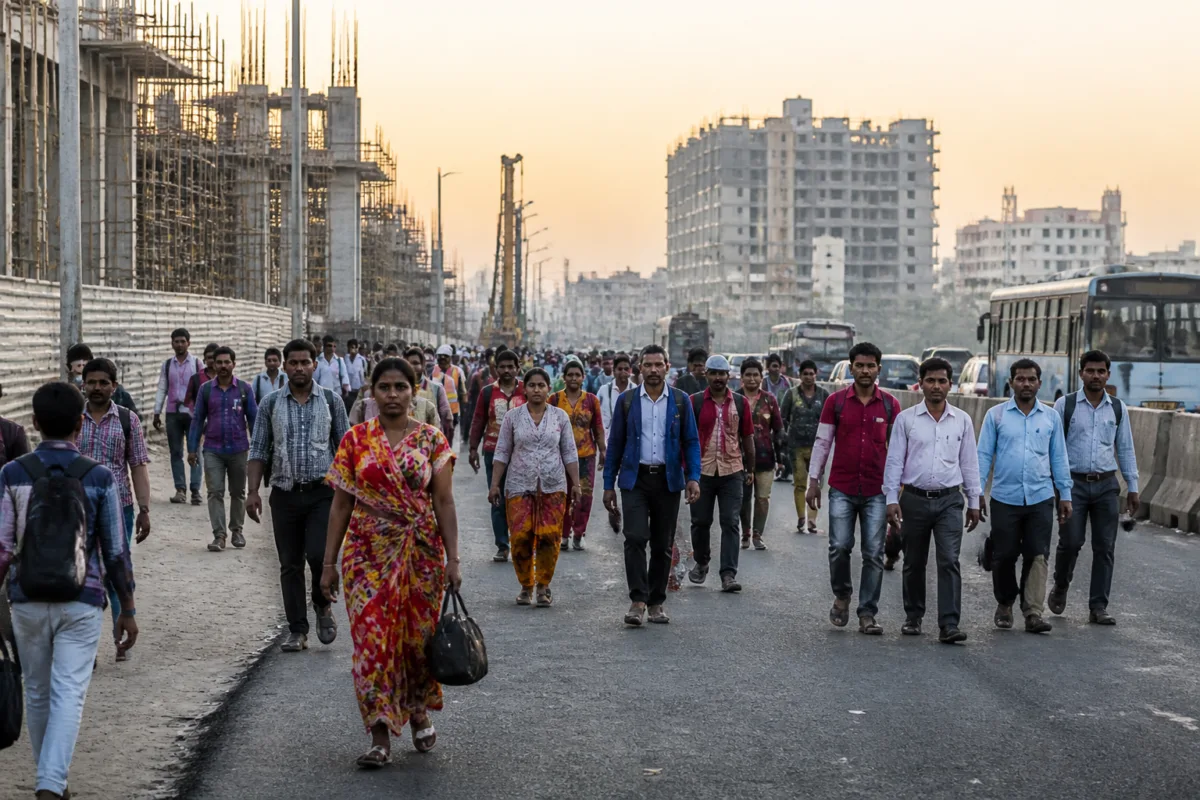
This combination matters for cities because the poverty story is also a labour-mobility story. Government capital expenditure has connected farms to markets, improved farmer realisations and enabled labour movement to urban areas for casual work, according to the experts cited. It has also directly generated construction employment. The service sector and services exports have added organised jobs and supported further employment in the unorganised economy. In this account, infrastructure is not only a physical asset; it is also a channel through which workers, goods and household incomes move.
But the relationship between migration and urban opportunity is not automatically secure. The report says that households in rural and urban areas both experienced substantial welfare gains, with faster progress in rural India narrowing the rural-urban gap. At the same time, most of those who remain poor continue to live in rural areas, where productivity is lower and access to better non-farm employment is more limited. The evidence therefore points to convergence in measured welfare without establishing that cities have become equally accessible or affordable destinations for workers seeking upward mobility.
The geographical concentration of poverty is particularly important for the next phase. The World Bank says that a contiguous belt stretching from Uttar Pradesh to West Bengal accounts for about 57% of India’s poor population. Further national reductions will increasingly depend on creating productive employment in these states. That has direct implications for the planning of transport links, industrial locations, construction markets, logistics networks and urban services, even though the supplied report does not provide a state-by-state account of infrastructure capacity or migration flows.
The numbers on employment show both progress and constraint. Between 2017 and 2023, the number of employed people rose by approximately 134 million, nearly twice the increase in the working-age population. A substantial part of this expansion came from rural women entering paid employment, increasing the number of income earners in households. The report also says labour-force participation and employment rates remained broadly stable between the first quarters of FY2026 and FY2027, while youth unemployment rose from 14.6% to 15.9%, particularly among rural young women.
The composition of employment is as important as its volume. The World Bank report notes that real earnings remained broadly unchanged and that employment growth was concentrated in relatively low-productivity activities. This is the central limitation in treating poverty reduction as a completed process. More people may be earning, and more households may be receiving support, but if earnings do not rise in real terms or jobs do not become more productive, households can remain vulnerable to inflation, illness, unemployment or the withdrawal of assistance.
The urban economy reflects this tension. Construction, logistics, ecommerce and casual labour can create accessible entry points for workers without advanced formal qualifications. They can also be unstable, low-paid or dependent on continued public and private investment. The supplied evidence does not quantify wages or working conditions in these sectors, but it does indicate that employment growth has been concentrated in lower-productivity activities. For cities, this creates a familiar planning challenge: economic expansion can attract labour faster than formal housing, transport, healthcare and social protection systems can absorb it.
Household consumption offers another way to understand the change. Food, beverages and tobacco accounted for nearly 60% of private final consumption expenditure in the early 1960s. By the 2020s, their share had fallen to less than half, while non-food spending on transport, education, health and other goods and services increased. The shift is consistent with rising incomes and improved living standards, although the expert cited in the report cautions that consumption composition alone cannot capture every dimension of welfare.
For municipal and urban institutions, this change in spending has practical significance. Greater expenditure on transport, education and health can indicate that households are participating more fully in the urban economy, but it can also expose the cost of access. A family may cross a monetary poverty threshold while continuing to face expensive commuting, insecure rental housing, private healthcare bills or interrupted employment. The available evidence does not measure these costs, so it cannot establish how much of the income gain is being absorbed by urban living expenses. It does, however, show why income poverty and urban quality of life should not be treated as identical indicators.
The policy architecture behind the decline is broad. Food subsidies and transfers protect consumption directly. Direct benefit transfers move assistance into bank accounts. Rural employment support provides an income source, while public capital expenditure can improve market access and generate work. State governments have added their own income-transfer and subsidy programmes. Together, these interventions have helped households increase spending power and manage basic consumption, particularly when the private economy has not created enough jobs for all workers.
The weakness is that a welfare-supported improvement may be difficult to sustain if productive employment does not expand at the same pace. One expert cited in the report warns that withdrawing a food subsidy of about Rs 2 lakh crore could push households down the income ladder. The concern is not that welfare has failed; it is that the durability of poverty reduction depends partly on whether transfers are complemented by higher earnings, stronger human capital and more resilient employment.
The report consequently places public health, education and skilling at the centre of the next transition. Health insurance can reduce the risk that medical expenses push households back into poverty. Greater women’s participation in productive employment can expand household incomes and the effective labour force. Technological change, including artificial intelligence, creates a further requirement for research, technology adoption, skilling and reskilling. These priorities connect the poverty question to the capacity of cities and regions to provide education, healthcare, transport and employment ecosystems rather than isolated welfare benefits.
India’s income ambitions add another layer. The World Bank’s lower threshold for upper-middle-income status is given as $4,636 per capita at market exchange rates for 2026-27, while India’s estimated per capita GDP is around $2,759 at market exchange rates and $12,998 in 2021 purchasing power parity terms. An EY expert cited in the report says that sustaining real GDP growth of around 6-7%, increasing women’s participation in productive employment and managing technological disruption would be important to crossing that threshold by the mid-2030s.
The evidence confirms a major reduction in extreme poverty and a broad improvement in several welfare indicators. It also shows that the remaining challenge is changing in character. The question is no longer only how to bring households above an extremely low poverty threshold. It is how to support stable earnings, productive employment and access to essential services for households that remain vulnerable, especially in the belt from Uttar Pradesh to West Bengal and among rural young women. India’s next poverty phase will therefore be judged not only by how many people cross a line, but by whether economic growth, public investment and urban opportunity make that movement durable.

