


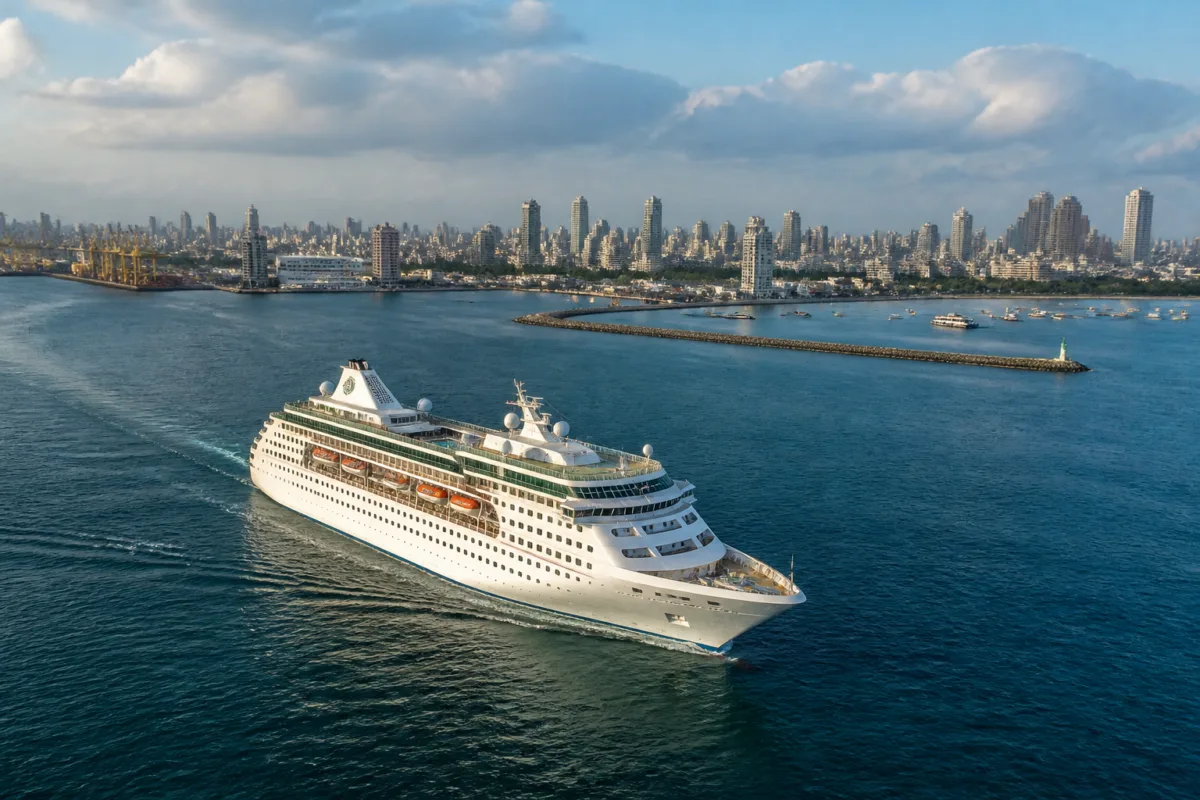
Cordelia Cruises’ ambition to place India among the world’s five largest cruise markets by 2032 is not only a tourism target. It is also a test of whether India can build the ports, destinations, passenger services and regulatory systems required to turn a long coastline into a functioning domestic cruise network.
The company currently operates Cordelia Empress and Cordelia Sky, while a third vessel, Cordelia Sun, is likely to join the fleet earlier than scheduled, according to President and CEO Jurgen Bailom. Cordelia Sky has begun commercial operations from Mumbai, and the operator says its network now includes weekend sailings, Goa and Lakshadweep cruises, and international itineraries to the Maldives and Sri Lanka from Mumbai and Kochi.
That expansion gives the announcement a significance beyond one company’s fleet plans. Cruise tourism depends on a chain of urban and coastal systems: port access, passenger terminals, immigration facilities, road and rail connectivity, destination management, fuel logistics, waste handling and the ability of smaller coastal locations to receive visitors without damaging the environments and communities that attract them.
The opportunity is large, but the available evidence also shows how far India remains from the stated goal. The latest global cruise passenger data cited in the report, released by the Cruise Lines International Association in April 2026, places the United States, Germany, the United Kingdom and Ireland, Australia, and Canada among the top five cruise source markets. India does not appear among the top 10 in the published rankings.
The comparison is important because India’s proposed rise would require more than adding ships. The CLIA figures show the scale of established source markets. The United States recorded 20.6 million cruise passengers, followed by Germany with 2.8 million, the United Kingdom and Ireland with 2.5 million, Australia with 1.45 million and Canada with 1.27 million. The figures indicate that India is competing not simply for destination status, but for the travel habits, disposable income and repeat demand that sustain a large source market.
Cordelia’s own passenger numbers offer one measure of emerging demand. Bailom said around 200,000 Indians took international cruises annually before the company entered the domestic market, while Cordelia Cruises has already carried one million passengers. These figures are company statements and are not independently broken down in the supplied material by itinerary, passenger origin or repeat travel. Even so, they point to a market that has begun to move from an outbound niche towards a domestic leisure product.
The company’s estimate of potential demand is much larger. Bailom said approximately 13-14 per cent of Indians could afford to cruise in India, representing about 200 million people. The statement describes a potential addressable market, not the number of people currently willing or able to take a cruise. It also does not establish how many could travel regularly, what fares they could sustain, or whether ports and ships have the capacity to serve them.
That distinction matters for planning. A large potential customer base does not automatically create a large cruise market. The product has to be accessible from major cities, priced competitively against other forms of leisure travel, supported by reliable transport links and matched to destinations capable of handling visitors. Cruise demand also depends on confidence in schedules, boarding procedures, safety, weather conditions and the quality of shore experiences.
Mumbai is central to that calculation. Cordelia Sky has started commercial operations from the city, and a press conference was held aboard the vessel off the Mumbai coast. Mumbai offers a major metropolitan catchment area, an established port ecosystem and links to domestic and international transport networks. But a cruise market cannot be assessed only by the presence of a ship. The passenger journey begins before embarkation, requiring dependable access to the terminal and clear coordination among port authorities, operators, immigration agencies, security services and local transport providers.
Kochi is another important node in the company’s stated network. Together, Mumbai and Kochi provide access to western and southern passenger markets and support itineraries towards Goa, Lakshadweep, the Maldives and Sri Lanka. The operator also said it is developing private destinations and now visits three locations in Lakshadweep, compared with one earlier. That expansion raises a central infrastructure question: how can destination capacity grow without turning fragile coastal areas into high-volume excursion points without adequate water, waste, transport and environmental systems?
The report does not provide passenger-handling capacities, terminal investment figures, port-wise traffic data or environmental assessments for the destinations mentioned. Those gaps make it impossible to measure how close India is to the proposed 2032 ranking. They also show why cruise-market growth cannot be tracked through fleet size alone. A larger fleet may increase deployed capacity, but the wider system must absorb passengers at ports and destinations at the same time.
The policy and institutional framework is similarly distributed. A cruise itinerary involves a shipping and port interface, tourism promotion, coastal destination management, immigration and security procedures, and local civic services. The supplied report does not identify a single coordinating authority or disclose a national capacity-building plan linked to the 2032 objective. That does not mean such coordination is absent; it means the report does not establish how it is organised or funded.
For cities, the operational effects can be both concentrated and temporary. Cruise passengers arrive in large groups, often within narrow time windows, placing pressure on access roads, buses, taxis, waterfront public spaces, attractions, food services and emergency response. The economic benefit depends on how much passenger spending reaches local businesses and workers rather than remaining within the ship-based package. The report highlights corporate travel, meetings, incentives, conferences and exhibitions, as well as weddings, as growing parts of Cordelia’s business, suggesting that cruise vessels are being positioned as floating venues as well as transport and leisure products.
The company is also seeking international tourists through longer itineraries. That strategy could broaden the role of Indian ports from embarkation points for domestic passengers to gateways for regional travel. However, the supplied material does not provide international passenger targets, average itinerary durations, port-call volumes or projected foreign-exchange earnings. These are among the indicators needed to distinguish a commercially successful cruise network from a fleet expansion that remains dependent on a limited domestic customer base.
Operating costs present another constraint. Bailom said fuel prices had risen by 100 per cent amid geopolitical tensions in West Asia and the Russia-Ukraine conflict, and that the company would have made Rs 40 crore more profit if fuel prices had remained at the previous year’s level. He said the company remained profitable and that cruise operators had more flexibility than airlines to respond to higher fuel costs by changing itineraries, reducing speeds and improving operational efficiency.
That flexibility is useful, but it also connects profitability to the geography of the network. Altering routes or speeds can affect port calls, passenger expectations, destination economies and the commercial viability of particular sailings. The report does not disclose fuel consumption, fare levels, load factors or route-wise profitability, so the financial resilience of the expansion cannot be assessed in detail.
The company’s status as a listed entity also places limits on what it has disclosed. Bailom said Cordelia had further options for several more ships but could not make forward-looking statements because of Securities and Exchange Board of India regulations. This leaves the timing and scale of fleet expansion uncertain. The arrival of Cordelia Sun is described as likely to occur earlier than scheduled, but the supplied material does not state a firm date or explain the vessel’s planned routes and capacity.
India’s coastline of around 12,000 kilometres is frequently presented as a major advantage for cruise tourism. Geography, however, is only the starting asset. The market’s development will depend on whether coastal infrastructure, port administration and local destinations can convert that coastline into reliable, affordable and environmentally manageable itineraries. It will also depend on whether domestic passengers view cruising as a repeatable form of travel rather than a one-time premium experience.
The 2032 ambition therefore contains two separate tests. The first is commercial: whether operators can add ships, fill cabins, manage fuel costs and develop routes that attract Indian and international passengers. The second is institutional: whether ports, cities and coastal destinations can provide the physical and administrative capacity required by larger passenger volumes.
The evidence currently confirms growing company-level capacity, a widening itinerary network, rising interest in domestic cruising and a significant gap between India and the leading global source markets. It does not yet establish how India will rank by 2032, how many ships the market can support, or what public infrastructure investment will be required. The next milestones to watch are the induction of Cordelia Sun, further fleet disclosures, passenger volumes across Mumbai and Kochi, the development of Lakshadweep and other destinations, and the infrastructure arrangements that will determine whether cruise growth becomes a broader urban and coastal economy rather than a narrow fleet story.

