


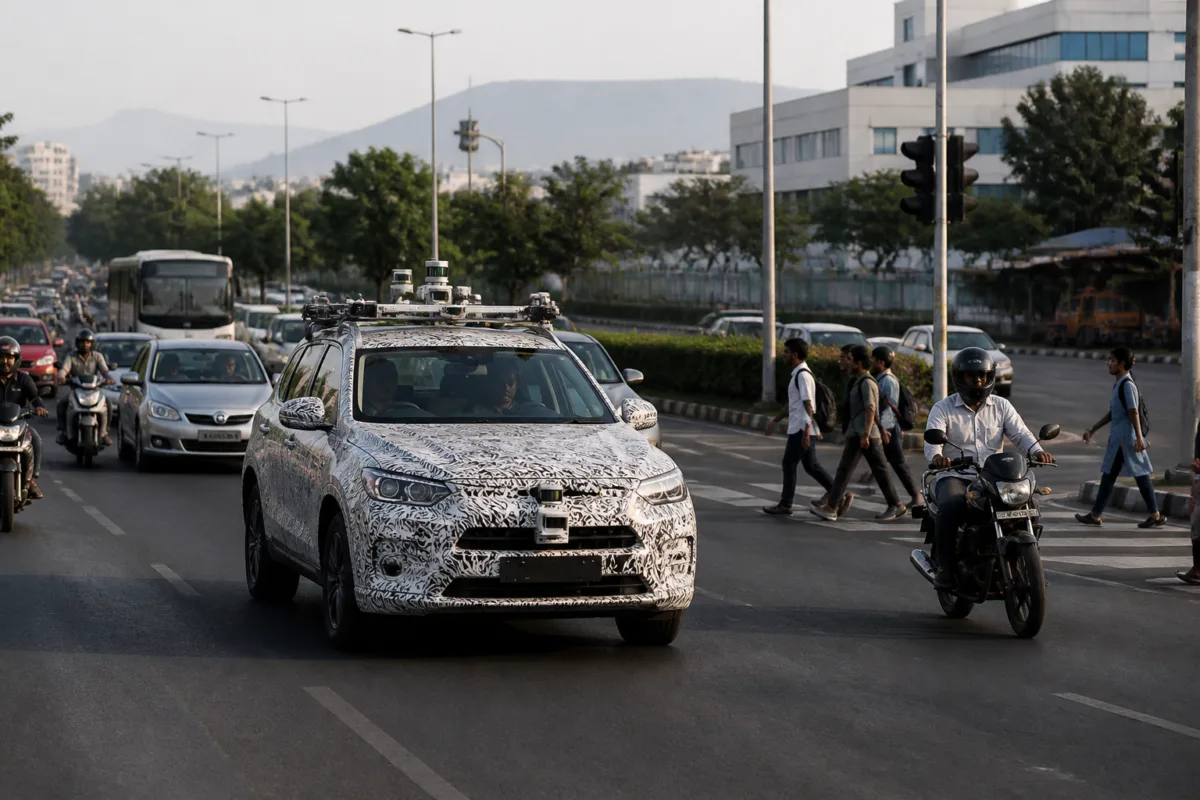
India’s push towards advanced driver assistance systems is running into a problem that is less visible than sensors, cameras or artificial intelligence: the need for driving data that accurately reflects Indian roads. Senior executives of Thyssenkrupp Automotive Technology have said ADAS applications must be trained for country-specific driving behaviour, while India’s unusually complex traffic conditions will require larger volumes of real-world data before such systems can become competitive.
That assessment places the technology within a wider urban systems challenge. ADAS is often presented as a vehicle-level innovation, but its performance depends on the interaction between motorists, road design, traffic rules, surrounding infrastructure and the decisions made in unpredictable situations. A system trained largely on European traffic conditions may recognise lanes, vehicles and obstacles, yet still struggle to reproduce the choices required on Indian roads if the underlying driving patterns are different.
For cities, this distinction matters because automated assistance is not being introduced into a controlled environment. It is being introduced into roads where human-driven vehicles, pedestrians and other road users will continue to coexist with increasingly automated vehicles. The quality of the transition will depend not only on whether a vehicle can detect an object, but also on whether its algorithm can interpret what other road users are likely to do.
The executives’ comments also show why the central question is not simply whether India can import ADAS hardware. It is whether the country can build the local datasets and testing conditions required to make those systems reliable here.
Country-specific behaviour is the missing layer
Viktor Molnar, chief operating officer of Thyssenkrupp Automotive Technology, said developers already train ADAS applications around country-specific driving patterns in Europe, the United States and Asia. He said differences could be seen even between European countries, despite similarities in traffic regulations.
The implication is that legal rules alone cannot define how an automated system should respond. Drivers may interpret gaps, braking situations, lane changes and right-of-way decisions differently across markets. Molnar said an automaker must capture real-world driving situations to understand how motorists respond and then train automated systems to reproduce those decisions.
Bjorn Erbe, senior vice-president of research and development at Thyssenkrupp’s Bilstein Motion Solutions business unit, said the amount of data needed to train competitive algorithms would be larger in India’s case. His explanation points to the difference between a system that is technically capable and one that is properly adapted to the environment in which it operates.
The challenge is especially significant in dense urban traffic, where formal road rules interact constantly with informal behaviour. The report does not provide a national dataset or a measured comparison of Indian and European traffic. It does, however, identify the underlying requirement: systems need evidence from the roads on which they will be used, rather than relying primarily on data generated elsewhere.
From vehicle technology to urban data infrastructure
This makes ADAS partly a data-infrastructure issue. The relevant data is not limited to vehicle speed or road geometry. It also includes how motorists react, when they brake, how they negotiate conflicting movements and how automated systems should respond when the surrounding traffic is not following a predictable pattern.
Molnar said real-time data collection in India could help developers accelerate the introduction of ADAS applications suited to the country. He also said information from actual driving conditions would be valuable for increasing the speed of implementation. The argument treats roads as live testing environments, although the report does not specify the operating rules, privacy safeguards or institutional arrangements that would govern such collection.
The reference to the Automotive Research Association of India’s test track is therefore important. The report says ARAI recently developed the facility to create ADAS data suited to Indian road conditions, because much of the data used to develop ADAS had been based on European traffic. The test track represents an effort to close the gap between imported development assumptions and local operating realities.
At the same time, a test track cannot capture every condition found in Indian cities. The supplied report does not claim that it can, nor does it quantify the volume or type of data being generated. Its significance is that it creates a recognised setting for testing Indian conditions while the industry considers how to supplement controlled testing with real-world information.
The institutional question is who builds and maintains this evidence base. Thyssenkrupp’s executives pointed to government research institutions as well as startups. That broadens the issue beyond individual carmakers. If local data becomes a critical input for safe and competitive ADAS, access to representative road information could influence which companies are able to develop, validate and commercialise systems in India.
Why Indian traffic creates both difficulty and opportunity
India’s traffic complexity is described in the report as a problem because it increases the number and variety of situations that algorithms must learn. The same complexity is also presented as a commercial opportunity. Erbe said Indian startups could develop specialised solutions around local traffic conditions, rather than leaving the task only to institutional research bodies.
This is a notable shift in how automotive innovation can be understood. A local solution would not necessarily compete by replicating a global system at lower cost. It could instead focus on specific patterns of Indian road use and build expertise around the decisions that automated systems need to make in those conditions.
The report does not identify particular startups, products or commercial agreements, so the opportunity remains a sector-level possibility rather than an established market outcome. What is clear from the executives’ comments is that the demand for country-specific training creates a new role for companies able to collect, structure and interpret local driving data.
The same data could also be relevant to infrastructure. Erbe said AI-based systems could combine data from a car with information from infrastructure and environmental sources. That points towards an ADAS ecosystem in which the vehicle is not the only source of intelligence. However, the report does not specify which infrastructure systems are currently connected, what standards would apply or how such integration would be implemented across cities.
AI does not remove the need for local evidence
The executives also contrasted conventional rule-based algorithms with AI-based systems. Erbe said rule-based systems are static, while AI applications offer greater flexibility and can combine different data sources. He argued that this flexibility becomes more relevant as traffic conditions become more complex.
That claim should not be read as suggesting that AI eliminates the need for rules or testing. In the context described by the report, AI changes how data can be used, but it still depends on the quality and relevance of the datasets supplied to it. A more flexible system trained on unsuitable or incomplete local information could still make inappropriate decisions.
The distinction is important for public understanding. The presence of AI in a vehicle does not automatically make the system capable of interpreting every road environment. The reported comments instead suggest a sequence: local conditions must be captured, data must be used to train the system, and the resulting applications must be tested for the regions where they will operate.
This also makes transparency around testing significant, although the report provides no details on performance benchmarks, failure rates or approval procedures. Without such information, it is not possible from the supplied material to assess how close India is to widespread deployment of country-specific ADAS.
The transition will involve people, not only algorithms
A further challenge identified by Molnar is the coexistence of human-driven and automated vehicles. Automated vehicles will need to understand human driving behaviour, while human motorists will need to accept automated vehicles. That is a social and operational transition embedded within a technical one.
In practical terms, the system must respond to the road as it exists, not only to the road as regulations intend it to function. The supplied report does not examine public attitudes, liability or enforcement, but the executives’ comments establish that mixed traffic will be part of the transition towards higher levels of vehicle automation.
This reinforces the importance of testing beyond vehicle components. A sensor, braking system or algorithm may perform as designed in isolation, but its urban value depends on how the complete system behaves around people who do not share the same level of automation. The issue is therefore connected to road safety, traffic operations and the design of future mobility systems.
Pune’s role in the emerging ecosystem
The report also offers a local institutional detail: Thyssenkrupp currently has around 120 engineers at its Pune engineering competency centre and plans to increase the workforce to more than 300 in less than a year. The expansion places Pune within the company’s development capacity for automotive technology, even though the report does not state that all of these engineers will work specifically on India-focused ADAS.
That workforce growth, alongside ARAI’s Indian-condition testing effort and the stated opening for startups, suggests that the ADAS question is also connected to the geography of engineering and research. Pune’s role is not presented as proof that a local ecosystem has already matured. It is evidence of continuing investment in technical capability while the industry works through the data problem.
The evidence supplied confirms three points. First, Thyssenkrupp executives consider country-specific driving data essential to ADAS development. Second, Indian traffic conditions are seen as demanding larger and more locally relevant datasets. Third, the need for such data could create opportunities for research institutions and startups, while Pune is receiving additional engineering capacity.
What remains unresolved is equally important: the scale of data required, the standards for validating systems, the arrangements for real-world collection, and the way automated and human-driven vehicles will share Indian roads. Until those questions are answered through documented testing and implementation, India’s ADAS opportunity will depend less on importing the latest technology than on proving that it understands the streets where that technology must work.

