


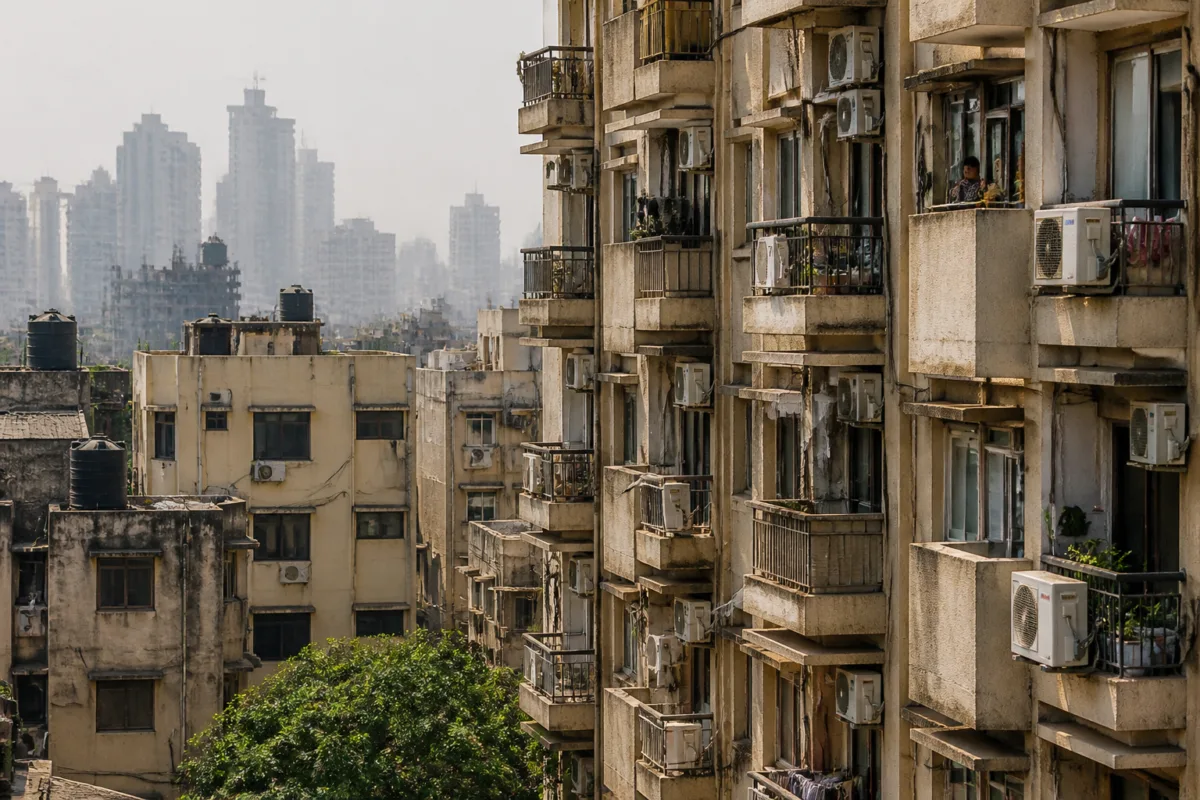
India is expected to add nearly 200 million air conditioners to households over the next decade, a shift that could make cooling one of the country’s most consequential urban energy challenges, according to the International Energy Agency’s World Energy Outlook 2026, as reported by the Economic Times.
The projected growth is being driven by rising temperatures, urbanisation and higher living standards. It comes as fewer than one in five households in India and Indonesia owns an air conditioner, despite high cooling requirements. By comparison, around 90% of households in Australia, Japan and the United States have air conditioning, the report said.
For Indian cities, the implications extend beyond household appliance sales. Wider air-conditioner ownership will increase electricity consumption in buildings and place additional stress on the power system during periods when temperatures are highest. The IEA expects India’s electricity demand to grow at an annual rate of 6% over the next decade under its Stated Policies Scenario, the fastest rate among major regions.
Overall energy demand is projected to rise by 2.5% annually, around three times the global rate. The report also expects India’s electricity generation to increase from approximately 2,114 terawatt-hours in 2025 to 3,585 terawatt-hours by 2035. Non-fossil sources are projected to account for 51% of generation by then, although coal is expected to remain a mainstay.
Cooling demand is becoming a more prominent planning issue as global building energy use changes. The IEA said demand for cooling in buildings was overtaking demand for heating for the first time. Globally, space-cooling demand is projected to rise by 1,700 terawatt-hours by 2035, an amount roughly equivalent to India’s current electricity consumption.
The pressure on electricity networks could be greater if heatwaves become longer or more frequent. Under the IEA’s heatwave scenario, cooling demand growth is 700 terawatt-hours, or 40%, higher than the baseline projection. That increase has particular significance for peak electricity demand because air conditioners are used simultaneously during the hottest periods.
The report’s Current Policies Scenario projects global peak cooling demand to rise by 720 gigawatts by 2035, exceeding India’s entire current power-generation capacity. Although this is a global projection, it illustrates the scale of the capacity challenge facing countries where cooling access is expanding rapidly.
India’s cooling demand will also grow alongside other energy-intensive urban and economic activity. The IEA expects more than 12,000 cars to be added to the country’s roads each day, while built-up space is projected to expand by 33%. Steel and cement production are also expected to increase, adding to the demand placed on the electricity and wider energy system.
The country’s energy investment is projected to rise by 85% in 2035 compared with 2025 levels, making India the fastest-growing major destination for energy spending, according to the report. That investment will need to support not only generation but also the wider system required to deliver electricity reliably as demand becomes more concentrated during extreme heat.
The projections place building cooling at the intersection of household affordability, urban heat and infrastructure planning. Greater access to air conditioning can improve comfort during hot weather, but the resulting electricity demand can raise operating costs for households and increase pressure on peak power supply. The scale of new demand also means that cooling efficiency and the performance of buildings will influence how much additional generation and network capacity cities require.
The IEA’s outlook indicates that India’s cooling transition will take place while emissions remain a major concern. India’s carbon dioxide emissions are projected to peak only around 2040, even as non-fossil sources account for a larger share of electricity generation. The country’s ability to meet rising cooling needs while expanding cleaner power will therefore remain central to the urban energy challenge over the next decade.

