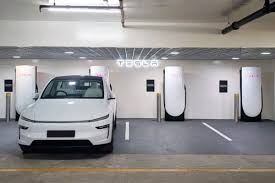
India Tesla Strengthens EV Charging Infrastructure Push
Tesla is accelerating its infrastructure footprint in India with plans to expand its charging and service network across major urban centres, signalling a deeper push into one of the world’s fastest-growing electric mobility markets. The strategy focuses on improving accessibility to charging while strengthening after-sales support—two critical barriers to wider electric vehicle adoption in Indian cities.
The company’s recent additions to its charging ecosystem reflect a shift towards integrating infrastructure into everyday urban life. A newly operational hub in Navi Mumbai, for instance, places fast chargers within a high-footfall commercial setting, indicating a move to align charging access with routine consumer behaviour. At present, Tesla’s charging network in India spans a limited number of locations across cities such as Delhi, Mumbai and Gurugram, but expansion plans aim to cover more urban corridors. Industry observers note that scaling such infrastructure is essential to address “range anxiety”—a key deterrent for potential EV buyers—and to enable seamless intercity travel. The expansion of the Tesla charging network also underscores broader structural gaps in India’s EV ecosystem. Despite rising adoption, the country faces a significant shortfall in public charging infrastructure, with estimates suggesting the need for over a million charging points by the end of the decade.
This mismatch between vehicle growth and infrastructure readiness has implications for both urban mobility and energy planning. Tesla’s approach appears to prioritise high-speed charging technology and strategic placement in dense urban zones, including business districts, transport corridors and lifestyle destinations. Such siting decisions reflect an emerging model where charging infrastructure is embedded within the built environment rather than treated as a standalone utility. For rapidly urbanising regions, this could influence how future commercial developments and public spaces are designed. From a sustainability lens, the expansion of the Tesla charging network aligns with India’s broader push towards reducing transport emissions in cities struggling with air pollution and congestion. However, urban planners caution that infrastructure alone cannot deliver meaningful decarbonisation unless paired with clean energy sourcing, public transport integration, and equitable access to EV ecosystems. The economic dimension is equally significant. As global EV players scale operations in India, local supply chains, real estate usage, and energy distribution systems are likely to evolve. Charging hubs could emerge as new nodes of commercial activity, reshaping land use patterns in urban areas while creating opportunities for ancillary services.
Yet, the current focus on premium EV segments raises questions about inclusivity. Experts suggest that for the Tesla charging network—and the wider EV transition—to have systemic impact, infrastructure expansion must eventually extend beyond affluent urban pockets to serve a broader demographic. As India navigates the shift to cleaner mobility, the pace and distribution of charging infrastructure will play a decisive role. Tesla’s expansion signals momentum, but also highlights the need for coordinated urban policy to ensure that electrification contributes to more sustainable, accessible, and resilient cities.