


India has announced development assistance worth Rs 15,000 crore to Nepal, including Rs 3,500 crore in grants for post-disaster reconstruction and new infrastructure projects and a Rs 11,500 crore Line of Credit for energy-sector projects.
The announcement came during Nepal Prime Minister Balendra Shah’s two-day state visit to India on November 22–23, 2026, at the invitation of Prime Minister Narendra Modi. The two countries also adopted a Joint Vision for a “Viksit Bharat and Samunnat Nepal”, covering infrastructure, connectivity, energy, water resources, climate resilience and disaster management.
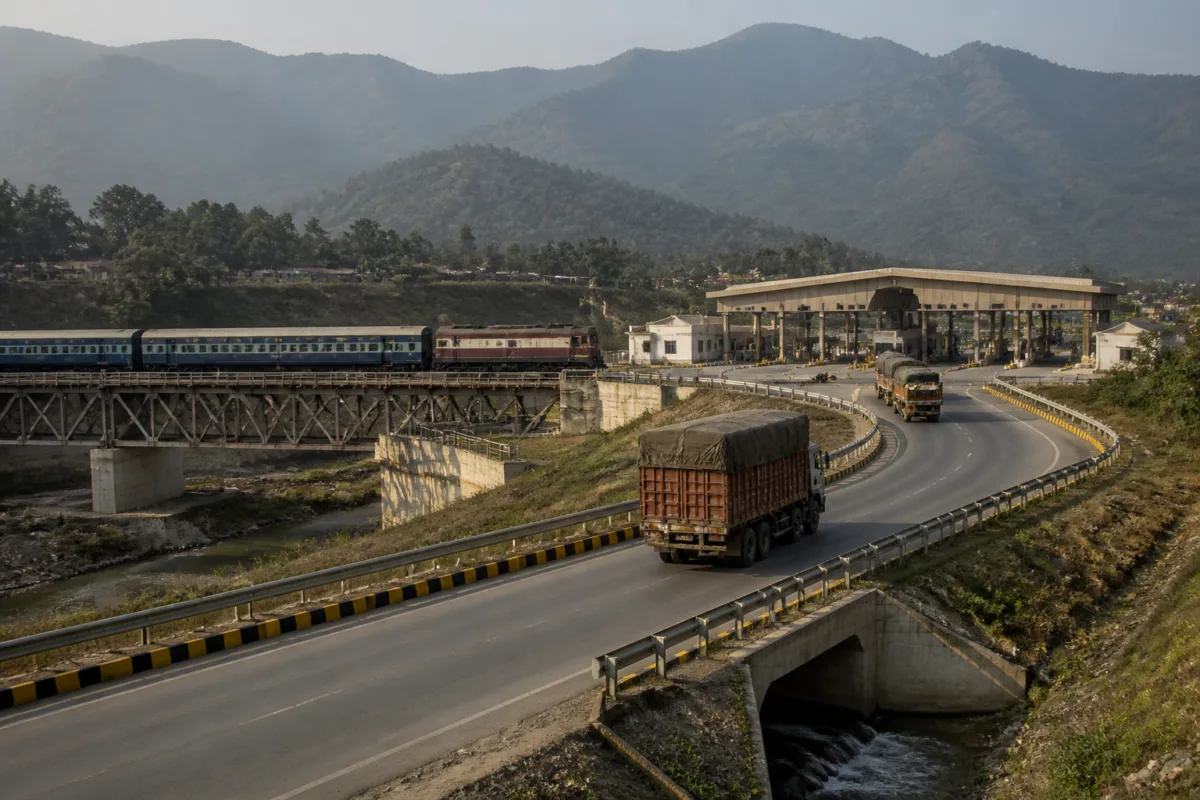
The infrastructure agenda includes new railway lines, bridges, Integrated Check Posts (ICPs) and petroleum pipelines intended to strengthen cross-border movement. The leaders flagged off the inaugural Sarayu-Kamala Express rail service between Ayodhya and Janakpur, linking the two cities and supporting connectivity along the Ramayana Circuit.
India and Nepal also finalised the Field Location Survey for the proposed Raxaul–Kathmandu electrified broad-gauge railway line and agreed to cooperate on Nepal’s East-West Railway. The countries agreed to make the existing B345 Kathmandu-Bhairahawa-Lucknow aviation route bidirectional, subject to technical consultations.
Nepal will receive a new transit connectivity option through Deendayal Port at Kandla in Gujarat. Access to Paradip Port in Odisha is also expected to become available once the necessary infrastructure is in place.
On border infrastructure, the leaders virtually laid the foundation stone for a new ICP at Banbasa and reviewed progress on facilities at Bhairahawa, Sunauli and Dodhara-Chandani. Three ICPs between India and Nepal are already operational, according to the report. A new motorable bridge connecting Dharchula in India with Darchula in Nepal was also inaugurated to improve connectivity in western Nepal.
In the petroleum sector, India and Nepal dedicated Phase II of the Motihari-Amlekhgunj pipeline. They also laid the foundation stone for a petroleum terminal at Jhapa and emphasised the early start of the Siliguri-Jhapa petroleum pipeline. The two sides agreed to explore cooperation on gas pipelines.
Energy cooperation includes the foundation stone for the 669 MW Lower Arun Hydroelectric Project and a call to expedite hydropower projects being developed by Indian companies in Nepal. The leaders also directed the Pancheshwar Development Authority and the Joint Committee on Water Resources to accelerate preparation of the Detailed Project Report for the Pancheshwar Multipurpose Project.
India and Nepal agreed to speed up the DPRs for the Saptakoshi and Sunkoshi multipurpose projects, which are intended to support water-resource use and flood-impact mitigation. The two countries also noted progress towards joint ventures for two high-capacity cross-border transmission lines: one linking Inaruwa in Nepal with New Purnea in India, and another connecting Dododhara in Nepal with Bareilly.
The visit included an agreement to establish an offshore IIT campus in Nepal and cooperation in technology, start-ups and digital and financial connectivity. Eight memoranda of understanding were exchanged across areas including academic and research collaboration, police training, civil-service capacity building, traditional medicine, satellite communications, sustainable urban development, healthcare, and livestock and fisheries development.
Specific projects and the modalities for extending the Rs 15,000 crore assistance will be finalised through further consultations between the two countries. The leaders also agreed to strengthen cooperation in disaster management and climate resilience.

