


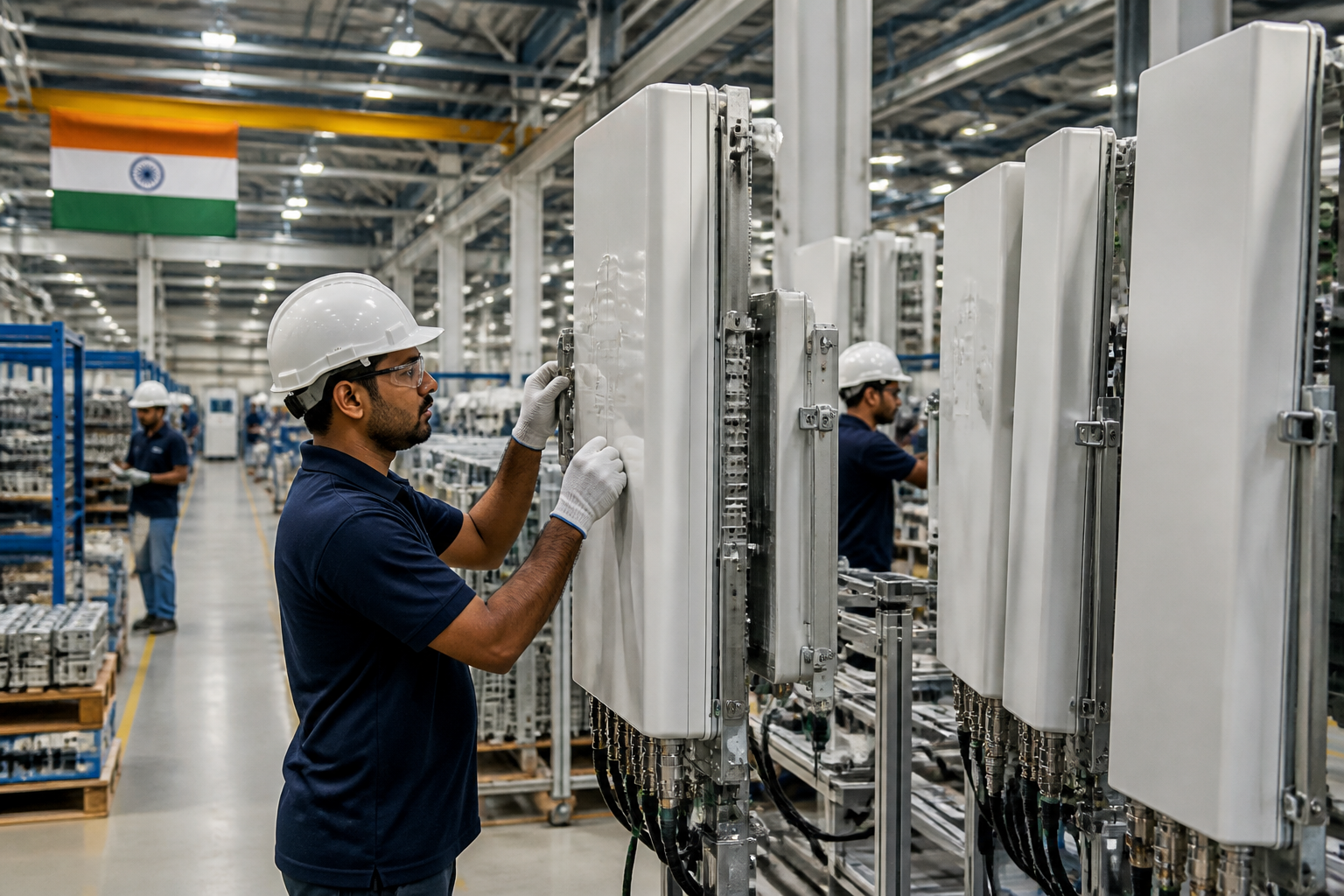
Ericsson will export India-made antennas to Europe, expanding the country’s role in the Swedish telecom equipment maker’s global manufacturing and engineering network, senior executive Andres Vicente said at the India Mobile Congress 2026.
Vicente, Ericsson’s Senior Vice President and Head of Market Area South East Asia, Oceania, and India, said the company currently manufactures 4G and 5G radios used in India, as well as antennas for massive MIMO and other network applications. The company has now announced that the antennas produced in India will also serve European and other international markets.
Ericsson said more than 15,000 antennas and 25 million components have been produced through its growing Indian manufacturing ecosystem since July 2025. The company said antennas made in India are already being exported to Europe and other global markets, strengthening the country’s position within its global engineering, manufacturing and supply footprint.
The expansion covers local sourcing, engineering, production and exports, with Ericsson working with manufacturing and technology partners. Mikael Eriksson, Head of Ericsson Antenna System, said the company was building an end-to-end antenna ecosystem that combines local manufacturing with Ericsson’s global engineering capabilities.
“As networks become more intelligent and programmable, antenna performance will be increasingly important in getting the most from spectrum, sites and network investments,” Eriksson said. He added that expanding these capabilities in India would strengthen Ericsson’s ability to serve local customers and India’s contribution to the company’s global operations.
The announcement comes as India moves deeper into 5G standalone networks and prepares for future network architectures. Vicente said India’s transition to 5G standalone had been completed, making its networks more cloud-driven and programmable. He described these capabilities as important foundations for the country’s move towards 6G.
According to figures cited by Vicente, India’s mid-band 5G coverage reaches 95 per cent of the population, compared with 45 per cent globally. India has 430 million 5G mobile subscriptions, accounting for 35 per cent of total subscriptions, while 43 per cent of mobile data traffic is carried on 5G. Vicente said average usage stood at 35 gigabytes per customer, with demand growing across video and gaming.
He said India’s scale of deployment and usage provided a competitive advantage as the telecom sector moved towards 6G. The next phase, he said, would require networks to support artificial intelligence through greater computing capacity, lower latency and improved uplink performance. These capabilities would be relevant to applications such as autonomous vehicles and drones.
Vicente also described artificial intelligence as a two-way change for telecom networks: AI would be used to operate networks, while networks would need to support AI applications. He said bringing computing and inference closer to the network would be an opportunity for operators and governments seeking greater control over digital intelligence.
Ericsson’s local manufacturing expansion builds on its long-term presence in India. Vicente said the company began its India journey in 1903 and established manufacturing operations in the country in 1994. The latest announcement extends that base from serving domestic network demand to supplying equipment for international markets.
