


Moody’s decision to raise India’s FY27 real GDP growth forecast from 6% to 7% is more than a change in an economic projection. It is a test of whether India’s growth model has become better equipped to absorb external shocks, particularly when energy prices, trade routes and geopolitical relationships are all under strain. The evidence cited in the latest assessment points to an economy supported by domestic consumption, investment, manufacturing and services rather than one relying on a single source of momentum.
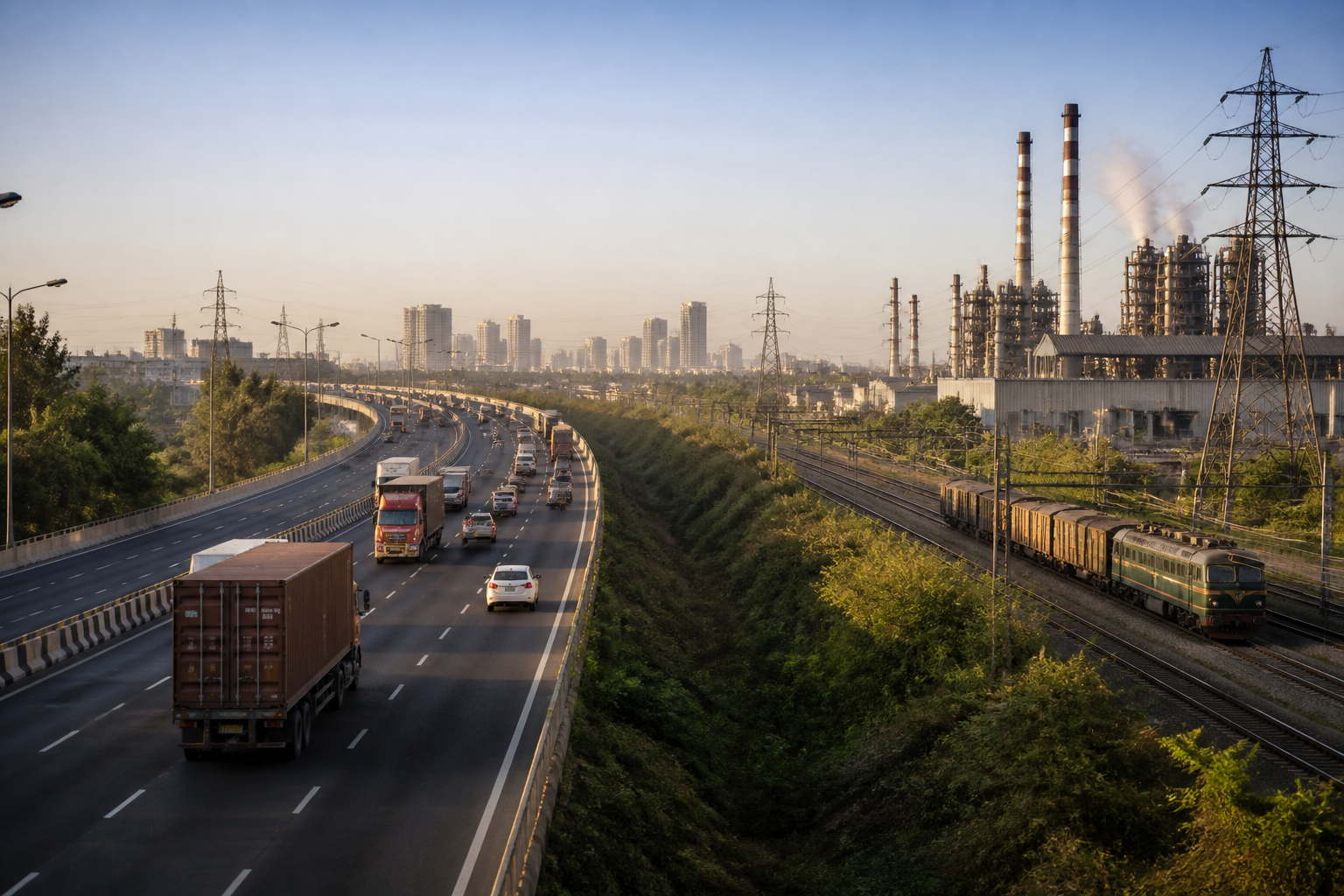
That distinction matters for cities. India’s capacity to withstand a global shock is increasingly connected to the performance of its roads, railways, ports, power networks, digital infrastructure and industrial clusters. These systems determine how much it costs to move goods, how quickly manufacturers can expand, how reliably businesses receive energy and whether domestic demand can compensate when external markets weaken. The current episode therefore offers a view of infrastructure not merely as a construction activity, but as part of the economy’s shock-absorption capacity.
Moody’s raised its forecast while acknowledging that the risks have intensified. Brent crude has remained above $100 a barrel and moved towards $110 before easing to around $102, according to the report. Attacks on energy infrastructure and disruption around key shipping routes have added pressure to an economy that imports much of its oil. The United States has also opened another front by considering tariffs of up to 100% on countries that continue buying Russian energy.
For India, expensive oil affects more than the fuel bill. It can increase the import bill, put pressure on the rupee and raise transportation and production costs. Higher logistics costs eventually reach households and businesses through prices. If the shock persists, the chain can extend from fuel and freight to inflation, household consumption and interest rates. Moody’s has warned that a prolonged Middle East conflict could push inflation above its 4.8% forecast for FY27. It has also identified possible higher subsidy spending, weaker remittances from the Middle East and softer external demand as risks.
Yet the first-quarter numbers changed the immediate assessment of how the shock was travelling through the economy. India’s GDP expanded 7.8% in the April-June quarter of FY27, above the Reserve Bank of India’s 7% forecast and the 7.1% median estimate in a Reuters poll, according to the supplied report. Growth was broad-based: private consumption rose 7.1%, gross fixed capital formation increased 11.9% and manufacturing expanded 9.2%. Financial, real estate and professional services grew by about 12%.
The composition of investment is particularly important. Gross fixed capital formation rose to 34.3% of GDP from 31.4% a year earlier. Private-sector capital investment increased by more than Rs 5 trillion from the previous year, while corporate capital expenditure rose 11%. Higher factory utilisation, stronger bank credit and healthier corporate balance sheets are helping private investment become a larger contributor to growth.
This represents a significant change from a recovery driven almost entirely by public spending. Government capital expenditure remains important, but the report indicates that companies are increasingly committing money to data centres, manufacturing, power and other forms of capacity. A broader investment cycle gives the economy more than one engine. It also creates demand for construction, industrial land, utilities, transport links and urban services.
Public infrastructure spending continues to provide the base for that expansion. India’s April-July fiscal deficit stood at Rs 4.55 lakh crore, or 26.8% of the FY27 target, while capital expenditure during the period increased to Rs 4.5 lakh crore from Rs 3.5 lakh crore a year earlier. Roads, railways, ports and power networks do not only add to GDP when they are built. Once operational, they can reduce logistics costs, expand market access and allow firms to increase capacity.
The urban implications are direct. Manufacturing growth depends on industrial areas being connected to ports, freight routes and reliable power. Services growth depends on commercial districts, digital networks and transport systems that allow workers and businesses to operate at scale. Real estate and professional services are also affected by the investment cycle because new factories, offices, warehouses and data centres generate demand for land, construction and supporting infrastructure.
The report does not establish that infrastructure spending alone caused the stronger growth. It does, however, show why infrastructure is central to the resilience argument. When roads, railways, ports, power networks and digital systems improve together, the economy can adjust more easily to changes in supply chains and demand. The capacity to redirect goods, secure alternative suppliers and maintain production is partly an infrastructure question.
There is a fiscal trade-off. Moody’s has cautioned that infrastructure and defence spending, combined with possible energy subsidies, could slow fiscal consolidation. Sustaining capital expenditure while also absorbing a more expensive energy import bill places pressure on public finances. The question is not simply whether the government can spend more, but whether investment produces durable economic capacity that reduces future vulnerability.
Energy procurement illustrates the complexity of that vulnerability. Russian crude became an increasingly important source of supply after 2022, allowing Indian refiners to access discounted barrels and reduce dependence on any single supplier. That flexibility has now become a source of friction with the United States. The report says India absorbed a 25% tariff related to Russian oil purchases in 2025 rather than immediately abandoning Russian crude; imports reached about 1.8 million barrels per day in November 2025 before later declining.
The current situation is more difficult because Gulf supplies have also been disrupted. Replacing Russian barrels is not simply a matter of changing suppliers when Brent crude is around $100-$105 a barrel and tanker freight costs are elevated. Indian refiners would be competing for alternative supplies in a tight market. The result is a policy tension between energy security and access to important trading relationships.
Domestic demand provides a buffer, but it is not an unlimited one. Consumption accounts for a large share of India’s economic activity, making the country less immediately dependent on external trade than an export-led economy. That helped household demand continue growing despite geopolitical uncertainty and higher oil prices. However, prolonged inflation can reduce purchasing power, particularly if fuel, transport and food costs rise together.
Food prices add another layer of uncertainty. Moody’s has pointed to El Niño-related food-price pressures as a risk to inflation, consumption and growth. A wider current account deficit could emerge if energy imports become more expensive, while higher global interest rates could increase financing costs. The rupee, hovering near 96 to the dollar in the report, is another pressure point because a weaker currency can make imported energy costlier.
The policy landscape is therefore split between supporting growth and containing the costs of resilience. Public capital expenditure can strengthen infrastructure and crowd in private investment, but it also competes with fiscal consolidation and potential subsidy requirements. The Reserve Bank of India’s foreign-exchange interventions and market expectations of future rate hikes show how energy and geopolitical shocks can move from international events into domestic financial policy.
Moody’s forecast should consequently be read as an assessment of improved shock absorption, not immunity. India has continued to grow while oil prices, trade routes and external relations have become less predictable. The 7.8% first-quarter expansion, 11.9% growth in gross fixed capital formation and 9.2% manufacturing growth suggest that investment and production have not yet been derailed.
What remains uncertain is how long that resilience can last if the oil shock persists or if tariff pressures intensify. The evidence confirms that domestic demand, infrastructure spending and private investment are currently supporting growth. It does not remove the risks to inflation, public finances, the rupee or export performance. For India’s cities, the next indicators to watch are whether infrastructure-led investment continues to attract private capital, whether logistics and energy costs remain manageable, and whether household consumption holds as external pressures move through the economy.

