


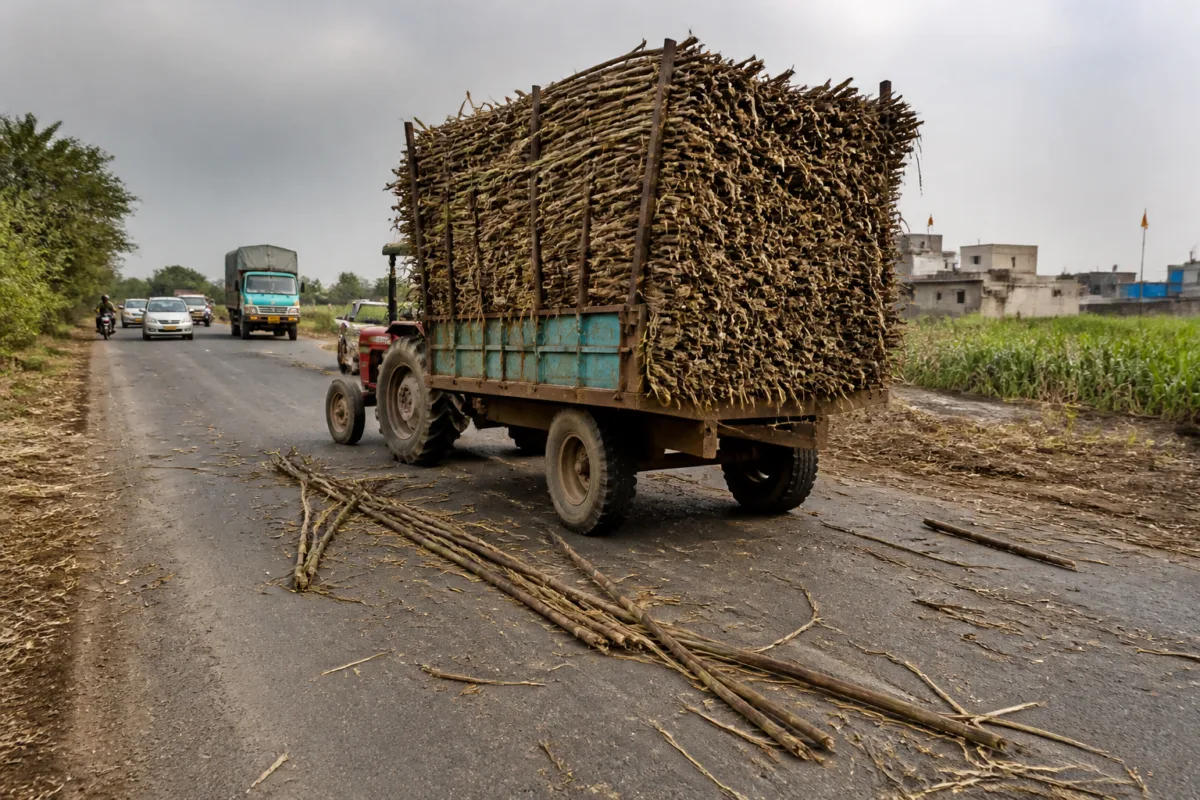
Illegal sugarcane transport during the ongoing crushing season is causing crop losses for farmers and creating serious road-safety risks in Siddhatek, as overloaded trailers shed cane on the road and drivers continue towards factories without clearing it.
The issue has emerged as the sugarcane crushing season gathers pace. Sugar factories are reportedly facing shortages of cane, but farmers are still suffering financially because cane cut by labourers is not being loaded securely into trailers and is then transported without adequate precautions.
According to the report, transporters are filling trailers beyond their stated capacity in an attempt to carry larger quantities in a single trip. The pressure of overloading causes sugarcane to fall from the trailers while they are moving. In some cases, drivers leave the cane on the road and continue towards the factory, shifting the loss to the farmer whose crop has already been harvested.
The problem has two connected effects. First, cane that falls during transport is not delivered to the factory, reducing the quantity received from the farmer. Second, loose sugarcane left on carriageways can obstruct traffic and create hazards for motorists, particularly when vehicles are parked dangerously along the roadside or when trailers lack basic visibility equipment.
The reported unsafe practices include attaching two or more trailers to a single tractor, operating trailers without reflectors or indicators, using underage or unlicensed drivers, playing music at high volume and parking vehicles dangerously at the side of the road. These practices raise concerns about vehicle control, night-time visibility and the ability of drivers to respond safely to other road users.
The report states that violations during the crushing season have been linked to a rise in accidents each year. It describes improper sugarcane transport as a serious road-safety issue and says that stricter discipline is needed across the transport chain, from loading at the field to unloading at the factory.
The Sugar Commissionerate and the Regional Transport Department have issued directions for strict rules and punitive action against illegal and dangerous sugarcane transport, according to the report. Their directions place responsibility on transport operators and create an enforcement role for the agencies overseeing road safety and factory-linked movement of cane.
Vithal Bhosale, general manager of Ambalika Sugar, said the factory would not accept such vehicles for unloading. “We do not unload such vehicles at the factory site. To ensure that the farmer does not suffer losses, we have appointed a separate team for this responsibility,” he said.
The factory’s stated response indicates that controls at the receiving point are being used to address unsafe loading and transport. However, the reported practices also involve road-level enforcement, driver eligibility, trailer equipment and the conduct of transporters before vehicles reach the factory. The next stage of the response will depend on how consistently the directions of the Sugar Commissionerate and Regional Transport Department are implemented during the remainder of the crushing season.

