


The Indian Institute of Technology Kanpur and Rolls-Royce have begun a six-month research project to study how engine vibrations contribute to noise inside aircraft cabins and identify possible ways to make air travel more comfortable.
The project will examine structure-borne noise, which arises when engine vibrations travel through an aircraft’s structure and reach the cabin. The research will combine numerical methods with experimental validation, according to the institutions’ announcement.
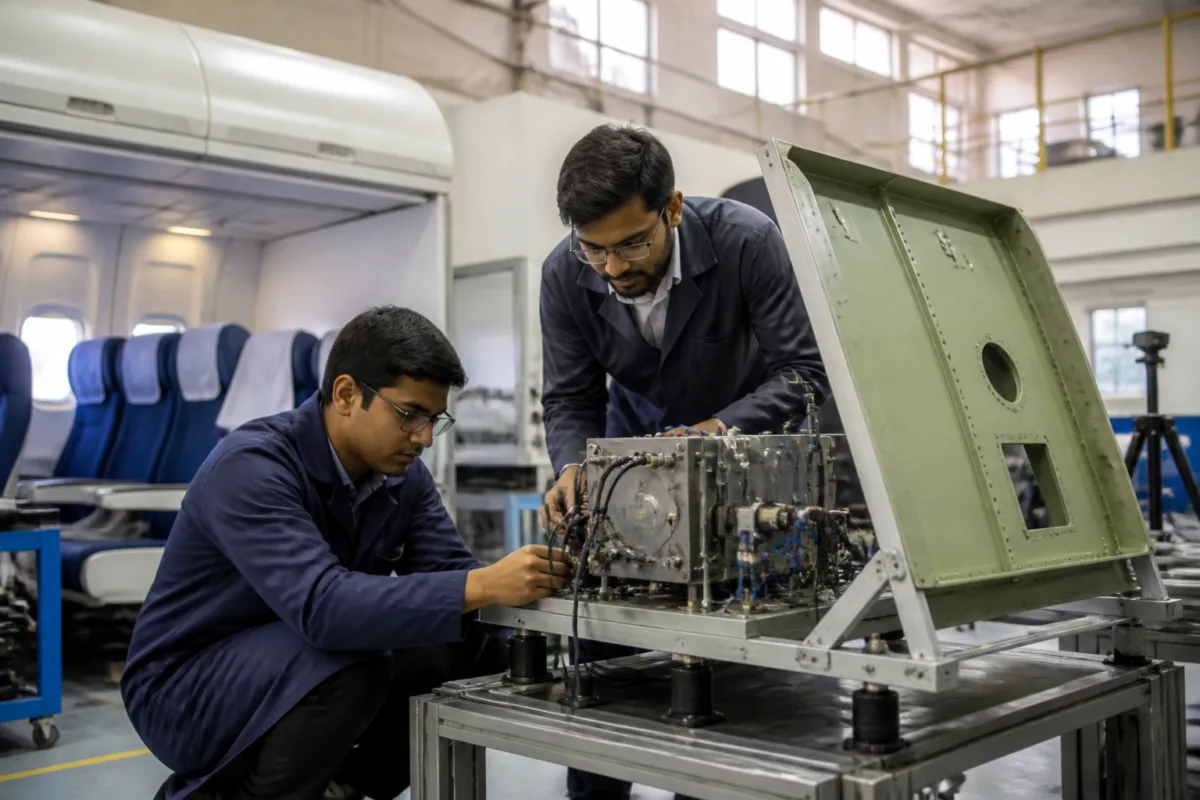
IIT Kanpur will establish an experimental test rig to study vibration transmission through aircraft structures. The work is being conducted as Phase 1, with the possibility of further research phases.
IIT-K director Prof Manindra Agrawal said the project would investigate an important aspect of aircraft cabin comfort while connecting numerical analysis with experimental testing. He said the research could generate insights into vibration transmission and noise-reduction strategies, and strengthen the institute’s deep-tech ecosystem by linking academic capabilities with industry requirements.
The initiative follows a broader industry-academia collaboration between Rolls-Royce India and IIT Kanpur, formalised through a memorandum of understanding earlier in the year. That agreement provides a framework for joint research, internships, knowledge exchange and skill development.
Rolls-Royce said its engines, including the Trent XWB, use advanced technologies and low-noise features. The latest project is intended to improve understanding of how engine vibrations affect cabin noise and to explore further reduction strategies.
Sashi Mukundan, executive vice-president of Rolls-Royce India, said the partnership would strengthen local research capabilities and support collaborative innovation. He also said the company was advancing internships and knowledge-sharing initiatives to give students hands-on experience with engineering challenges.
The project does not yet establish a specific noise-reduction solution or quantify any expected change in cabin sound levels. Its immediate significance lies in creating an experimental and analytical basis for future work on aircraft vibration and passenger comfort.

