


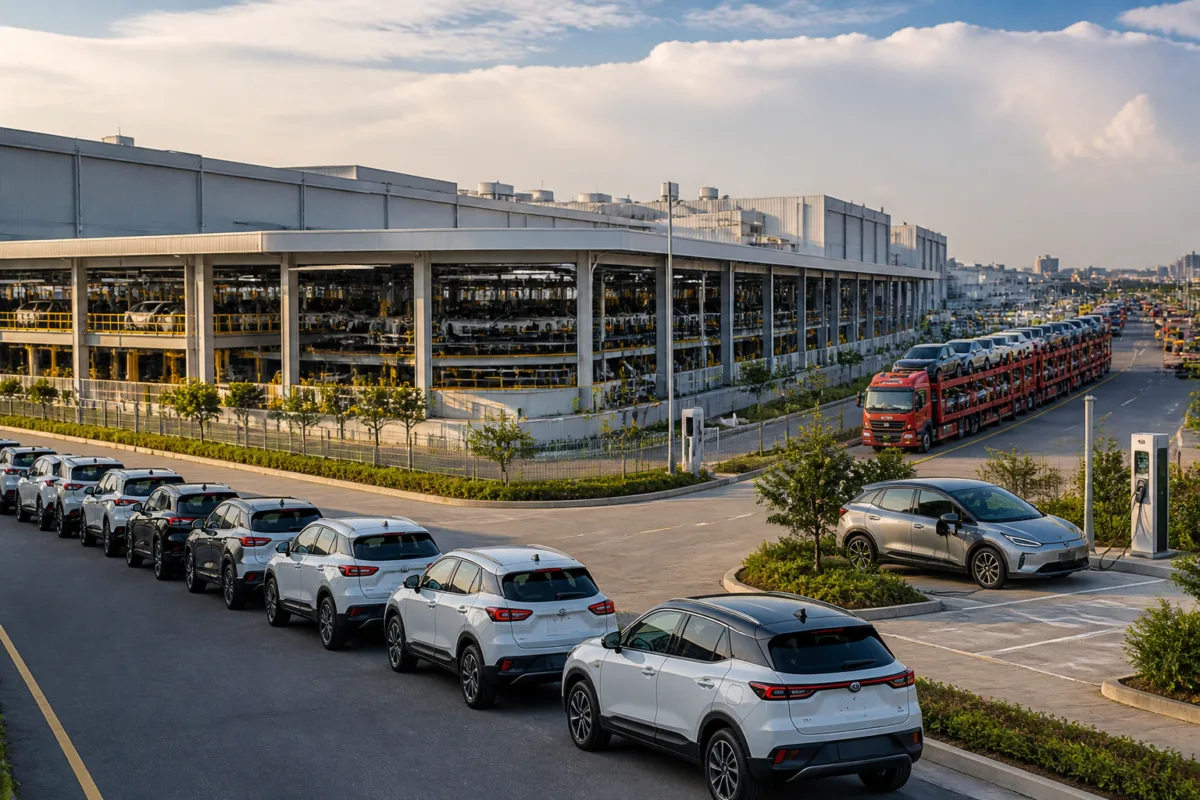
Hyundai Motor India’s plan to raise annual production capacity to 1.14 million vehicles by 2030 and component localisation to 92 per cent by 2032 is more than a manufacturing expansion. It is a response to the changing geography of India’s vehicle demand, the growing importance of SUVs and the industry’s move towards CNG, electric and hybrid powertrains.
The company currently has installed annual capacity of 9.94 lakh vehicles. Its two Chennai plants account for 8.24 lakh units of that capacity and remain central to both domestic sales and exports, Managing Director and Chief Executive Officer Tarun Garg said at the launch of the Bayon. Hyundai has sold nearly 14 million vehicles from India, including 10 million in the domestic market and four million through exports, according to the company.
The planned increase to 1.14 million units by 2030 would add 1.46 lakh vehicles to Hyundai’s current installed capacity. The announcement does not specify the plant, investment amount, construction schedule or production model allocation through which the additional capacity will be created. What it does establish is the scale at which the company expects India to remain central to its manufacturing and market strategy.
That strategy is being shaped by a passenger vehicle market that Hyundai says has expanded from 3.7 lakh units in 1998 to an estimated 52.5 lakh units in 2026. The company began operations in India with sales of 8,500 vehicles in 1998. The figures presented by Garg place Hyundai’s growth within a wider expansion of vehicle ownership and production, although the supplied material does not provide a broader industry breakdown of how this growth is distributed across cities, income groups or vehicle categories.
The most important change in the market, according to Hyundai, is the rise of SUVs. Garg said the mid-size SUV segment grew from 1.1 lakh units in 2015 to 8.7 lakh units in 2026. He described the segment’s compound annual growth rate as 21 per cent, compared with around 6 per cent for the total passenger vehicle market. The comparison explains why the company is adding the Bayon between the sub-four-metre Venue and the mid-size Creta in its product portfolio.
This shift matters for cities because vehicle demand is not only a question of factory output. The popularity of larger personal vehicles affects the space required on urban roads, parking demand, fuel consumption and the design of mobility systems. The supplied information does not quantify those effects, but it shows that manufacturers are aligning capacity and product planning with a market in which SUVs have become a major growth category.
Hyundai’s localisation target adds another layer to the capacity plan. The company currently sources about 83 per cent of its components locally at the Tier-1 supplier level. It says this includes more than 1,200 localised components and an ecosystem of around 200 Indian supplier partners. By 2032, it aims to raise localisation to 92 per cent.
At the operational level, localisation links vehicle production to a wider network of Indian suppliers rather than to the assembly plants alone. The company’s announcement does not identify the components that account for the remaining share of imports, nor does it specify how the localisation target will be achieved. It nevertheless indicates that the next phase of manufacturing growth will be measured not only by the number of vehicles produced but also by the depth of the domestic supplier base supporting that production.
For the built environment, this is relevant because large-scale manufacturing depends on more than factory floors. It requires industrial land, supplier access, freight movement, utilities and connections between production facilities and domestic and export markets. Hyundai’s two Chennai plants are identified as the core of its operations, but the supplied material does not state whether the additional capacity will require new land, expansion within existing facilities or changes to the surrounding logistics network.
The company’s localisation plan also coincides with a broadening powertrain strategy. Hyundai intends to expand its offering across CNG, electric and hybrid vehicles, while continuing to grow in SUV segments. Garg said SUVs had grown 29 per cent year on year, CNG vehicles 40 per cent and electric vehicles 77 per cent. These figures were cited by the company and are not accompanied in the supplied report by the underlying market series or a definition of the periods being compared.
Even with that limitation, the direction is clear. Hyundai is not presenting electrification as a stand-alone replacement for conventional vehicles. Its stated plan combines CNG, electric and hybrid choices, suggesting that the company expects India’s mobility transition to involve several powertrains at the same time. The production system therefore has to support a wider range of technologies while maintaining the volumes required by the dominant passenger vehicle market.
The planned compact electric SUV is central to this positioning. Hyundai said it would launch a mass-market compact electric SUV in the current financial year, with the Bayon and the electric SUV forming two new nameplates planned for the fiscal period. The company described the products as a way to expand its presence in growing segments and offer customers a wider choice of powertrains and mobility solutions.
The announcement does not provide the electric SUV’s price, production location, battery specifications, expected volumes or charging-related plans. Those details will determine how far the product can extend electric mobility beyond premium or early-adopter segments. At this stage, the evidence supports only the conclusion that Hyundai is preparing a mass-market electric SUV as part of its capacity and product strategy.
Software and artificial intelligence are also part of Hyundai’s stated direction. Garg said artificial intelligence and software would increasingly shape the ownership experience, including vehicles that listen, connect and provide more personalised experiences. The statement points to an expansion of the vehicle’s role from a manufactured object to a connected product, but the company has not provided details in the supplied material about the software systems, data arrangements or services involved.
The institutional significance of the announcement lies in how several industrial decisions are being combined. Capacity expansion addresses the volume of vehicles that can be made. Localisation addresses where components are sourced. The product pipeline addresses which segments and powertrains are expected to drive demand. Together, they show a company reorganising its manufacturing narrative around domestic market growth, exports, supplier depth and a changing vehicle mix.
The Bayon launch illustrates the immediate commercial logic. Positioned between the Venue and Creta, it gives Hyundai an additional model in a segment where the company says demand is expanding rapidly. The company also said Creta sales had come under pressure recently, making the addition of a second product in the broader SUV space commercially significant. The supplied material does not identify the causes of that pressure or provide sales figures for either model.
For Indian cities, the unresolved question is how this manufacturing and product transition will interact with urban mobility priorities. More locally produced vehicles can deepen industrial activity and supplier employment, but a market increasingly led by SUVs also raises questions about road space, parking and energy use. The announcement itself does not answer those questions, and the available evidence does not support a conclusion about their eventual effects.
What it does confirm is that Hyundai expects India to remain a major production base through the end of the decade. Its current plans combine a rise from 9.94 lakh to 1.14 million units of annual capacity, an increase in Tier-1 localisation from approximately 83 per cent to 92 per cent by 2032, continued SUV expansion and the introduction of a mass-market compact electric SUV in the current financial year. The next developments to monitor are the location and implementation of the additional capacity, the details of the electric vehicle launch and the progress of the company’s supplier-localisation target.

