


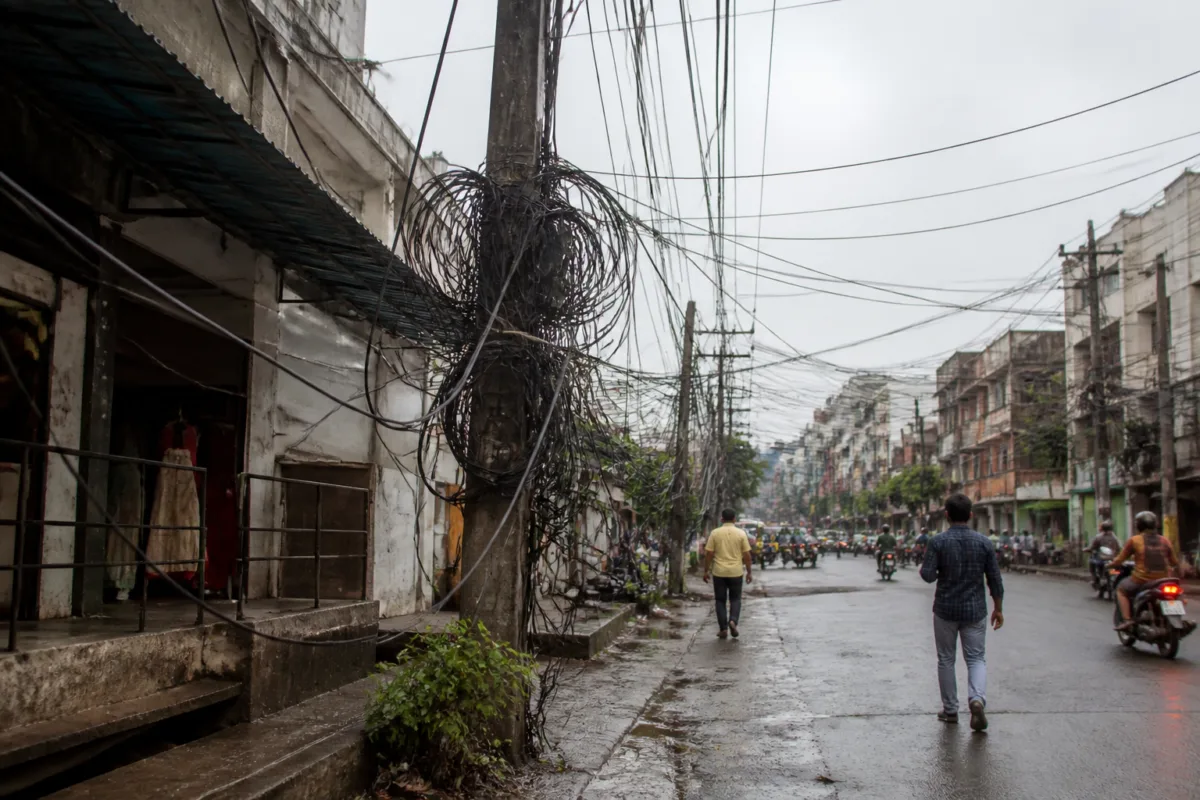
Unused and loosely hanging telecom cables continue to create safety risks across Hyderabad despite the Telangana Southern Power Distribution Company Limited (TGSPDCL) reducing the annual rental for laying optical fibre cables on electricity poles from ₹600 to ₹100 per pole in May, according to a report by Deccan Chronicle – South.
Residents in several parts of the city said abandoned cables hang across entrances, obstruct footpaths and create fears of electrocution, particularly during rain. The problem has gained urgency after five people were killed last year at Ramanthapur when a dangling cable reportedly came into contact with a live power line during a religious procession.
The Telangana High Court has also ordered the removal of unauthorised cables from electricity poles. The court noted that such cables had caused multiple fatalities in the state.
At Yellareddyguda, school principal A.S. Madhavi said wires hang so low outside schools that she avoids allowing children to play near the gate and compound wall. She said the cables swing close to the entrance during rain, raising concerns that they could snap or touch a live power line.
Businesses and residents in other neighbourhoods reported similar problems. Kavitha, who operates an establishment in Krishnanagar in Srinagar Colony, said abandoned cables left by earlier internet operators had accumulated around a pole near her premises. She said customers hesitated to stand near it and that the cables made repairs difficult.
Residents in Ameerpet reported low-hanging wires affecting pedestrian movement and creating risks for two-wheeler riders. In Kavadiguda, P. Vasanthi said unused cables remained tied to electricity poles even after operators shifted or disconnected their connections. According to her, they were generally not removed unless an accident occurred.
TGSPDCL chairman and managing director Jitesh V. Patil recently reviewed implementation of the Telecommunications Right of Way Rules, 2024, with telecom, broadband and data service providers. He directed operators to identify and remove unused cables, while ensuring that active cables were properly bundled and securely fastened.
Patil also stated that cables could not be installed without permission and compliance with safety norms. The directions place responsibility on operators to distinguish between functioning connections and abandoned lines, while the discom continues to oversee the use of its electricity poles.
TGSPDCL is also exploring coordination with telecom companies through its TCUR underground cabling project. Under the proposal, single-fibre cables could be laid in trenches excavated for power cables. The arrangement is expected to reduce repeated road excavation and gradually clear overhead cable congestion.
The immediate implementation steps are the identification and removal of unused cables, the secure bundling of active lines and coordination between the discom and telecom operators under the Right of Way rules and the underground cabling project.

