


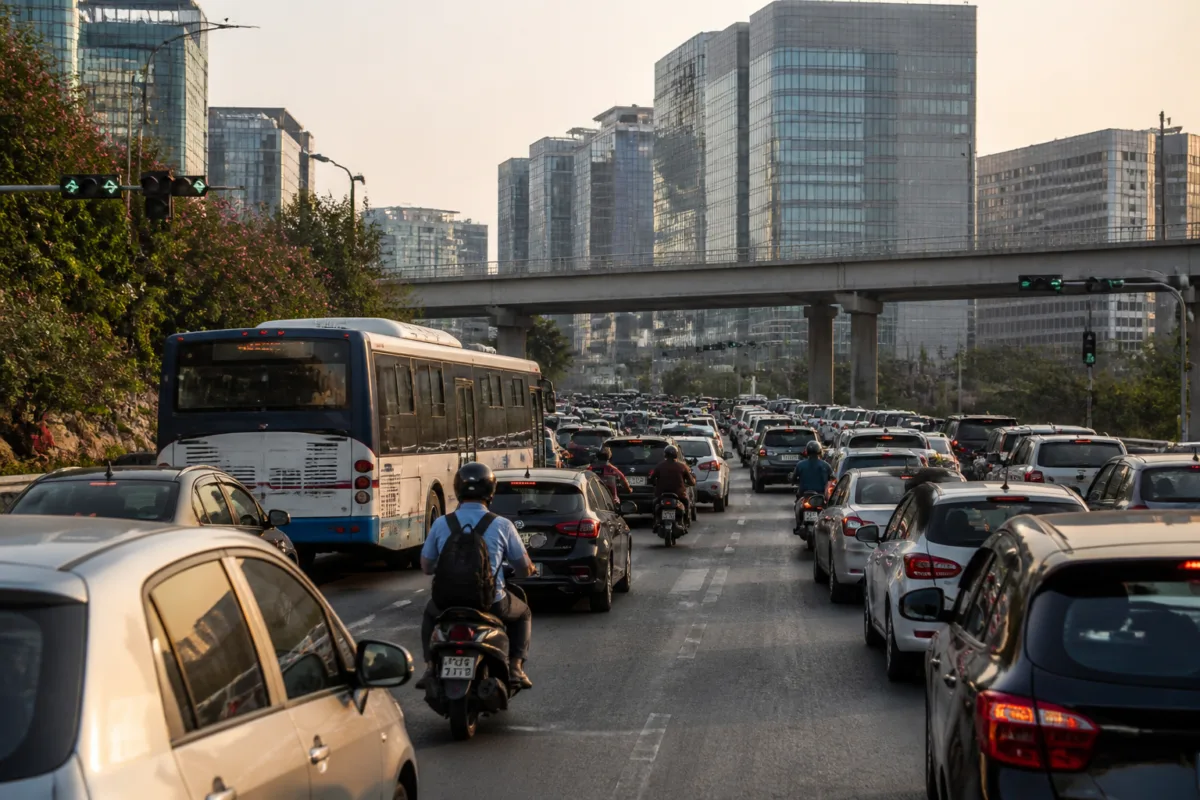
Hyderabad’s Cyberabad IT corridor is facing a familiar urban transport problem: employment and residential growth have expanded faster than the capacity of public transport to absorb daily commuting. The result is a road network dominated by private vehicles, even as widening and grade-separated infrastructure continue to struggle with congestion.
Data cited from Cyberabad Police and the Society for Cyberabad Security Council (SCSC) indicates that public transport accounts for barely 2 per cent of commuter movement in Cyberabad’s main IT hubs. Four-wheelers and two-wheelers together account for 82 per cent, according to the same data. Across 15 major IT-sector locations, more than 2.5 million vehicles cross different stretches connecting the corridor each day.
The figures were cited in a Deccan Chronicle report focused on the potential of public transport and shared mobility to address congestion. They point to a structural imbalance: a large employment centre is being served primarily by modes that use more road space per passenger.
At Biodiversity Junction and other busy locations, the consequences are visible during weekday peaks. Cars, often carrying one person, share congested lanes with two-wheelers and buses. Public transport vehicles can carry more commuters, but when buses are held in the same traffic queues as private vehicles, their capacity advantage is weakened by slow and unreliable journeys.
The report argues that adding road space alone has not resolved the problem. Over two decades, the area has seen road widening, flyovers and underpasses, while employment, housing and private-vehicle use have continued to grow. In a land-constrained urban region, building road capacity at the pace required to match vehicle growth is increasingly difficult.
That makes the performance and reach of public transport central to Cyberabad’s future mobility. Buses, Hyderabad Metro services and MMTS trains can move more people while consuming less road space than individual cars, but each mode requires supporting infrastructure and reliable operations.
The report notes that additional buses would require procurement, depots, charging facilities and trained staff. Metro capacity would depend on manufacturing, testing and commissioning additional coaches. It also identifies the need for more frequent and punctual MMTS services, alongside stronger first- and last-mile connections. Thousands of electric buses have been planned for Hyderabad, while a tender has reportedly been floated for 60 additional Metro coaches. The speed at which these measures reach commuters will determine their practical effect.
In the interim, the report highlights carpooling as a way to use transport capacity that already exists. Many vehicles entering Cyberabad carry only one occupant, leaving seats that could accommodate other commuters travelling in the same direction. A higher average occupancy rate could reduce the number of vehicles entering the corridor during peak periods without requiring immediate road construction.
Carpooling is already being encouraged in some companies and residential communities. The report names TCS, Cognizant, Infosys, Tech Mahindra, Wipro and Capgemini among companies that promote ride-sharing. It also refers to carpooling activity at Tech Mahindra’s HITEC City campus, Raheja Mindspace and gated communities in areas including Kondapur, Kokapet and Pragati Nagar.
These arrangements remain uneven because they often depend on informal networks or individual champions. The report suggests that employers could support them through priority parking, designated pick-up and drop-off points, recognition for regular participants and measurable shared-commute targets.
Safety and trust would be necessary for such a system to expand, particularly for women and employees travelling outside conventional office hours. Employer participation, together with visible support from SCSC, Cyberabad Police and the Cyberabad Municipal Corporation, could help make shared travel more dependable. The report presents these measures as complementary to public transport investment, not as a substitute for it.
The central challenge is therefore not simply congestion at individual junctions. It is the relationship between land-use growth, employment concentration and the modes available to reach major job centres. If most new trips continue to be made in private vehicles, additional road capacity is likely to face the same demand pressures that have already affected existing infrastructure. If buses, Metro, MMTS and shared mobility become more reliable and convenient, Cyberabad could carry more commuters without requiring every additional trip to occupy a separate vehicle.
For commuters, the outcome will depend less on broad commitments than on delivery: more frequent services, dependable connections, safe interchange points, adequate fleet capacity and practical employer support. Until those elements work together, the corridor’s transport system will remain heavily dependent on private vehicles, with congestion costs borne by workers, businesses and the wider city.

