


RSM US Integrated Services India’s decision to double its Hyderabad footprint is more than a corporate office expansion: it shows how the city is positioning itself as a centre for specialised global capability-centre work, professional services and technology-enabled operations. The firm says its Hyderabad headcount has risen by nearly 150% in three years and that it moved from a roughly 20-person presence in a co-working space around 2022-23 to a 100,000 sq. ft. office in under four years.
That trajectory captures an important feature of Hyderabad’s current urban economy. Growth is not being driven only by conventional technology companies. Professional-services firms are also expanding teams that work across consulting, tax, assurance, technology, digital transformation, innovation and business operations. Their requirements are shaping demand for larger offices, specialised talent, training partnerships and workplaces designed around collaboration rather than fixed seating alone.
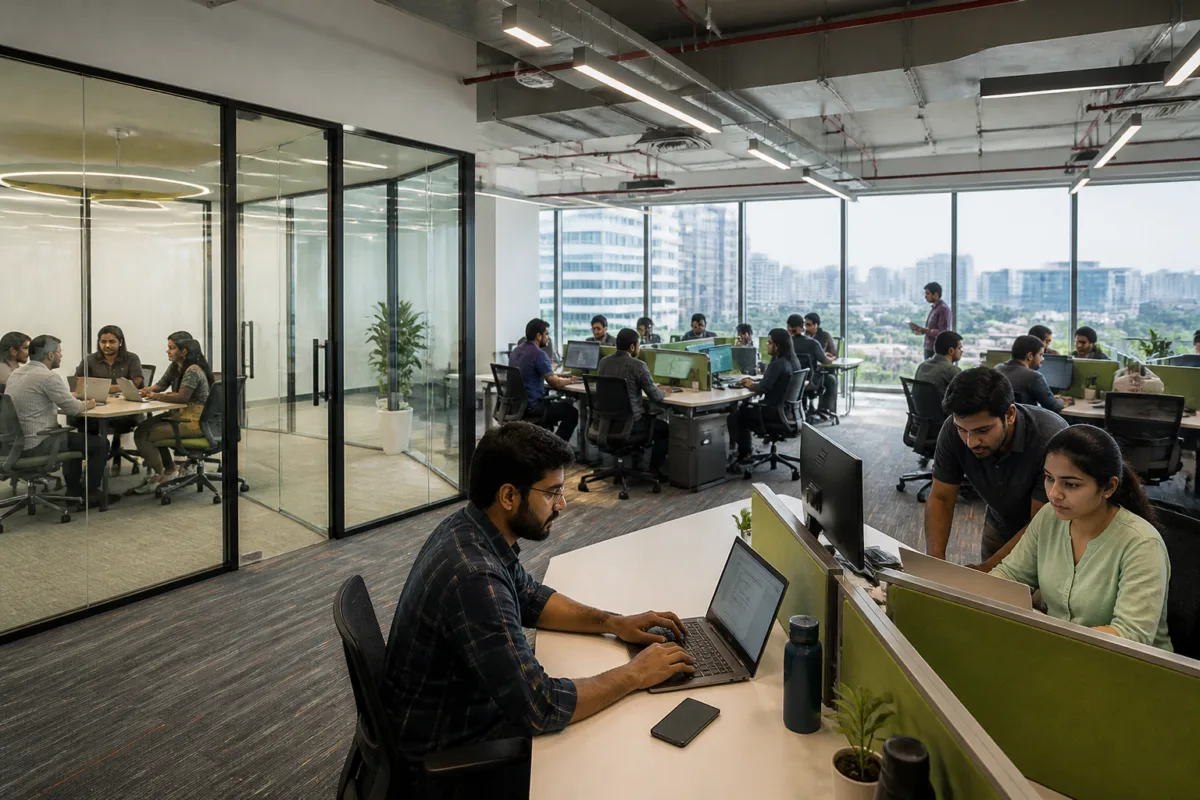
RSM’s new Hyderabad workplace is described as an IGBC-certified, technology-enabled office with smart meeting and learning spaces, sensor-based room management, flexible work settings and wellness features. These details matter because they show how the physical office is being adapted to a business model in which teams in India and the United States work jointly on complex assignments and automated platforms. The office is not presented simply as additional capacity; it is part of the firm’s effort to build specialist teams and connect local employees to global engagements.
The expansion also places Hyderabad inside a wider four-city strategy. RSM operates in Gurugram, Kolkata, Hyderabad and Bengaluru and plans to consolidate its Indian presence in these locations. Its Bengaluru office, inaugurated a day earlier, covers 1.54 lakh sq. ft., compared with 60,000 sq. ft. previously. Across India, the company has grown from about 700 employees five years ago to approximately 4,200 today, according to India Leader Ashokkumar Prabhakar, who spoke to Deccan Chronicle.
The concentration in four cities is significant for the way urban growth is organised. Instead of distributing operations across a large number of locations, RSM is choosing cities where it believes talent and professional-services ecosystems are sufficiently deep. For Hyderabad, that creates a direct link between the city’s labour market and its office market. Larger facilities become viable when firms can recruit at scale, while the availability of skilled workers becomes stronger when firms establish teams that offer training, career paths and exposure to international work.
RSM’s Hyderabad expansion began from a small base. Prabhakar said the company entered the city around 2022-23 with about 20 employees in a co-working space before moving into a 100,000 sq. ft. office in less than four years. The company now describes Hyderabad as an important pillar of its global build-out. The numbers supplied by the firm indicate rapid expansion, although the material does not establish the total current headcount in Hyderabad or the number of new jobs directly associated with the latest office.
That distinction is important in assessing the urban impact. A larger office does not automatically translate into an equivalent increase in employment, and the supplied account does not provide occupancy, construction cost, lease value, commuting patterns or additional infrastructure requirements. What it does establish is that the company’s physical and organisational commitment to Hyderabad has increased substantially, alongside a reported headcount rise of nearly 150% over three years.
The firm’s hiring model also reveals how GCC growth is changing the relationship between offices and educational institutions. Campus hiring is conducted mainly in July, while lateral hiring continues throughout the year to manage the seasonality of audit and tax work. Digital and technology roles are largely filled through lateral recruitment, while consulting roles do not require mandatory certification. RSM sponsors certifications, provides on-the-job training for freshers and has run customised programmes with universities, particularly in tax, where company professionals teach, certify and onboard students.
This model creates a talent pipeline that extends beyond recruitment. It connects the office to universities, professional certifications and internal training systems. For a city such as Hyderabad, the significance lies in the possibility that office expansion can support not only immediate hiring but also the development of specialised skills. However, the source material does not provide details on the number of university partnerships, students enrolled or employees certified through these programmes, so the scale of that pipeline remains unspecified.
RSM’s stated investment priorities are talent, real estate and skilling, including artificial intelligence. The three are closely connected. Real estate provides the setting for collaboration and learning; talent determines whether teams can take on more complex work; and skilling allows employees to use new tools and processes. The company’s Hyderabad and US teams are jointly building platforms that automate workflows from document submission to review, with AI integrated into those systems.
This is a different office story from one based solely on employee volume. The value of the Hyderabad centre, as described by the company, is also tied to the complexity of the work it can perform. The workplace is intended to support teams contributing to global priorities, while technology is being used to automate parts of the audit, tax and business workflow. The firm expects stable growth over its three-year plan and said it does not anticipate a substantial impact of AI on headcount. It measures performance by client impact and contribution, rather than revenue alone, according to Prabhakar.
The claim about AI and employment remains a company expectation rather than an independently established urban labour-market outcome. The supplied report does not include an external assessment of how automation will affect hiring, job categories or office demand. It does, however, document the company’s current position: AI is part of its skilling and platform investments, while the firm expects its workforce to continue growing in a stable manner under its three-year plan.
The location strategy also reflects the competitive structure of India’s professional-services market. Prabhakar described audit and tax as competitive areas, with more mid-market players entering India, but said the four selected cities provide sufficient talent. Hyderabad’s role therefore depends on more than its identity as a technology city. It is being used as a base for professional and business operations that require accounting, tax, consulting, technology and digital capabilities in the same organisational system.
For the built environment, this produces several visible consequences. Firms require larger and more specialised workplaces, including meeting rooms, learning areas, flexible work settings and technology infrastructure. The office becomes a platform for collaboration between local and international teams, rather than simply a place where employees sit during fixed working hours. The source does not specify whether RSM’s new premises are leased or owned, nor does it identify the building or micro-market. Even so, the expansion adds another example of how GCC growth is generating demand for high-specification commercial space in Hyderabad.
The urban governance implications are less direct but still relevant. A growing office economy depends on transport access, reliable utilities, digital connectivity and a steady supply of developable or occupiable commercial space. None of these requirements is quantified in the report, and there is no official assessment attached to the announcement. The evidence supports a narrower conclusion: companies expanding in Hyderabad are making decisions based on the city’s talent base and technology ecosystem, and those decisions increase the importance of the urban systems that support concentrated employment.
The comparison with Bengaluru also shows that corporate expansion is being distributed across multiple established centres. RSM’s Bengaluru office has nearly tripled in area from 60,000 sq. ft. to 1.54 lakh sq. ft., while Hyderabad has become the firm’s fastest-growing location by headcount, according to the company. This does not establish a ranking of the two cities across the entire GCC market, but it shows how firms can expand in more than one major urban centre while consolidating operations around a limited national footprint.
The larger question is whether Hyderabad’s GCC economy can continue moving from scale to specialisation. RSM’s account points towards a model in which the city is expected to provide talent, professional expertise, technology capability and institutional links to universities. The office expansion is therefore both a real-estate decision and a capability decision. It increases the firm’s physical capacity while supporting a workforce intended to handle more complex, globally integrated assignments.
What the evidence confirms is a substantial expansion of RSM’s India operations, a particularly rapid rise in Hyderabad, a move into a 100,000 sq. ft. workplace and a four-city consolidation strategy. It also confirms that the company is combining hiring, university engagement, professional certification, workplace technology and AI-enabled process automation. What remains unclear is the precise number of new Hyderabad jobs, the office’s occupancy and commercial arrangement, and the measurable effect of the expansion on surrounding infrastructure and housing demand. Those are the indicators that would show whether the city’s GCC growth is translating into a broader and more durable urban transformation.

