


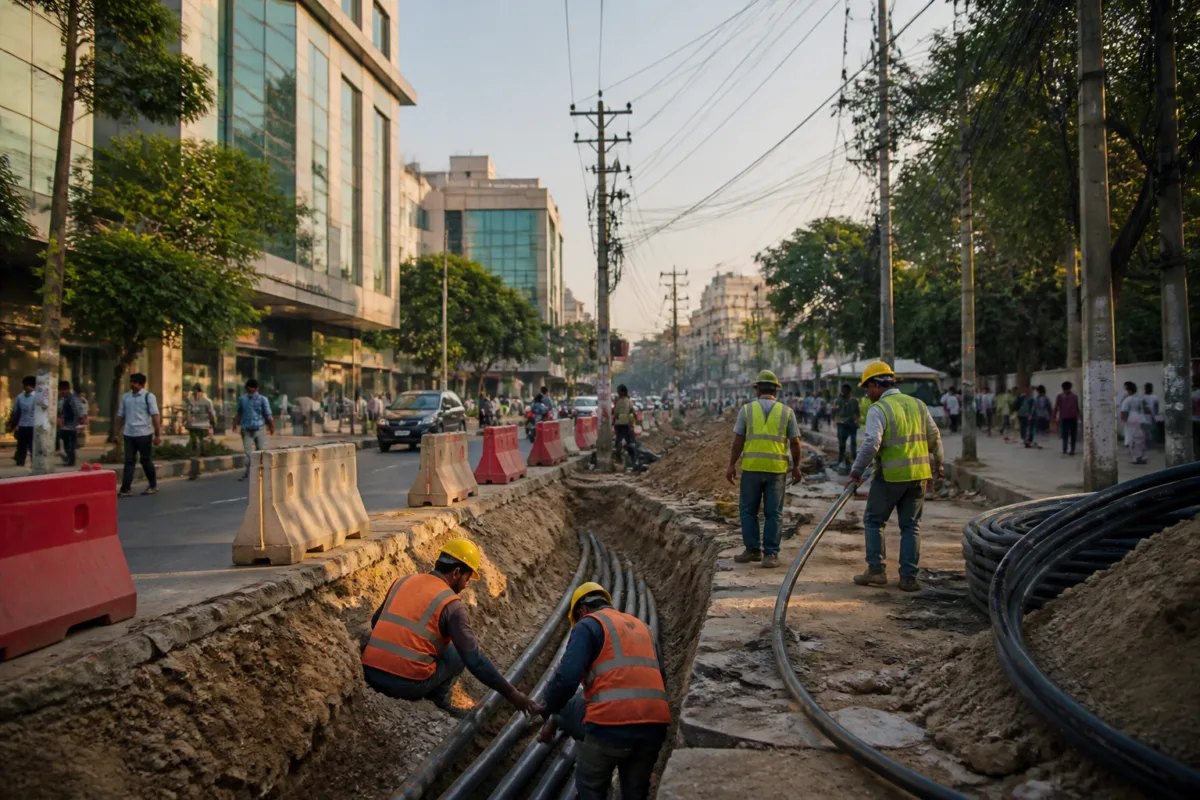
Hyderabad’s ₹5,756-crore underground power cabling project will begin in the new year, with the first phase covering 11 divisions across four electricity distribution circles, according to project officials. The two-year initiative will replace major overhead power lines with underground cables and use insulated aerial bunched cables in narrow lanes where underground installation is not proposed.
The first phase will cover Banjara Hills, Greenlands, Saifabad, Paradise, Cantonment, Mehdipatnam, Charminar, Begum Bazar, Bowenpally, Asmangadh and Azamabad. These areas fall under the Banjara Hills, Secunderabad, Hyderabad Central and Hyderabad South circles in the city’s Metro Zone.
The tendering process has begun. The work will be carried out under the direct supervision of TGSPDCL chairman and managing director Jitesh V. Patil. Project director V. Sivaji said the initiative was intended to improve the safety and reliability of power distribution, with the proposed network designed to meet Hyderabad’s requirements for the next 30 years and beyond.
The first phase is planned to cover about 1,243 11-kV feeders, 256 33-kV feeders and nearly 136 33/11-kV substations. The planned cable network includes 311 km of 33-kV underground cables, 5,772 km of 11-kV underground cables and 1,718 km of low-tension underground cables. A further 6,251 km of low-tension aerial bunched cables will be installed in locations where underground cabling is not proposed.
Existing 33-kV and 11-kV overhead lines will be replaced with tree-retardant cross-linked polyethylene underground cables. Low-tension lines along main roads will also be shifted underground. The network will include around 4,555 Supervisory Control and Data Acquisition-based Ring Main Units, comprising 210 units operating at 33 kV and 4,345 at 11 kV. Another 9,946 compact 11-kV Ring Main Units are planned.
According to Sivaji, the equipment will support remote monitoring, faster fault identification and restoration of electricity through alternative routes under a ring-main system. Officials expect the project to reduce outages linked to rain, strong winds, falling branches and lightning, while lowering the risk of electrocution from exposed overhead wires.
The project is also expected to alter the use of public road space. Removing electricity poles and clusters of overhead wires could free footpaths for pedestrians and reduce visual congestion along city roads. Businesses, hospitals, information technology companies and data-centre operators are among the users officials said could benefit from fewer interruptions. Consumers could also benefit over time from reduced technical losses, power theft and maintenance costs, although the supplied project details do not specify the expected savings.
The utility plans to use horizontal directional drilling at road junctions, along main roads and at other sensitive locations to limit open excavation. Where excavation is unavoidable, the executing agency will restore roads according to Greater Hyderabad Municipal Corporation standards, with restoration costs included in the project.
Optical-fibre ducts will be installed alongside the underground power cables. This will allow telecom and cable television operators to shift their networks away from overhead poles and onto underground infrastructure. The proposed network will also support smart metering and automation as the project moves into implementation.

