


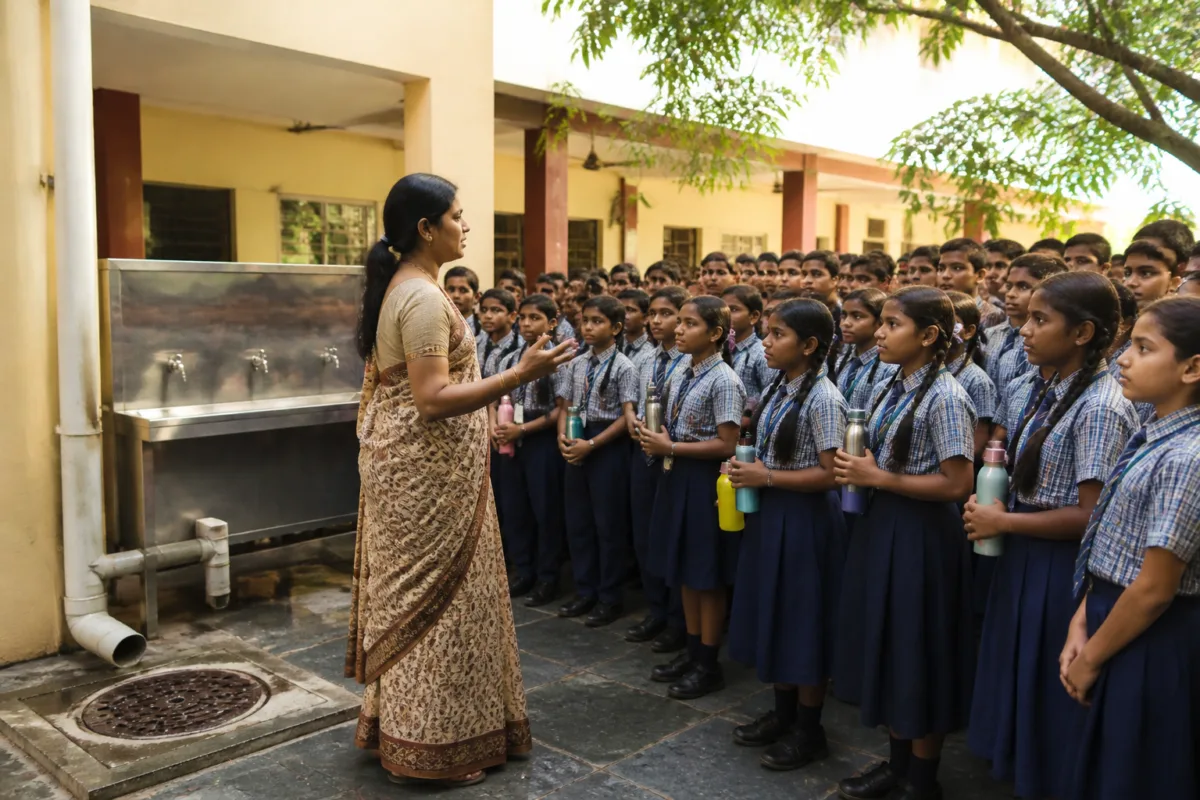
Hyderabad schools have been asked to make water conservation part of their daily morning assemblies as the city prepares for possible drinking-water stress linked to rainfall deficit and low reservoir levels.
The Telangana school education department issued instructions to all district educational officers on November 15, asking government and private schools, including those in the CURE area, to conduct one-minute awareness sessions on water conservation and administer a pledge to students. The instructions cover the impact of El Niño conditions on rainfall and the need to conserve drinking water, particularly during summer.
The directive followed a request from the Hyderabad Metropolitan Water Supply and Sewerage Board (HMWSSB), which is preparing an advance action plan for drinking-water availability and water management in Hyderabad. The board cited deficit rainfall and low water levels in reservoirs including Singur and Manjeera as reasons for encouraging judicious consumption and preventing wastage, according to the Times of India report.
Schools have been asked to sensitise students to switch off taps after use, report leakages and avoid unnecessary water consumption while brushing, bathing and washing hands. The guidance also promotes rainwater harvesting and recharge pits. Students have been encouraged to take these messages to their families and friends.
The approach uses schools as an institutional network for extending a water-conservation message beyond classrooms. Its immediate focus is behavioural awareness: reducing avoidable household and institutional wastage, improving reporting of leaks and familiarising students with measures such as rainwater harvesting and groundwater recharge.
The education department’s instructions do not, in the supplied report, set out school-level water-use targets, monitoring arrangements or a timeline for assessing whether the awareness sessions reduce consumption. The report also does not specify the scale of the reservoir decline or provide a citywide supply forecast. Those details will be important for judging how the education campaign fits into HMWSSB’s broader advance action plan.
For residents, the directive signals that water management preparations are being extended into public institutions before the summer demand period. It also places responsibility on schools to make conservation practices routine rather than limiting the response to occasional public advisories. The practical impact will depend on whether the messages are supported by functioning taps, prompt leakage repairs, rainwater systems and clear institutional guidance on water use.
The schools’ campaign is therefore one component of a wider preparedness effort, rather than a substitute for reservoir management, supply planning or infrastructure maintenance. HMWSSB’s forthcoming action plan will determine how the awareness measures connect with operational steps to maintain drinking-water availability in Hyderabad.

