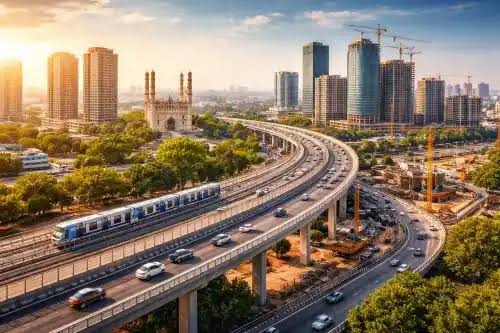
Hyderabad Mobility Push Gains Momentum With New Projects
HYDERABAD: Telangana has sought stronger central backing for a wide range of infrastructure, transport, education and industrial projects as it works towards its target of becoming a USD 1 trillion economy by 2034. The proposals place Hyderabad at the centre of a broader growth strategy covering metro expansion, regional connectivity, advanced manufacturing and urban infrastructure.
The state has renewed its proposal for an M-6 Task Force covering six major economic cities — Delhi, Mumbai, Kolkata, Chennai, Hyderabad and Bengaluru. It has sought a dedicated ₹6 lakh crore urban infrastructure fund, with ₹1 lakh crore proposed for each city. The proposal reflects the growing need for large-scale investment in metropolitan transport and basic services as urban populations and economic activity expand. For Hyderabad, the proposed Metro Rail Phase-II is among the most significant requests. The planned network would cover 122.9 km across seven corridors, with an estimated cost of ₹38,595 crore. Telangana has proposed a joint funding model involving the Centre and the state. The state has also sought support for a Regional Ring Rail Project and a high-speed rail hub at Shamshabad. Proposed rail connections between Hyderabad and cities including Chennai, Bengaluru and Pune could strengthen the metropolitan region’s links with other major economic centres.
Road infrastructure forms another major part of the request. Telangana has sought faster approvals for the northern and southern corridors of the Hyderabad Regional Ring Road, the Hyderabad-Amaravati-Bandar Port Expressway and a four-lane elevated corridor between Mannanur and Srisailam along NH-765. Beyond transport, the state has renewed its demand for an Indian Institute of Management in Hyderabad. It has offered 200 acres of land for the proposed institute, arguing that the city already has a strong base of higher education and research institutions. The proposal comes alongside efforts to modernise industrial training and expand skills programmes. Industrial development is also being linked to the state’s long-term economic strategy. Telangana has requested projects under India Semiconductor Mission 2.0 and sought approval for an Electronics Manufacturing Cluster 2.0 at Future City. Such initiatives could support higher-value manufacturing and create new employment opportunities if backed by adequate infrastructure and skilled workers.
The wider package also includes irrigation priorities such as the Palamuru-Rangareddy Lift Irrigation Scheme and discussions with Maharashtra over the Tummidihatti Barrage. For Hyderabad, the scale of the proposed investments highlights both an opportunity and a planning challenge. Expanding transport and industrial capacity can support economic growth, but it will also increase demand for housing, water, public transport and other civic services. Coordinating these systems will be essential to ensure that infrastructure-led growth remains accessible, efficient and resilient.