


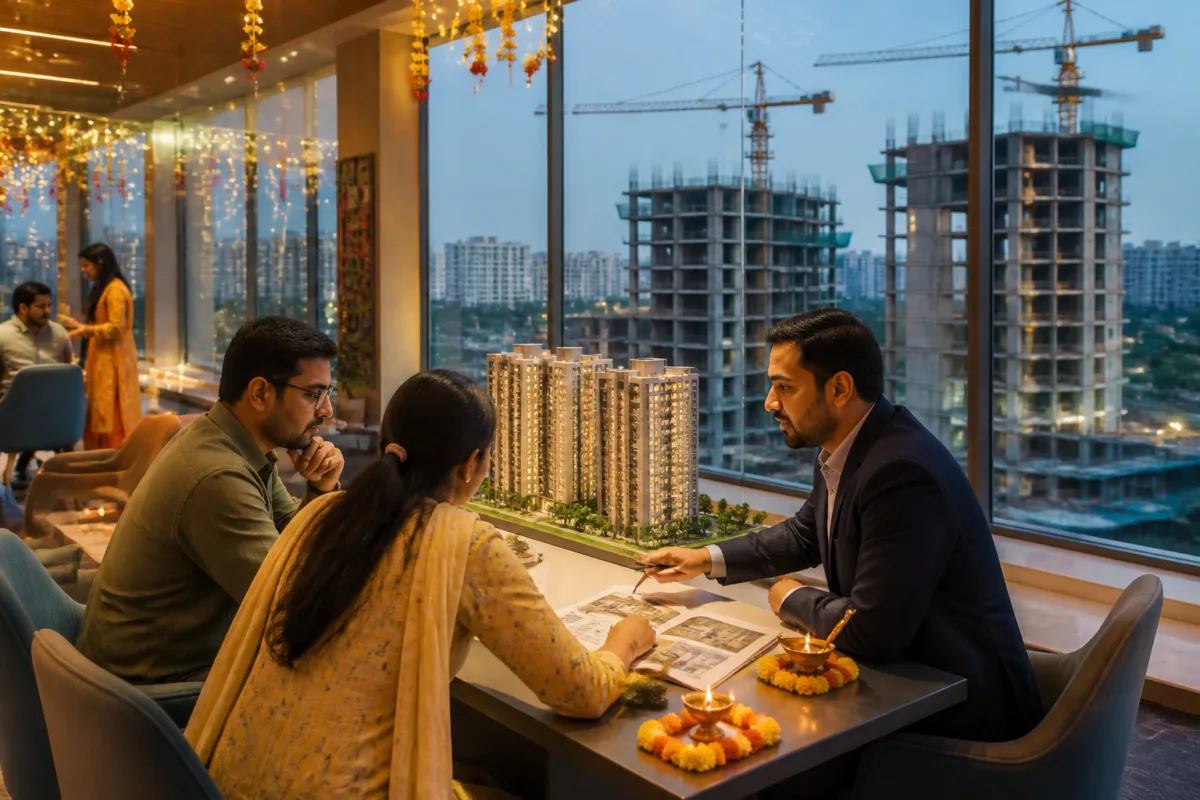
Hyderabad’s Diwali property market is revealing a widening gap between developer marketing and buyer confidence. Builders are offering gold, cars, smartphones, international travel and even chances to win another property, but the incentives have not produced the festive surge in bookings and registrations that the residential market typically expects.
The pattern matters because it shows how developers are responding to a slowdown without substantially reducing headline apartment prices. Instead of cutting prices directly, they are attaching visible rewards to transactions. The strategy is designed to create urgency and excitement around projects, while preserving the basic price structure on which residential projects are marketed.
The offers reported in Hyderabad range from 10-gram gold coins and 50-gram silver coins to a car, an iPhone 18 Pro Max and Dubai air tickets. Some projects are also using lucky draws and a ‘buy one, get one free’ promise involving an additional property. These promotions are being used to convert enquiries into bookings at a time when potential buyers are becoming more cautious about committing to large, long-term financial obligations.
One developer marketing a project near Yapral is offering a car worth Rs 10 lakh as part of its Diwali promotion. Another project in Narapally, along the Hyderabad-Warangal highway, is offering 10-gram gold coins to buyers and 100-gram silver coins for referrals on 2 BHK flats starting at Rs 52 lakh. The scale and variety of the incentives suggest that festive campaigns are being treated as a serious sales channel rather than as a limited-time discounting exercise.
Yet the reported buyer response remains subdued. An office-bearer of CREDAI Hyderabad said the expected rush of buyers was missing compared with previous years, when Diwali was associated with higher home bookings and property registrations. According to the office-bearer, prospective buyers are adopting a wait-and-watch approach because of concerns about job security, layoffs and persistent inflation. The slowdown, the office-bearer added, is not limited to Hyderabad but is also visible across major metropolitan markets.
This combination of aggressive promotions and muted demand provides a useful window into how the housing market functions during periods of uncertainty. A home is not an ordinary festive purchase. For most households, it involves a substantial down payment, a long tenure of loan repayments and exposure to future income risks. A gold coin or a holiday may improve the immediate appeal of a transaction, but it does not remove concerns about employment, monthly cash flow or the total cost of ownership.
That distinction helps explain why developers may prefer gifts over direct price reductions. Ch Ramchandra Reddy, managing director of RV Nirmaan, said promotional benefits were marginal compared with the overall value of a property. He gave the example of 1 kg of silver, worth a little over Rs 2 lakh, being offered on a Rs 1 crore flat. On that calculation, the incentive would account for barely 2% of the property’s value.
The arithmetic is important. A visible reward can be advertised prominently and can make an offer appear more valuable, while its cost remains a relatively small share of the underlying property price. Reddy said such promotional expenses were unlikely to significantly affect developers’ margins. In his assessment, festive incentives are primarily a marketing strategy to create excitement, attract prospective buyers and push sales rather than a substitute for a broad reduction in apartment prices.
This creates two different kinds of value in the same transaction. For the developer, the incentive is a controlled promotional expense that can be attached to selected units, projects or campaign periods. For the buyer, however, the main financial decision remains the purchase of the home itself. The offer may reduce the psychological barrier to booking, but it does not necessarily change the affordability of the apartment, the size of the loan required or the monthly repayment burden.
The reported price points illustrate this difference. A 2 BHK home in the Narapally project starts at Rs 52 lakh, while the Yapral promotion includes a car worth Rs 10 lakh. These figures may make the campaign highly visible, but they do not establish whether the advertised property is affordable for the intended buyer, whether the incentive applies to every booking or whether other charges and conditions alter the final transaction cost. The supplied report does not provide those details, and the offers therefore need to be understood as marketing terms rather than as a complete measure of housing affordability.
The market’s response also indicates that festive sentiment has limits. Property purchases are often associated with auspicious periods, and Diwali traditionally gives developers a concentrated opportunity to bring buyers into sales offices and accelerate registrations. But cultural timing cannot fully offset economic caution. When households are concerned about layoffs, job continuity and inflation, the decision to buy may be postponed even if the immediate offer appears attractive.
For developers, this shifts the purpose of a Diwali campaign. The campaign is no longer simply about capturing demand that is already ready to transact. It is also about maintaining visibility, generating enquiries and persuading undecided buyers to move from consideration to booking. The difference between an enquiry and a completed sale becomes central in a market where interest may exist but commitment is delayed.
For Hyderabad’s housing system, the more significant signal is therefore not the value of the gifts but the need for such gifts to sustain buyer attention. High-value incentives can indicate intense competition among projects for a limited pool of active buyers. They can also show that developers are attempting to defend prices while using non-price benefits to make individual projects stand out.
The report does not establish whether the subdued Diwali market will lead to lower prices, delayed launches or changes in construction activity. It also does not provide city-wide booking numbers, registration data or a comparison between projects offering incentives and those relying on conventional discounts. Those gaps prevent a broader conclusion about the direction of Hyderabad’s residential market.
What the available evidence does establish is narrower but significant. Developers are escalating festive promotions, while industry representatives report that buyers are not responding with the usual level of urgency. The gap reflects a housing market in which marketing pressure is rising faster than buyer confidence. Until concerns about income security and inflation ease, a car, gold coin or international ticket may attract attention, but it cannot by itself resolve the larger financial decision involved in buying a home.

