


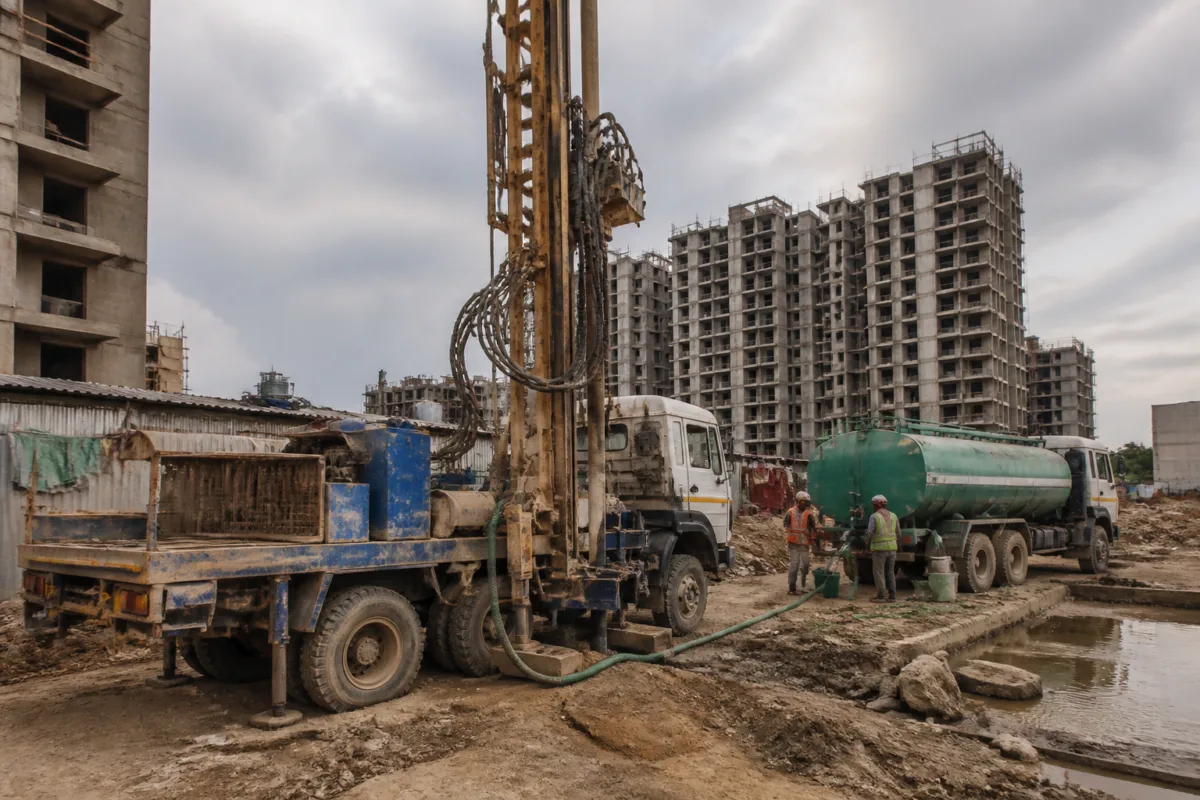
Hyderabad’s borewell ban is being presented as a water-conservation measure, but its immediate consequences extend well beyond drilling permissions. From November 1, the Telangana government will prohibit new borewells for construction and other non-drinking-water purposes, placing the city’s building activity, migrant workforce and private drilling businesses at the centre of an emerging water-management conflict.
The restriction follows warnings of an anticipated El Nino-induced water crisis. State officials have begun preparing micro-level contingency plans to prevent shortages of drinking water and electricity, while the government has instructed departments to use electricity economically. The decision reflects a familiar urban dilemma: when public water systems come under pressure, groundwater becomes an informal buffer for construction sites, commercial activity and workers’ settlements. Restricting that buffer may protect drinking-water reserves, but it also exposes how dependent the construction economy has become on sources that are difficult to regulate and unevenly distributed.
Special Chief Secretary Jayesh Ranjan said permission for drilling borewells in Hyderabad should be restricted to drinking-water requirements, subject to existing regulations. No new borewells will be permitted for construction or other activities, while the deepening of existing borewells will be allowed only for drinking-water needs. From November 1, the government plans to supply treated water from sewage treatment plants to construction sites through green water tankers.
That arrangement shifts the problem from groundwater extraction to the availability, quality, transport and cost of treated water. The supplied report does not establish how much treated water will be available for construction sites or whether the planned supply will meet demand across Hyderabad. This uncertainty is central to the dispute because construction projects require water not only for activities such as mixing and curing but also for workers living in temporary quarters at project sites.
The city’s existing water position has sharpened the concern. With supplies from the Manjeera and Singur reservoirs unavailable, officials said the usual 110 million gallons per day supply was being supplemented through alternative sources. These include 60 million gallons per day from Mission Bhagiratha, along with additional supplies from the Krishna river and other sources. The figures indicate that the city’s formal water system is already being supported through multiple channels, even before the restrictions on construction-related borewells take effect.
For the government, the priority is to protect water for drinking. The restriction also targets unauthorised drilling, which can increase pressure on groundwater reserves and make local water conditions harder to monitor. The Greater Hyderabad Rig Owners Association has itself urged the government to act firmly against unauthorised borewell drilling while seeking exemptions for genuine requirements, particularly at construction sites. This distinction suggests that the policy challenge is not simply whether borewells should be allowed, but how legitimate demand can be separated from unregulated extraction during a shortage.
Builders say the proposed alternative could increase project costs and disrupt construction schedules. A member of the Telangana Builders Federation said transporting treated water from the plant at Ramanthapur to construction sites would substantially increase expenditure. The representative also questioned whether treated water would be suitable for construction, claiming that its use could cause corrosion of cement and steel and that structural engineers did not recommend it. These claims are attributed to the industry representative; the supplied report does not include an independent technical assessment or a government response on the suitability of the treated water.
The federation member estimated that project costs could rise by at least 2% to 3% if water availability was reduced. The reason is not limited to the price of water. Construction workforces cannot be reduced immediately when a site faces a short-term supply interruption, while delays can affect schedules and increase expenditure. The reported estimate therefore links water access to the wider financial structure of urban construction, where labour, equipment, interest payments and customer commitments continue even when work slows.
The impact is likely to be uneven across project types. Builders of conventional apartments and individual houses may have fewer internal arrangements for water reuse or storage than larger developments. High-rise projects, meanwhile, must provide water to workers living on site. Industry representatives said advances in cement manufacturing technology had reduced water requirements for curing, but supplying labour quarters remained a significant concern.
CREDAI Hyderabad representatives estimated that between 15 lakh and 20 lakh migrant workers, including civil workers, electricians and plumbers, are engaged at construction sites. The figure is presented by the industry body and is not independently verified in the supplied material. Even so, the concern it raises is institutionally important: construction-site water is not only an input for buildings. It is also part of the basic service system supporting a large temporary population that may not have access to the city’s regular municipal network.
This makes the borewell decision a question of urban labour infrastructure as much as water regulation. If workers’ quarters do not receive adequate water, projects may face absenteeism or departures, according to the industry representatives cited. Daily wage workers are particularly exposed because their income depends on whether work continues each day. The report quotes a worker at Yousufguda who earns a daily wage and said that a slowdown would make it difficult to meet household expenses after migrating to Hyderabad for employment.
The wage structure described in the report illustrates the vulnerability. Skilled workers earn between Rs 1,000 and Rs 1,500 a day, while semi-skilled workers receive between Rs 400 and Rs 500. These workers do not necessarily have the financial cushion to absorb a prolonged pause. Chief Minister A Revanth Reddy has warned that the state could face water and power supply challenges for the next eight to ten months. If that period coincides with reduced construction activity, the consequences could extend from individual sites to labour movement between Hyderabad, workers’ native villages and neighbouring states.
Borewell rig operators face a different form of exposure. The Greater Hyderabad Rig Owners Association estimates that the city has around 250 borewell-operating firms, although official figures are unavailable. Each drilling truck supports around eight workers, according to the association. Operators must meet salaries, maintenance costs and loan repayments, while a drilling truck can cost between Rs 1.5 crore and Rs 2 crore. Most operators reportedly purchased the vehicles through bank loans.
For these businesses, a ban is not only a restriction on new work. It threatens the cash flow needed to service equipment loans. The association has warned that a prolonged ban could expose operators to vehicle repossession and push them to seek business in Karnataka, Maharashtra and Andhra Pradesh. The report quotes an association member saying operators may be forced to migrate if drilling work remains unavailable. The potential movement of rigs and workers shows how a city-level water policy can affect regional labour and service markets.
The government’s response is built around contingency planning and substitution. Officials have prepared department-wise plans for severe conditions, while alternative water sources are being used to supplement the city’s normal supply. Treated sewage water is intended to serve construction sites, preserving drinking-water supplies for essential use. However, the success of this model will depend on operational details that remain unclear in the supplied material: the volume available, the distance between treatment plants and sites, the tanker network, pricing, quality standards and the mechanism for prioritising projects.
Those details matter because tanker-based supply can create a fragmented system. A project located close to a treatment plant may face different costs and reliability from one farther away. Construction sites also vary significantly in scale, workforce size and water requirements. Without a transparent allocation and monitoring framework, the restriction could encourage informal sourcing or create advantages for larger developers able to pay for storage and transport.
The source material does not establish whether such outcomes have already occurred, and it does not provide a government estimate of the expected reduction in groundwater extraction. It also does not include an independent assessment of the effect on construction schedules or the technical suitability of treated water. These gaps do not negate the policy’s stated purpose, but they show where implementation questions remain unresolved.
Hyderabad’s immediate water challenge therefore reveals a broader institutional problem. Construction, municipal water supply, groundwater regulation and migrant-worker welfare are being managed as connected parts of one crisis, but the responsibilities for each remain distributed across different authorities and stakeholders. A restriction imposed through water conservation policy can affect building approvals, project finance, employment, equipment loans and temporary housing at the same time.
The evidence currently confirms three pressures: the city is relying on alternative sources to maintain supply, the government is restricting new non-drinking-water borewells, and construction-linked businesses and workers fear disruption. What remains uncertain is whether treated-water infrastructure can replace borewell access at the required scale and cost. The next test will come after November 1, when the ban begins and Hyderabad’s construction sites are expected to shift to green water tankers under the government’s contingency arrangement.

