


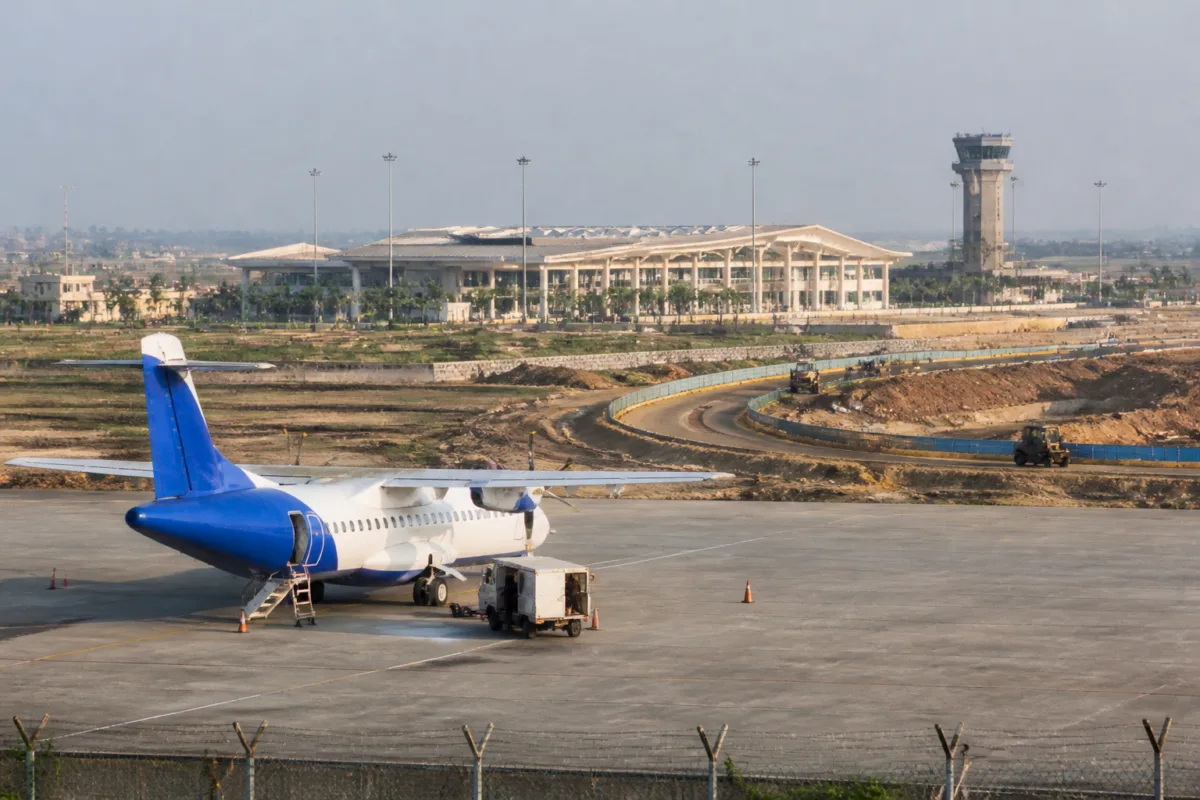
Uttar Pradesh’s Civil Aviation Promotion Policy, 2017 was designed to do more than add airports. It created a state framework for making regional air routes viable, upgrading underused airstrips and building an aviation ecosystem that included passenger services, cargo, maintenance, repair and overhaul (MRO), training and airport-support infrastructure.
The policy was framed alongside the Union government’s National Civil Aviation Policy, 2016 and the Regional Connectivity Scheme, or RCS-UDAN. It followed the state’s first round of RCS bidding, which the policy said had not produced adequate connectivity for Uttar Pradesh. At the time, the state had relatively few airports with scheduled services, while several state-owned airstrips and defence airports had limited or no civilian operations.
Its approach combined central RCS support with additional state incentives. These included a commitment to bear 20 per cent of the viability-gap funding for eligible RCS routes, concessions on aviation turbine fuel, reimbursement of State Goods and Services Tax on eligible air tickets, seat underwriting, and free or subsidised services at state-owned RCS airports.
The policy also linked aviation to wider economic goals. It identified air cargo as a means of supporting agricultural exports, perishables, manufacturing supply chains and e-commerce. It proposed incentives for cargo hubs, fulfilment centres, warehousing and facilities for handling time-sensitive goods. Airport development was therefore treated not only as a passenger-connectivity measure but also as part of a broader logistics network.
For airport and airstrip development, the policy envisaged both greenfield and brownfield projects. Land acquisition or procurement costs for brownfield airports could be borne by the Airports Authority of India, the state government or shared between them under mutually agreed arrangements. The policy also proposed upgrading selected airstrips into no-frills airports, particularly where RCS routes were awarded.
Development could involve the Airports Authority of India with Government of India assistance, a special-purpose vehicle involving the state and AAI, a state-owned company or a public-private partnership. Investment in airports, airstrips, heliports, helipads and related air-transport infrastructure could also qualify for incentives under Uttar Pradesh’s Industrial Investment and Employment Promotion Policy, 2017, subject to eligibility conditions.
The policy identified airstrips at Meerut, Moradabad, Ayodhya, Saharanpur, Jhansi, Chitrakoot, Azamgarh, Aligarh, Sonbhadra and Shravasti among its initial development priorities. It also linked airport connectivity with tourism destinations including Agra, Varanasi, Kushinagar, Ayodhya, Chitrakoot and Dudhwa. These were policy priorities in 2017, however, and should not be read as a current statement of airport status.
The proposed greenfield airport at Jewar, now known as Noida International Airport, formed part of the wider airport-infrastructure strategy. The policy also identified the area around Jewar as having potential for an MRO hub. For eligible MRO operations, it provided reimbursement of 100 per cent of State GST on MRO job contracts involving domestic or international airlines and 50 per cent reimbursement of State GST on aircraft parts and accessories used for maintenance. These incentives were specified for 10 years, alongside possible industrial-policy incentives for hangars and other MRO infrastructure.
A separate Aircraft MRO Policy was introduced by Uttar Pradesh in 2022. This means that new MRO investments should be assessed under the later framework rather than assuming that the 2017 provisions remain the primary scheme.
The policy’s airline incentives were particularly significant but largely time-bound. For eligible RCS flights, it provided aviation-fuel tax support at the prescribed level, a 20 per cent state share of RCS viability-gap funding and reimbursement of eligible State GST on air tickets. At state-owned RCS airports, airlines could receive free parking and night-halt facilities for an initial three years, office space of up to 100 square metres at zero rent for an initial three years, and a 50 per cent reimbursement of Route Navigation and Facilitation Charges up to Rs 2,000, also initially for three years.
Other proposed support included free water and fire services, subsidised electricity, road connectivity maintained by the Public Works Department and bus services through the Uttar Pradesh State Road Transport Corporation. The policy also provided for land, security and other facilities required for RCS airport development.
Seat underwriting was intended to reduce the revenue risk faced by airlines on routes with uncertain demand. The state could reimburse Rs 2,500 for each qualifying vacant seat, subject to route, aircraft and monthly limits. For small Category-1 aircraft with up to 20 seats connecting Lucknow with divisional headquarters, the state could underwrite all non-viability-gap-funding seats within the prescribed ceiling. For larger aircraft and other eligible RCS routes, 30 per cent of non-VGF seats could be underwritten, subject to a maximum of 360 seats per month per one-way trip.
These provisions were not universal or permanent fare subsidies. Airlines were expected to attempt commercial sales first, with unsold eligible seats becoming available to the state shortly before departure. The policy’s non-RCS route incentives were also limited. New connections involving airports such as Lucknow, Gorakhpur and Varanasi could receive specified fuel-tax and State GST support for one year, while some intra-state routes had additional seat-related assistance.
The policy included measures aimed at building the workforce needed for airport and airline expansion. It proposed aviation-related courses at technical institutes and universities, extension of scholarships to eligible aircraft-maintenance, cabin-crew and other aviation programmes, and a directorate-level cell to engage airlines and support professional placement. These were ecosystem-development provisions, not a universal cash benefit for all aviation trainees.
The Director, Civil Aviation, Government of Uttar Pradesh was designated as the implementing authority for fiscal incentives. A separate nodal officer was to manage the allocation of non-VGF seats to state government travellers. Airlines and operators remained subject to Directorate General of Civil Aviation standards, licensing requirements, airworthiness rules and route approvals. State incentives did not replace national aviation regulation.
According to the Invest UP figures cited in the report, Uttar Pradesh now has 15 functional airports, compared with four in 2017, and these connect more than 80 destinations. The same source reports that domestic passenger traffic rose from 87.90 lakh in financial year 2019-20 to 102.08 lakh in FY24, while cargo traffic increased from 18,615 tonnes to 25,915 tonnes. These figures indicate expansion, but they do not establish that the 2017 policy alone caused the change. Union government schemes, airport investment, airline decisions, market demand and later state policies also contributed.
The Uttar Pradesh Budget 2026-27 proposes Rs 2,111 crore for civil aviation, including Rs 750 crore for Jewar International Airport and Rs 1,100 crore for construction, expansion, strengthening and land acquisition for state airstrips. The 2017 policy remains officially listed by Invest UP alongside the state’s 2022 MRO policy and 2023 Airstrip Policy.
Its continuing relevance therefore lies less in treating every original incentive as active and more in understanding the institutional model it established. The policy connected airport construction with route viability, logistics, industrial incentives and workforce development. At the same time, its time-bound subsidies highlight a recurring challenge in regional aviation: infrastructure can be created through public investment, but sustained scheduled connectivity depends on demand, airline participation and the ability of routes to remain viable after temporary support ends.

