


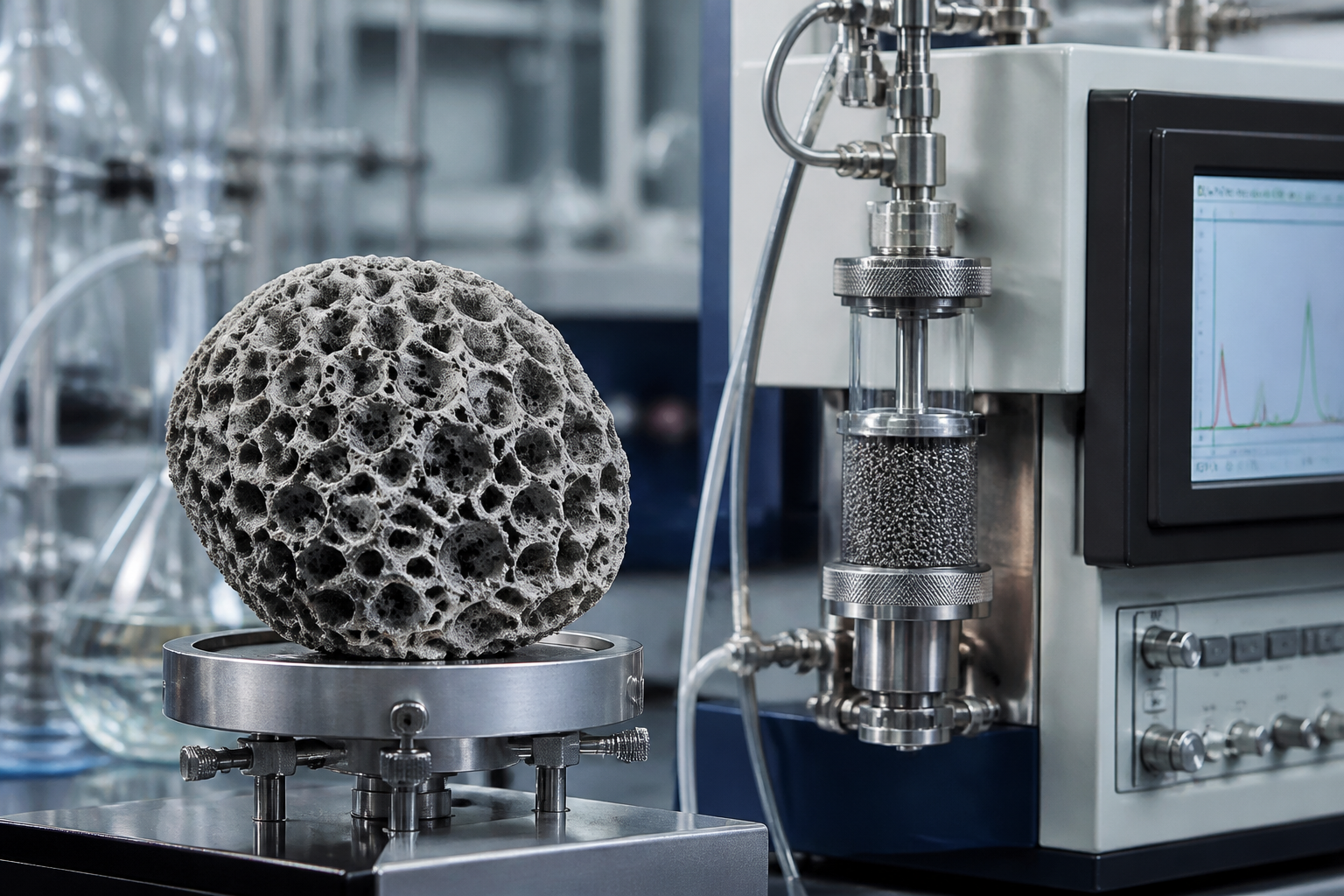
Researchers at BITS Pilani Hyderabad have developed a zirconium-based material that can selectively capture carbon dioxide and water while detecting certain amines, pointing to a potentially useful new direction for industrial pollution control and chemical separation. Named BITSH-3, the material has pore openings of about 4 angstroms and was designed to distinguish molecules by their size and shape.
The research matters to cities because carbon capture, solvent drying and chemical sensing are not isolated laboratory concerns. They are connected to the performance of industrial facilities, energy systems, chemical plants and environmental monitoring networks that support urban economies. The findings do not establish that BITSH-3 is ready for commercial deployment. They do, however, show how a material engineered at the molecular scale could address several separation problems relevant to industrial infrastructure.
The study was conducted by Govu Radha of the Department of Chemistry at BITS Pilani Hyderabad under the guidance of Dr Himanshu Aggarwal. It has been published in the journal Small, according to a statement cited in the report. The researchers used a bulky, rigid pyrene-based molecule, 1,6-pyrenedicarboxylate, to construct the material.
The central design finding challenges a conventional assumption in the manufacture of porous materials. Instead of relying only on shorter molecular linkers to create smaller pores, the team found that a wider and bulkier linker could also restrict the pore opening. This allowed the resulting structure to control which molecules could enter and which would be blocked.
That distinction is important for separation technologies. Industrial gases and chemical mixtures often contain molecules with similar properties, making selective capture difficult. A material that can separate molecules according to width and shape could potentially reduce the energy or processing burden involved in removing an unwanted component. The supplied study identifies carbon dioxide and water capture, molecular sieving and amine detection as possible applications, but it does not provide evidence of a commercial process, plant-scale test or cost comparison.
The reported carbon dioxide results were obtained at 298 degrees Kelvin and a pressure of 55 bar. Under those conditions, BITSH-3 absorbed up to 205 cubic centimetres of carbon dioxide per gram, while nitrogen, methane and hydrogen showed negligible uptake. This selectivity is significant within the reported experiment because carbon dioxide capture generally depends not only on how much gas a material can hold, but also on whether it can distinguish the target gas from other gases present in a stream.
The numbers should nevertheless be read within their experimental context. The report does not state how BITSH-3 would perform in a continuous industrial operation, how rapidly it could be regenerated, how many capture cycles it could withstand, or how its performance would change in the presence of impurities. Those factors would determine whether a laboratory material can be integrated into an industrial carbon-management system.
The material also showed a strong preference for water. At 1 bar, it absorbed 112.3 cubic centimetres of water, while methanol, ethanol and hexane showed negligible uptake. The researchers said this indicated potential for drying solvents by selectively removing water. In chemical and manufacturing facilities, controlling moisture can be important because water can affect reactions, product quality and the operation of separation systems. The research therefore extends beyond climate-related applications into industrial process control.
A third capability involved fluorescence-based sensing of amines. Smaller molecules, including ammonia, methylamine, ethylamine and n-butylamine, could enter the material’s tiny pores and reduce fluorescence. Larger aromatic amines, including aniline and N-methylaniline, produced negligible changes. The material could also distinguish between molecules with similar lengths but different widths: n-butylamine could enter the pores, while the wider diethylamine was largely blocked.
The reported calculated detection limits were 0.43 parts per million for ammonia, 0.90 parts per million for methylamine, 0.76 parts per million for ethylamine and 1.29 parts per million for n-butylamine. The study attributed the reduction in fluorescence to dynamic quenching and electron transfer involving the amine molecules.
This sensing function offers a different urban connection from carbon capture. Ammonia and other amines can be relevant to chemical handling, industrial workplaces and environmental monitoring. A selective sensor could, in principle, help identify specific compounds rather than merely indicate that a broad class of chemicals is present. However, the supplied report does not establish how the material would perform in a field sensor, how long the response would remain stable, or whether it could distinguish target compounds in a complex real-world atmosphere.
Material durability is another important part of the findings. BITSH-3 retained its crystal structure after exposure to acidic and basic conditions, water, boiling water, air and amines. Stability under these conditions is relevant because industrial separation and sensing materials may encounter moisture, chemical variation and repeated exposure during operation.
Yet structural stability is not the same as operational readiness. The report does not provide information on manufacturing volume, production cost, regeneration energy, lifecycle performance or integration with existing equipment. Nor does it establish whether the material can maintain its reported selectivity over extended use. These unanswered questions separate a promising material design from a deployable urban or industrial technology.
The research also highlights the institutional role of universities in addressing infrastructure problems that are usually discussed at the level of plants, emissions and public regulation. The work was undertaken within a chemistry department but has possible links to carbon management, industrial water control and chemical safety. Such connections show how the built environment increasingly depends on invisible material systems: filters, sensors, membranes and adsorbents that influence the performance of facilities without being visible to most city residents.
For urban policy, the immediate lesson is not that BITSH-3 will solve carbon emissions or replace existing capture systems. The evidence supports a narrower conclusion. Precise control over pore size and molecular access can create a material with multiple selective functions, and those functions may be relevant to industrial systems serving cities. Whether that relevance becomes practical depends on testing beyond the reported laboratory conditions.
The study therefore raises a broader question about the next stage of urban environmental infrastructure. Cities often focus on large physical assets such as treatment plants, transport networks and power systems, but the effectiveness of those assets can depend on advances in specialised materials. Carbon capture equipment, solvent recovery systems and chemical sensors all require components that can separate, retain or identify molecules reliably.
BITSH-3 is an example of that materials challenge. Its reported performance combines carbon dioxide uptake, water preference and size-selective fluorescence response in one zirconium-based metal-organic framework. The evidence confirms a strong laboratory result and a design principle based on the width and shape of molecular building blocks. It does not yet confirm commercial viability, field performance or measurable emissions reductions. Those are the next questions that further testing and scale-up would need to answer.
