


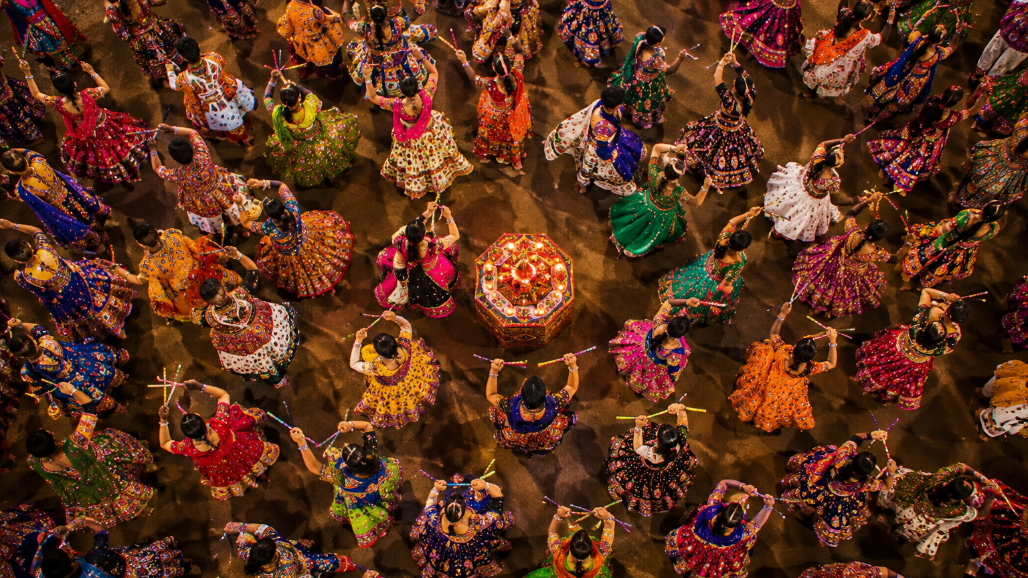
Ahmedabad’s Navratri economy is no longer confined to garba grounds and traditional markets. According to a report by Gujarat Samachar – Ahmedabad, the 10-day festival is expected to generate an estimated ₹700 crore in business across event venues, clothing, jewellery, food, entertainment, security, photography and related services. The report says party-plot passes alone account for around ₹250 crore, while seasonal markets have spread to 10 to 15 locations across the city.
The scale of this activity reveals a wider change in how Ahmedabad’s cultural economy is organised. Navratri began as a community and neighbourhood celebration centred on the garbo, the chowk and open-air dancing. It has since developed into a temporary urban system with ticketed venues, professional performers, themed installations, event technology, specialised retail and service providers. The festival now creates demand across several parts of the city at the same time, rather than concentrating spending in one traditional marketplace.
That expansion is visible in the geography of shopping. The report identifies Law Garden and Manek Chowk as established Navratri shopping destinations, but says new seasonal markets have emerged in areas including Nikol, Vastral and Bopal. It describes such markets operating at 10 to 15 locations, with shoppers arriving nearly a fortnight before the festival. This shift matters because it indicates that Navratri consumption is following Ahmedabad’s expanding residential footprint.
A citywide festival economy depends on proximity. When retail activity is limited to a few central markets, shoppers travel longer distances and commercial benefits remain concentrated. The spread of seasonal markets allows neighbourhood businesses, temporary vendors and local service providers to participate. It also changes the movement patterns of shoppers, performers and workers, although the supplied report does not provide data on traffic, parking, public transport use or municipal arrangements at these locations.
Clothing remains one of the largest visible components of this market. The report says that chaniya cholis priced between ₹2,000 and ₹5,000 are selling most actively, while sellers estimate that more than three lakh chaniya cholis have been sold in the city. It also records demand for embroidered kediyas and kurtas, rental outfits for different nights, and orders from outside India. These figures are market estimates cited in the report and should not be treated as an audited measure of total sales.
The supply chain behind this demand extends beyond Ahmedabad. The report says that chaniya cholis and kediyas are largely produced in Ahmedabad, Surat, Mumbai and Delhi. This means the festival’s economic footprint is distributed across manufacturing, wholesale, retail, tailoring, transport and cross-border or out-of-city orders. A seasonal purchase made at an Ahmedabad market therefore supports a production network that is not limited to the city itself.
The same pattern is visible in event production. Party-plot celebrations require venue preparation, themed decoration, stages, lighting, orchestras, sound systems, singers, security, catering and food stalls. Professional photography and videography have also become part of the experience, with the report citing charges of roughly ₹500 to ₹2,500 for curated festival reels. These services represent the conversion of participation into a package of paid experiences, each creating a separate layer of work and expenditure.
The festival’s venue model has also become more formalised. The report says that many organisers are introducing face-recognition entry, in which a ticket buyer uploads a photograph and is identified biometrically at the venue. The stated purpose is to reduce delays caused by scanning printed tickets during peak crowd movement. This brings a technology and governance question into a cultural event: how are private organisers collecting, storing and using biometric information, and what safeguards apply to people who buy access to a temporary venue?
The source does not provide details of consent procedures, data retention, cybersecurity arrangements or regulatory oversight for these systems. It also does not establish whether face recognition will be used uniformly across venues. Those gaps are important because a faster entry system can also create new obligations around privacy, access and accountability. The immediate operational benefit described by organisers cannot by itself answer those questions.
Artificial intelligence is entering the festival economy in less formal ways as well. The report says that participants are using AI tools to decide combinations of clothing, jewellery, makeup and hairstyles. This is a small but telling example of how digital tools are moving into everyday consumption. AI is not replacing the physical market; instead, it is helping consumers navigate a larger range of products and construct a festival identity before they reach the venue.
The festival is also generating demand for products beyond human participants. The report describes Navratri clothing for pets priced between ₹700 and ₹2,500. It records changing jewellery preferences, including double-tone silver and gold-coloured designs, and continued demand for traditional ornaments such as the hansdi. It also notes sales of decorated dandiyas, devotional chunris and garlands made with Kashmiri roses. These details show how a cultural event creates multiple specialised micro-markets around dress, appearance, ritual and social media presentation.
Not all reported growth is equally measurable or equally institutionalised. The ₹700-crore estimate combines party-plot passes with a wide range of activities, including food, decoration, transport-related services, security and entertainment. The report does not explain the methodology, time period used for the estimate, or whether informal transactions are included. Similarly, the claim of a 50 per cent rise in demand for private detectives during Navratri is attributed to private detective Shiv Shukla and is not supported in the supplied material by an industry-wide survey or official data.
That distinction matters for understanding the festival’s economic role. A large headline estimate can communicate the scale of activity, but it does not show who captures the value, how much is formal or informal, or how much income reaches temporary workers and small vendors. A fuller assessment would require information on municipal permissions, venue capacity, licensing, taxation, employment duration, vendor numbers and the geographic distribution of earnings. Those measures are not provided in the report.
The expansion of Navratri also places additional demands on urban administration. Multiple temporary markets and party plots require decisions about land use, crowd management, road access, parking, public safety, waste collection, noise control and emergency response. The supplied report focuses on commerce and consumer trends and does not detail how Ahmedabad’s civic agencies are coordinating these functions. Yet the growth of a temporary economy makes those administrative systems central to the festival’s functioning.
The private nature of many venues adds another layer. Party plots and event grounds operate through organisers, ticketing systems, contractors and security providers, while the effects of crowd movement extend to public roads and surrounding neighbourhoods. This creates a shared urban management problem: commercial organisers may control entry and programming, but public agencies remain relevant to transport, safety, sanitation and enforcement beyond the venue boundary.
The strongest evidence in the report is therefore not only the ₹700-crore estimate. It is the pattern of diversification. Navratri spending now covers central and neighbourhood markets, domestic and overseas clothing orders, rented garments, jewellery, beauty services, event production, digital styling, biometric entry, pet clothing and social-media content. The festival has become an annual platform through which Ahmedabad’s retail, service and cultural sectors meet.
For the city, the larger question is whether this expanding festival economy is being matched by equally detailed public planning. The report confirms a substantial increase in commercial activity and identifies new technologies and markets, but it does not establish the full economic value or the administrative cost of the festival. Future assessments would need transparent market data, worker and vendor counts, venue-level safety information, and clear privacy rules for biometric entry.
What is established is that Ahmedabad’s Navratri has moved well beyond a nine-night cultural programme. It now functions as a temporary urban economy whose benefits and pressures are distributed across neighbourhoods, businesses, workers, venues and public infrastructure. The next step for policymakers and organisers is not simply to measure how much is spent, but to understand how this seasonal growth is managed, recorded and shared.

