


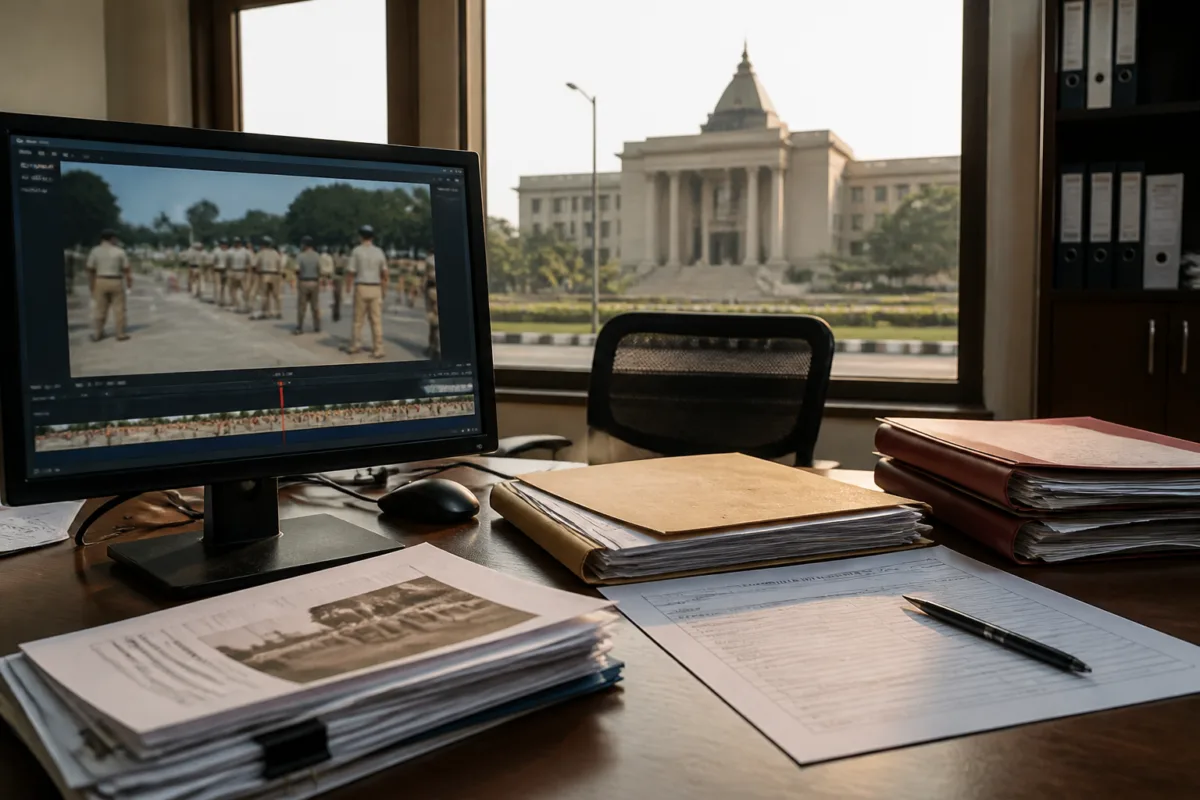
The Punjab and Haryana High Court’s direction to Haryana Police to provide an unsuccessful candidate with the videography of a recruitment test has widened the practical meaning of transparency in public hiring. The order does not decide whether the selection was irregular. It addresses a more basic institutional question: can an applicant obtain the contemporaneous record needed to examine a public assessment without first proving that the assessment was manipulated?
In allowing Sunder Lal’s petition, Justice Kirti Singh set aside the January 22, 2026, order of the Chief Information Commissioner, State Information Commission, Haryana, to the extent that it denied disclosure of the videography of the Band Skill Test conducted for the recruitment of Bandsmen, or Constables. The authorities were directed to furnish the recording within 30 days.
The court’s central observation was that “The right to seek information cannot be made dependent upon the information seeker first establishing the very irregularity which the information is sought to examine.” That reasoning places the burden of initial scrutiny on the public authority holding the record, rather than requiring an unsuccessful applicant to prove wrongdoing before receiving access to evidence that could help establish whether wrongdoing occurred.
The case arose from a recruitment process initiated through an advertisement dated November 30, 2022. The selection consisted of a Knowledge Test carrying 20 marks, a qualifying Physical Screening Test and a Band Skill Test carrying 60 marks. Sunder Lal, who belongs to the Backward Class-B category, qualified in the Knowledge Test and Physical Screening Test and took part in the remaining assessment.
The final selection list was published in February 2024. Sunder Lal then learned that Jaibir had been selected against the sole advertised post in the Backward Class-B category in the Brass Band. The marks later placed on record showed that both candidates had secured 13.6 marks in the Knowledge Test, but their Band Skill Test scores were substantially different.
According to the state’s submissions before the court, Sunder Lal had secured 38.6 marks overall: 13.6 in the Knowledge Test, three for an NCC Certificate and 22 in the Band Skill Test. Jaibir had secured 53.6 marks, including 13.6 in the Knowledge Test and 40 in the Band Skill Test. The state also pointed out that Sunder Lal had applied for the Bass Drum, while Jaibir had applied for the Bb Clarinet.
The numerical difference is important because the Band Skill Test carried 60 out of the total 100 marks. The test was therefore not a peripheral stage in the recruitment process. It was the component in which the largest share of the marks could be awarded, making the record of how the assessment was conducted directly relevant to an unsuccessful candidate seeking to understand the outcome.
Sunder Lal had earlier challenged the selection before the high court. That petition was disposed of as not pressed on August 8, 2025, with liberty to him to pursue remedies in accordance with law. He subsequently sought information under the Right to Information Act, 2005, including the videography of the Band Skill Test.
The request was initially rejected by the State Public Information Officer-cum-Deputy Superintendent of Police, Karnal, under Section 8(1)(j) of the Act. The stated basis was that the information related to other applicants. The State Information Commission later directed disclosure of the candidates’ marks but declined to provide the videography, citing the absence of material establishing malice or prima facie subversion of the assessment process.
That sequence reveals the institutional tension at the centre of the case. Recruitment authorities must preserve the integrity and privacy of examination records, but they are also public bodies conducting assessments that determine access to public employment. When a candidate is denied the record of an assessment, the denial can prevent the candidate from testing whether the process was fair. The court’s reasoning rejects the idea that access can be postponed until the applicant has already demonstrated the irregularity that the record may help investigate.
The distinction between a private document and a public assessment record was therefore central. Before the high court, Sunder Lal’s counsel, Animesh Sharma, argued that the videography was not private material but the contemporaneous record of a public recruitment examination. The submission was that an applicant could not be required to establish wrongdoing before being allowed to examine information sought to assess the fairness of the selection.
The state, represented by senior Deputy Advocate General Saumya Ahluwalia, opposed the petition and relied on the marks obtained by the two candidates, as well as the difference between the instruments for which they had applied. The court, however, held that the fact that the candidates applied for different instruments did not by itself answer whether the recording was exempt from disclosure.
The court described the Band Skill Test as an integral component of recruitment and the recording as the contemporaneous record of the assessment undertaken by the Selection Board. It also held that the presence of other candidates in the recording could not, by itself, justify withholding the entire information from an unsuccessful candidate who had participated in the same recruitment process and sought access to a record having a direct bearing on the selection.
This does not mean that every recruitment recording must automatically be released without safeguards. The order, as reported, is concerned with the specific refusal to provide the videography to a participant in the same recruitment process. It also does not establish that the selection of Jaibir was improper or that the assessment board acted with malice. The court directed disclosure of the record; it did not, on the facts supplied, make a finding of manipulation.
That distinction matters for public administration. Transparency is not the same as an adverse finding against an institution. A transparent process allows its records and reasoning to be examined. If an assessment was conducted properly, disclosure can help establish that. If the record reveals a procedural problem, it can provide a basis for an appropriate remedy. In both situations, access to the underlying record is the step that makes meaningful review possible.
The case also demonstrates how the design of a recruitment process affects later accountability. The Band Skill Test accounted for 60 marks, while the Knowledge Test accounted for 20. The final difference between the two candidates was therefore heavily shaped by the practical assessment. In such a system, a marks sheet can show the outcome but not necessarily explain how performance was judged. The videography becomes relevant because it preserves what occurred during the assessment itself.
The dispute further shows the limits of treating all information concerning other candidates as automatically beyond disclosure. The State Information Commission allowed disclosure of marks but withheld the recording. The high court’s reasoning indicates that the presence of other candidates in a record does not, without more, justify refusing the entire document to a participant seeking information about a common public selection process. The court’s operative direction was to provide the videography within 30 days.
For recruitment authorities, the order places emphasis on record management as part of procedural accountability. A video record is not merely an administrative by-product when it captures an assessment carrying a substantial share of the marks. It can become the evidence through which a candidate, an information authority or a court examines how the selection was conducted. The case therefore connects the right to information with the practical preservation and disclosure of records held by public institutions.
For applicants, the decision clarifies the sequence of scrutiny. An unsuccessful candidate need not first establish malice or prima facie subversion as a condition for seeking the contemporaneous record of a public test, at least in the circumstances described in the order. The candidate’s participation in the recruitment process and the direct connection between the requested record and the selection were significant to the court’s reasoning.
The broader urban governance question is how public institutions build trust in decisions that distribute scarce opportunities. Recruitment to public posts is not a city infrastructure project, but it is part of the administrative system through which cities and states function. When selection processes are difficult to examine, public confidence can weaken even where no irregularity is ultimately proved. Accessible records make accountability less dependent on assertion and more dependent on evidence.
The supplied report establishes the court’s direction, the marks placed before it, the competing submissions and the 30-day deadline. It does not establish what the videography will show or whether Sunder Lal will pursue any further challenge after receiving it. The immediate next step is therefore administrative: Haryana Police authorities must furnish the Band Skill Test videography within the period ordered by the high court.

