


The dispute over the Hansiyawas reservoir in Churu’s Sidhmukh tehsil is not only a conflict over the location of a proposed water project. It has exposed a deeper problem in regional infrastructure planning: land acquisition is moving ahead in the name of future water security, while the people giving up fertile farmland say they have no assured access to the irrigation benefits that the wider project is expected to create.
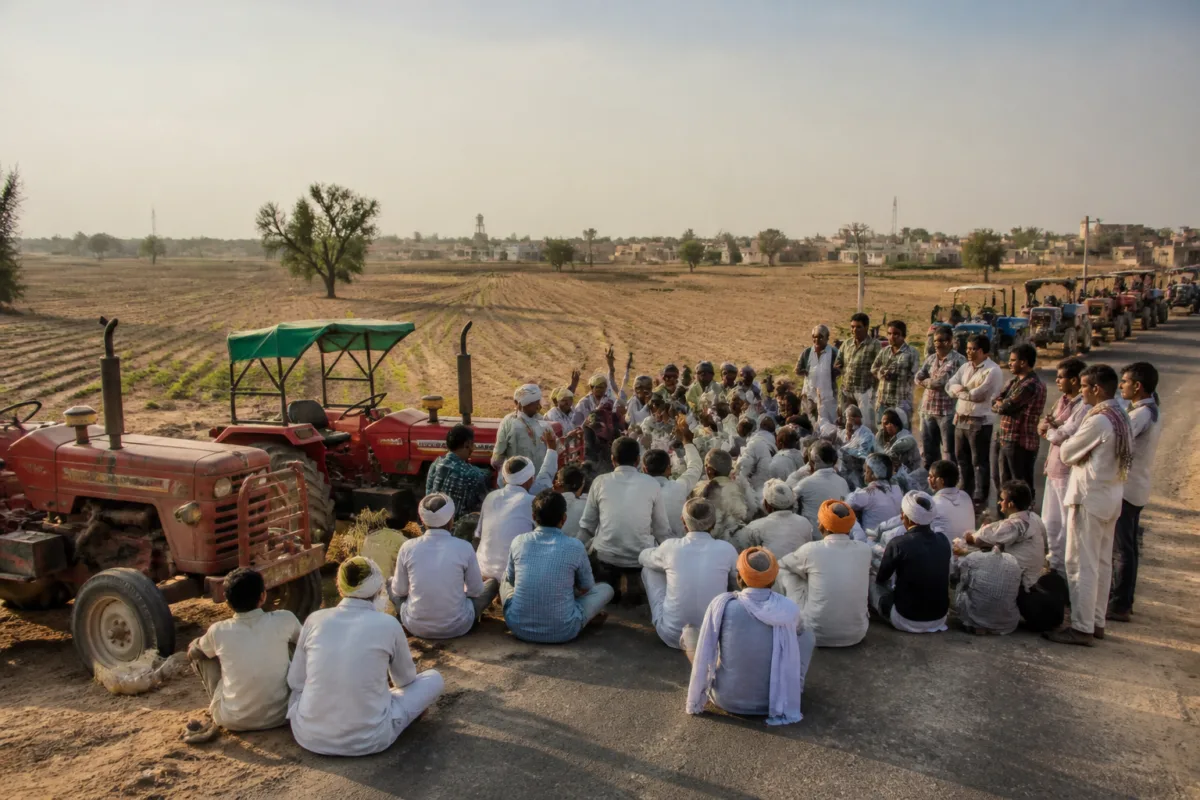
Farmers from eight villages—Tambakhedi, Ramsara Tibba, Chubkiagarh, Dhanothi Chhoti, Dhanothi Badi, Dumki, Hansiyawas and Dhigarla—have been protesting since mid-August. According to the Times of India report, the agitation has entered its third month, with farmers holding a dharna at Tambakhedi bus stand, tractor rallies, torchlight processions and demonstrations at the Sidhmukh tehsil office. They have now called for a Diwali boycott to press their demands.
The immediate issue is the proposed Hansiyawas reservoir under the Yamuna water project. Farmers say the project would require the acquisition of fertile agricultural land capable of supporting two crops a year. Their demand is that the reservoir be shifted to barren land or suitable government land so that the loss of cultivable land is reduced. They are also seeking better compensation and rehabilitation, alleging that the proposed package is inferior to those offered for similar projects elsewhere.
The central concern, however, is not simply the amount of compensation. Farmers say they are being asked to surrender productive land without an assurance that the water stored in the reservoir will be available for irrigation. That distinction matters. A reservoir can serve multiple public purposes, but the benefits received by the region affected by land acquisition depend on the project’s operating priorities, water allocation rules and the infrastructure built after storage is created.
In the account cited by the report, Churu MP Rahul Kaswan said the first phase of the Rajasthan-Haryana agreement provides for up to 577 million cubic metres of water between July and October. That supply is primarily intended for drinking needs and remains subject to the priority requirements of Haryana and Delhi, he said. The proposed irrigation of 1.05 lakh hectares has been moved to a second phase, which depends on three upstream dams. Kaswan also said there is no disclosed timeline for completion of those dams.
This sequencing is the most important institutional fact in the dispute. For the affected villages, land acquisition for a reservoir is an immediate and irreversible event. The irrigation benefit described in the project’s broader vision is presented as a later-stage outcome, dependent on additional upstream infrastructure and a future water-allocation arrangement. The result is a mismatch between the certainty of the cost and the uncertainty of the benefit.
That mismatch is common to large water and infrastructure projects. Authorities generally plan them as linked systems: a reservoir, upstream storage, conveyance arrangements, allocation agreements and distribution networks are expected to work together. Local communities experience them differently. They encounter the first visible component—land surveys, acquisition notices, construction activity or restrictions on land use—before the complete network is operational. If the downstream benefits are conditional or delayed, the project’s public justification can lose credibility at the village level.
The Hansiyawas protest also shows why compensation cannot be treated as a substitute for livelihood protection. The farmers’ claim is that the land under consideration is fertile and supports two crops a year. That makes the land more than a physical asset. It is also a productive base, a source of recurring income and part of the local economy. A one-time payment may compensate for ownership in formal terms, but it does not automatically replace agricultural output, local employment or the economic relationships built around cultivation.
The affected area is not a small isolated settlement. The eight villages together have a population of around 40,000, according to local reports cited by the newspaper. The scale of that population gives the project an urban and regional-planning dimension, even though the dispute is centred in rural Churu. Water infrastructure links villages, towns and cities through the same system of storage, allocation and supply. Decisions taken in a project area can determine drinking-water security elsewhere while imposing land and livelihood costs locally.
This creates a governance question: who gets to define the project’s public interest, and how are those costs distributed? From the farmers’ perspective, the proposed reservoir may serve a wider regional or inter-state water arrangement, while the immediate burden falls on particular villages. From the government’s perspective, the project may be part of a broader agreement whose benefits cannot be confined to the landholding community. A credible process has to address both positions through disclosed plans, negotiated rehabilitation and a clear explanation of the sequence linking acquisition to public benefit.
The first phase described by Kaswan further complicates the issue. The 577 MCM allocation is primarily for drinking water and is subject to the requirements of Haryana and Delhi. This means the availability of water for local irrigation cannot be assumed merely because the reservoir is associated with the Yamuna project. The farmers’ demand for an irrigation assurance is therefore connected to the project’s governing framework, not just to the physical presence of water near their villages.
The distinction between storage capacity, allocated water and delivered water is crucial. A reservoir may store water, but actual access depends on the project’s approved purpose, seasonal availability, inter-state priorities and distribution infrastructure. The source report does not establish how much water, if any, would be reserved for irrigation in the affected villages. It also does not provide the proposed reservoir’s capacity, the exact area to be acquired, the terms of the rehabilitation package or the status of acquisition proceedings. Those gaps are significant because they prevent residents from assessing the project on the basis of a complete public record.
The reported absence of a disclosed timeline for the three upstream dams adds another layer of uncertainty. Irrigation in 1.05 lakh hectares has reportedly been placed in the second phase, but the timing of that phase depends on infrastructure that is not yet scheduled publicly in the supplied account. For landowners, this raises a basic question of sequencing: should acquisition for a component connected to a future irrigation system proceed before the upstream works, water commitments and distribution arrangements are sufficiently defined?
The answer cannot be inferred from the protest alone. It requires the government to place the relevant project documents, land-acquisition details, water-allocation terms and rehabilitation provisions in the public domain. It also requires direct negotiations with the affected villages, which farmers say have not taken place despite more than two months of demonstrations. The absence of a dialogue does not resolve the technical questions; it leaves them to be contested through mobilisation.
The protest methods themselves reflect the widening gap between administrative procedure and public consent. A dharna at a bus stand, tractor rallies and demonstrations at the tehsil office are not merely expressions of opposition to a reservoir. They are attempts to make a project’s local costs visible in places where routine administrative communication has not, according to the farmers, produced negotiations. The Diwali boycott call is a further escalation intended to convert a land-acquisition dispute into a broader public issue.
The larger lesson from the Hansiyawas reservoir plan is that water infrastructure cannot be assessed only by the volume it is expected to deliver or the hectares it may eventually irrigate. Its legitimacy also depends on where the storage is located, whose land is acquired, which use receives priority, when benefits will arrive and whether affected residents have a meaningful role before acquisition proceeds.
The supplied report confirms that the dispute remains unresolved. Farmers are seeking a change in the reservoir site, assurances on irrigation, improved compensation and rehabilitation, while the project’s wider water framework places drinking-water requirements ahead of the irrigation target cited for the second phase. The next decisive development will be whether the Rajasthan government opens formal negotiations and publishes sufficient technical, financial and rehabilitation details for the eight affected villages to evaluate the project’s costs and promised benefits.

