


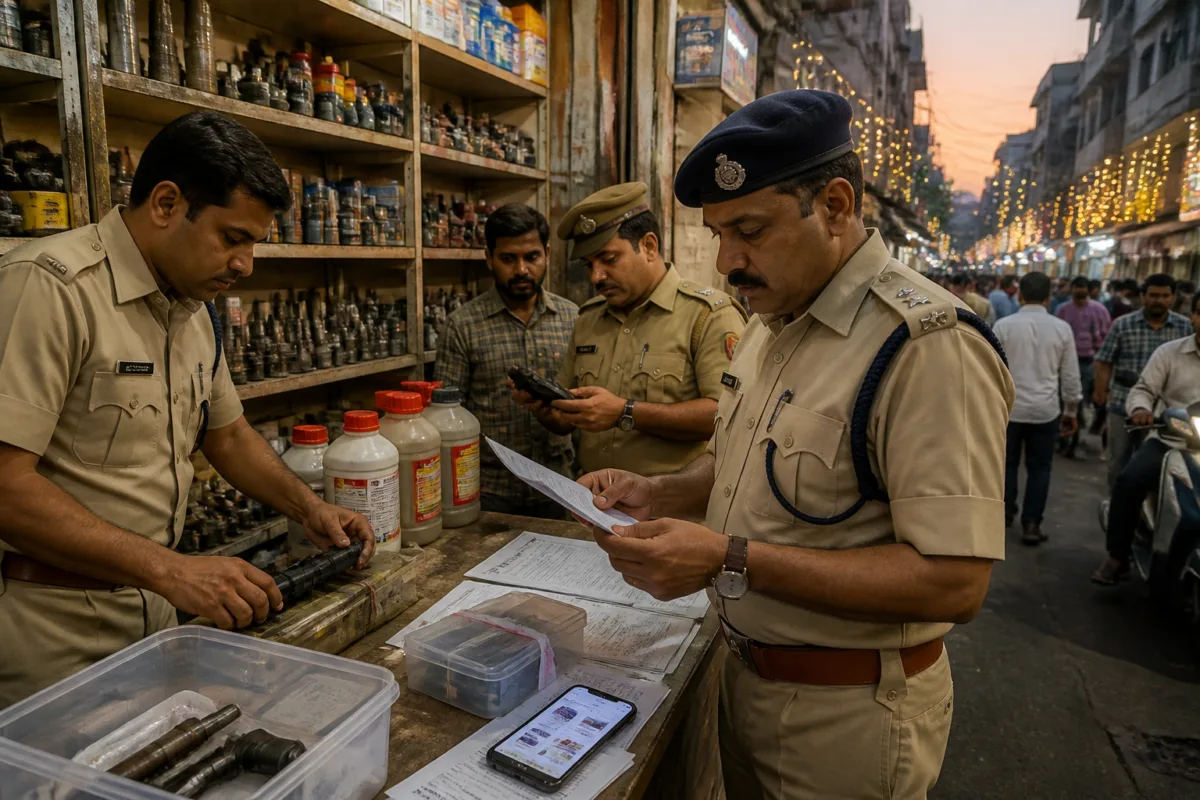
Gwalior’s carbide gun crackdown is moving beyond physical shops and fabrication units to the digital trail created by online sales. Police have sought sales and delivery records from e-commerce companies, while also preparing to inspect hardware shops, chemical calcium carbide outlets and possible manufacturing locations. The shift reveals a wider enforcement challenge: a device prohibited by the police can move through several ordinary-looking commercial channels before it becomes visible to investigators.
The action, outlined by Gwalior Police ahead of Diwali, places online transactions at the centre of a public-safety operation. The police want to identify buyers, examine delivery addresses and decide whether field-level verification is required. Depending on the information received, officers may visit listed addresses and take action where violations are established. The supplied report does not state how many transactions are being examined, whether any buyer has been identified, or how many devices have been seized.
That distinction matters. The police plan is an investigation and enforcement framework, not evidence that every online buyer has committed an offence or that all transactions connected to the records involve prohibited devices. The records could help investigators establish where products were delivered and connect buyers, sellers and manufacturers. But the report leaves open the central operational questions: what records will be supplied, how complete they will be, and how police will distinguish a genuine carbide gun transaction from a listing involving related materials or descriptions.
The police response brings together several units and levels of field activity. Senior Superintendent of Police Dharamveer Singh has directed all police station in-charges to intensify checks in their jurisdictions. The intelligence unit and Crime Branch have been tasked with tracing sources, inspecting fabrication workshops and checking hardware shops and establishments selling chemical calcium carbide. The stated objective is to follow the supply chain from sellers and manufacturers to online orders and deliveries, then initiate legal action wherever violations are established.
This is a significant change from treating the issue as a seasonal problem limited to neighbourhood markets. A physical inspection can identify a shop displaying or selling a device. An online transaction, however, may involve a marketplace listing, a seller operating elsewhere, a warehouse, a delivery network and a buyer’s address. Each part of that chain may sit under a different operational responsibility. Gwalior Police’s plan attempts to connect those parts through transaction data and coordinated field inspections.
The proposed role for e-commerce companies is therefore central. Police have sought details of carbide gun sales and deliveries in the region and intend to ask local representatives of e-commerce companies to cooperate. Warehouses associated with e-commerce platforms or online marketplaces may also be checked. The report does not specify whether the police have issued a formal legal notice, what data fields have been requested, or whether the companies have responded. Those details will determine whether the digital trail becomes usable evidence or remains only an investigative lead.
The enforcement model also depends on how online marketplaces classify products. Police will monitor social media posts and online marketplaces for listings involving carbide guns and related materials. That wording suggests that the problem is not restricted to products sold under one consistent name. Listings may be removed, renamed or presented as components, while the associated materials may be sold separately. The report does not establish how sellers are identifying these products or what screening systems platforms currently use.
The involvement of fabrication workshops, hardware shops and calcium carbide outlets shows why a single-platform response would be insufficient. Carbide guns are associated with the use of chemical calcium carbide, but the police are also investigating possible local manufacture and supply. A seller, fabricator, chemical supplier and buyer may not be located in the same place. Inspections across these points are intended to identify the source and route of the devices, rather than merely confiscate individual items after they reach users.
That approach places considerable importance on coordination inside the police force. Station-level officers are expected to intensify checks, while intelligence and Crime Branch teams trace sources and conduct inspections. The report also says information about illegal manufacture, sale or use will be followed up in coordination with concerned departments. It does not name those departments or describe a separate administrative protocol. The lack of detail makes the eventual division of responsibilities difficult to assess, but the stated plan clearly extends beyond routine beat policing.
The city-level impact is most visible in the police warning about injury and fire risks. Gwalior Police have said carbide guns can cause explosions, fires and serious injuries to the eyes, face and other parts of the body, and have specifically warned against their use by children during the festive season. Diwali increases the urgency of the operation because police are attempting to act before devices are used, not only respond after an incident. The supplied report, however, does not provide injury statistics, previous incident numbers or an assessment of how widespread use is in Gwalior.
The awareness component is intended to complement enforcement. Police stations have been directed to organise campaigns in schools, panchayats, markets and public places. Residents have been asked to report the manufacture or sale of carbide guns to the nearest police station or through the Gwalior Police WhatsApp number, 9407214576. The police have said informants’ identities will be kept confidential. This creates a public reporting channel alongside inspections and digital monitoring, although the report does not state how complaints will be recorded, verified or tracked to closure.
The inclusion of schools and panchayats is notable because it expands the response beyond commercial premises. Schools can serve as locations for warnings to children and families, while panchayats and public spaces extend the campaign into communities outside the immediate urban market. The report does not indicate how many awareness sessions are planned or whether educational institutions have been given specific guidance. It does establish, however, that the police view the issue as both an enforcement problem and a preventable safety risk.
The deeper governance question is how local enforcement adapts when a prohibited product is distributed through a mixed physical and digital economy. Police inspections are designed for identifiable premises. Online commerce complicates that model by separating the seller, warehouse, delivery address and end user. The Gwalior operation tries to restore that visibility through records and address verification. Its success will depend on whether information can move quickly enough between platforms, investigators and field officers before the festive period passes.
There is also an important evidentiary boundary. A delivery record can identify a transaction or an address, but the report does not say that it automatically proves possession, use or illegal manufacture. Police have indicated that further action will depend on what the records establish and whether violations are found. That qualification is essential to the credibility of the operation, particularly if door-to-door verification is undertaken. The supplied material gives no details about the legal process for searches, notices, seizures or prosecutions.
The available evidence therefore confirms a broad enforcement plan, but not its results. Police have directed station in-charges to intensify checks; intelligence and Crime Branch teams are examining supply sources; e-commerce records have been sought; online listings and related materials will be monitored; and awareness campaigns are planned. What remains unknown is the scale of online sales, the number of manufacturers or sellers under scrutiny, the companies’ response, and whether inspections have already produced seizures or arrests.
Gwalior’s carbide gun operation illustrates how a seasonal urban safety concern can expose weaknesses in the way authorities monitor products that move across physical and digital systems. The immediate focus is Diwali and the prevention of explosions, fires and injuries. The institutional test is whether police can connect marketplace data, delivery information, local inspections and public reporting without treating an investigative lead as proof of a violation. The next developments to watch are the response from e-commerce companies, the outcome of inspections and whether the awareness campaign produces verified reports before the festive period.

