


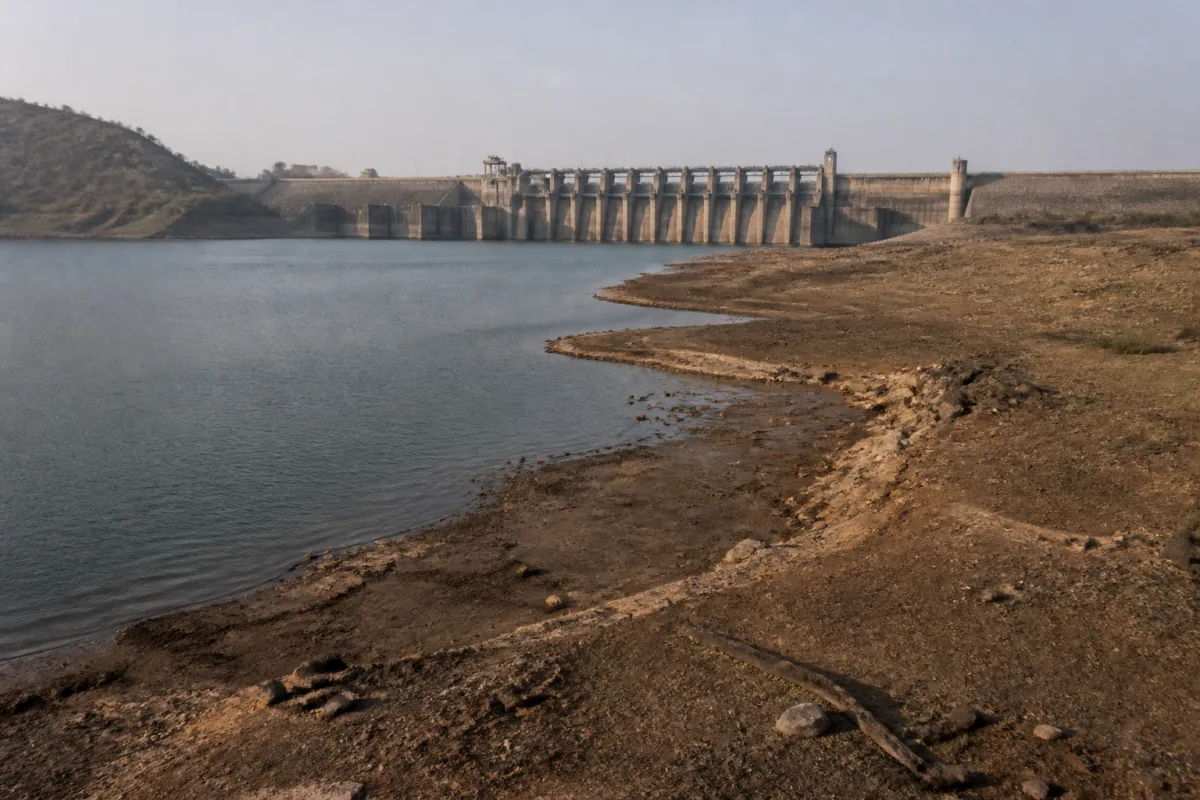
Gujarat’s water crisis has deepened after storage across the state’s reservoirs fell sharply from last year, with only Sardar Sarovar recording a higher water level and four districts facing drought conditions after below-average rainfall.
According to a report by Gujarat Samachar, the total water stored in Gujarat’s 206 reservoirs stood at 10,103 million cubic metres (MCM) in November 2026, compared with 15,284.37 MCM during the same period in 2025. The year-on-year decline amounts to 5,181.37 MCM.
The 17 major reservoirs have also recorded a significant reduction. Their combined storage fell from 12,783.78 MCM in November 2025 to 8,840.65 MCM this year, a decrease of 3,943.13 MCM.
The decline follows a weaker monsoon. Gujarat received 811.96 millimetres of rainfall in 2026, equivalent to 89.34% of the average, compared with 1,061.80 millimetres, or 119.13% of the average, by November last year. The state therefore received 249.84 millimetres less rainfall than in 2025, while the share of average rainfall fell by 29.79 percentage points.
The distribution of reservoir storage has also changed substantially. The number of reservoirs holding more than 90% of their capacity fell from 151 last year to 35 this year. At the same time, reservoirs with less than 70% storage increased from 30 to 147.
Sardar Sarovar remains the main source of relief in the state’s water system. Its storage increased from 9,369.82 MCM in November 2025 to 9,440.68 MCM this year, a rise of 70.86 MCM. The report said the dam’s comparatively stronger position has prevented the overall situation from becoming more severe.
The impact is particularly acute in Devbhumi Dwarka, Porbandar, Jamnagar and Kutch, where weak rainfall has contributed to drought-like conditions. Chief Minister Bhupendra Patel has declared drought in the four districts, according to the report. The reduced water availability is expected to affect agriculture as well as the wider management of water supplies.
Vadodara’s Ajwa reservoir is showing how quickly lower inflows can affect local water security. In 2025, strong rainfall pushed its level to 212.95 feet in September, requiring all 62 gates to be opened as inflows increased. This year, the reservoir did not reach the danger level even once. Its water level was recorded at 208.57 feet on the morning cited in the report, a level usually associated with February.
The figures place added pressure on Gujarat’s water management agencies to balance drinking water, irrigation and other requirements through the remaining dry period. The immediate concern is not only the total quantity stored, but also the much smaller number of reservoirs with high reserves and the wider spread of reservoirs below 70% capacity.

