


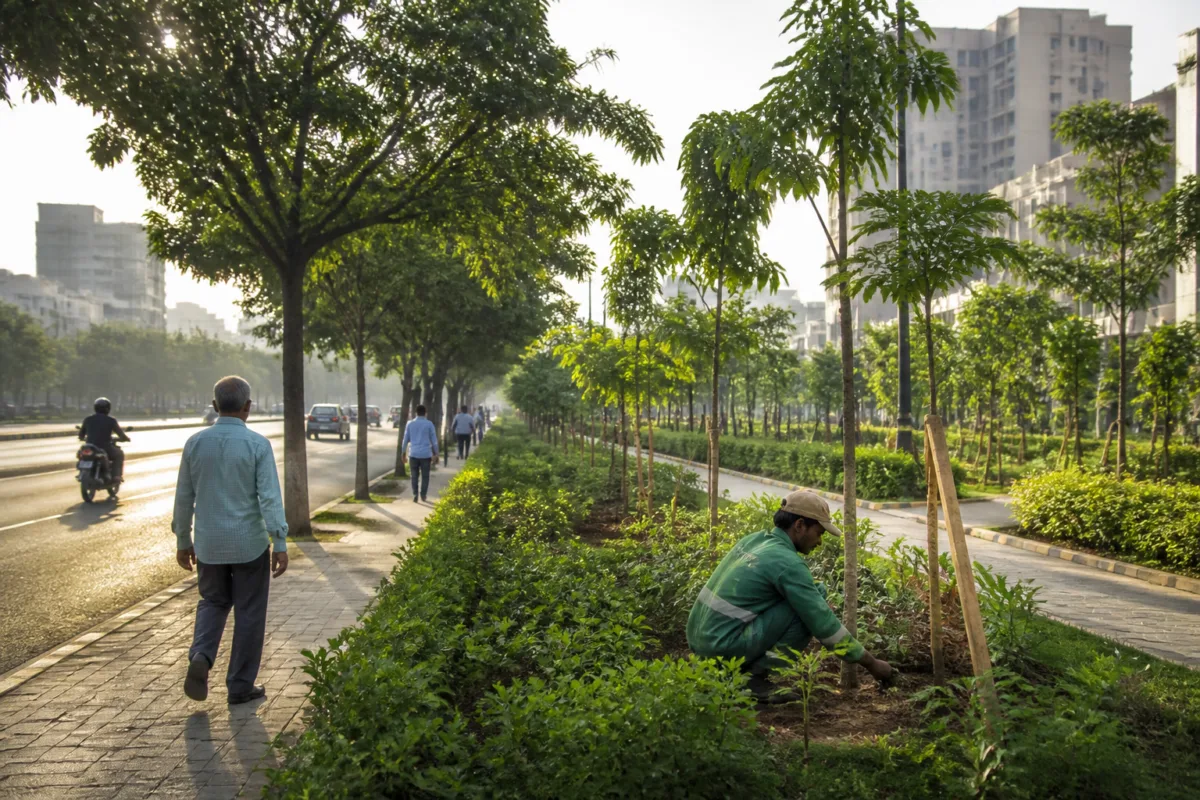
Gujarat’s Urban Greening Policy 2026 does more than set a target for planting trees. It attempts to change how the state’s cities define, fund and measure green infrastructure by linking urban local-body performance to green-cover expansion, sapling survival, access to open spaces and environmental outcomes.
The policy requires every city in Gujarat to increase its green cover by at least 20% over the next 10 years. It covers all 169 urban local bodies in the state: 17 municipal corporations and 152 municipalities. The policy will remain in force for a decade from November 2026 and will be reviewed every two years, according to the Gujarat government, as reported by The Times of India.
That breadth is important. The policy is not limited to Ahmedabad, Surat, Vadodara, Rajkot or other large municipal corporations. It applies equally to the smaller municipalities that often have fewer institutional resources for maintaining parks, roadside plantations and public open spaces. The central administrative question will therefore not only be how much greenery cities add, but whether the state can create a common implementation framework across urban bodies with different capacities, land pressures and financial resources.
The policy’s most consequential shift is its attempt to move urban greening beyond conventional tree-planting campaigns. Instead of treating plantation as the primary outcome, it proposes an interconnected system comprising urban forests, green belts, biodiversity parks, green corridors, roadside plantations and neighbourhood gardens. It also promotes rooftop gardens, vertical gardens and green facades in residential, commercial and institutional buildings.
This wider definition recognises that urban green cover is not created in a single type of site. A roadside plantation, a neighbourhood garden, a biodiversity park and a green building facade perform different functions and serve different populations. The policy, as described in the government announcement, places these interventions within one urban greening framework rather than treating them as isolated projects.
That matters because the value of urban greenery depends on location, access and maintenance as much as on the number of saplings planted. The policy specifically includes accessibility of green spaces among the indicators for assessing urban local bodies. This gives public access a formal place alongside planting and survival, although the supplied policy details do not specify how accessibility will be measured or what minimum standard cities will have to meet.
The Green Star Rating Mechanism is the policy’s main accountability device. Urban local bodies will be assessed annually on planting, sapling survival, access to green spaces and environmental outcomes. Cities scoring between 50% and 69% will be classified as Promising Green Cities, those scoring between 70% and 84% as Progressive Green Cities, and those scoring above 85% as Pioneer Green Cities. The highest-rated city will receive the annual recognition of Ultimate Green City of Gujarat.
These ratings create a common language for comparing performance, but their practical importance will depend on the quality of the underlying measurement. The policy provides thresholds and categories, yet the available details do not establish how much weight will be assigned to each indicator, how baseline green cover will be calculated, or how the state will verify environmental outcomes. Those technical rules will determine whether the rating system measures durable improvements or primarily rewards activity that is easier to count.
The policy also links performance to public finance. High-performing urban local bodies will be eligible for additional state funding and priority access to grants. Those falling short will be required to take corrective measures. Cities scoring below 50% for two consecutive years will be placed on an improvement track under state-level monitoring.
This creates a direct connection between urban greening and municipal administration. In many city programmes, planting is visible at the launch stage while maintenance becomes less visible over time. By making funding eligibility dependent on performance, Gujarat’s policy seeks to keep the municipal focus on outcomes after the plantation event has ended. It also gives the state a mechanism to distinguish between cities that are building and maintaining green assets and those that are not meeting the stated standards.
The policy’s minimum 80% sapling-survival target is particularly significant. Plantation projects will be paid for on the basis of verified survival and plant health over a minimum period of five years. This changes the payment logic from an input-based model—how many saplings were planted—to a longer-term maintenance model in which survival is part of the contract’s performance requirement.
The five-year period is also an administrative test. It requires urban local bodies and implementing agencies to maintain records, inspect plantations and verify plant health well beyond the initial planting season. The supplied account does not specify the verification methodology, the agency responsible for certifying survival, or the consequences for contractors when plants fail. Those details will be important because the credibility of the 80% standard will depend on independent and consistent verification across all 169 urban local bodies.
The policy identifies several urban pressures that it is intended to address: rising heat, air and noise pollution, stormwater management and the need for accessible recreational spaces. It also notes that nearly 48% of Gujarat’s population lives in urban areas. This urbanisation context explains why the state is placing green infrastructure within the urban planning system rather than treating it only as an environmental or horticultural programme.
Green infrastructure can be distributed through multiple layers of a city. Urban forests and biodiversity parks require larger land parcels, while roadside plantations, neighbourhood gardens, rooftop gardens and green facades can be integrated into more built-up areas. However, the policy details supplied do not state how land will be identified, protected or acquired for these uses. They also do not clarify how greening targets will be reconciled with competing demands for housing, transport infrastructure, utilities and other public facilities.
That omission does not invalidate the policy, but it highlights where implementation will become consequential. A city’s green-cover percentage can increase through plantations on available land, but the distribution of that greenery determines who benefits. The inclusion of neighbourhood gardens and accessibility in the policy suggests an interest in everyday public access, yet the published details do not establish whether the 20% target will be assessed citywide or by ward, neighbourhood or land-use category.
Institutionally, implementation will be distributed across several levels. Urban greening cells will be established under the parks and gardens departments of municipal corporations, urban development authorities and area development authorities. The Gujarat Urban Development Mission will act as the technical nodal agency. A state-level monitoring committee headed by a senior official of the urban development department will oversee implementation, expenditure, plantation survival and progress against green-cover targets.
The monitoring committee is scheduled to meet quarterly during the first year and twice a year thereafter. This timetable reflects a front-loaded oversight model: more frequent review during the initial implementation phase, followed by less frequent monitoring once the programme is established. The policy’s two-year review cycle provides another opportunity to revise its operation, although the available announcement does not specify whether the review will include public reporting or consultation with urban local bodies and residents.
The institutional design therefore combines local implementation with state-level technical and financial oversight. Municipal bodies and development authorities will be responsible for projects and maintenance, while the Gujarat Urban Development Mission and the monitoring committee will provide technical coordination, assessment and supervision. The arrangement may help standardise reporting, but it also means that the success of the policy will depend on clear division of responsibility among parks departments, municipal administrations, development authorities and state agencies.
The policy’s numbers establish an ambitious but measurable framework: 169 urban local bodies, a 20% green-cover increase over 10 years, annual ratings, an 80% sapling-survival threshold, a five-year minimum period for verified plant health, and a 48% urban population share. These figures turn a broad environmental objective into a set of administrative milestones. They also make future assessment possible, provided that the state publishes baselines and annual results.
What is not yet established in the supplied material is equally important. The policy account does not provide the current green-cover level for each city, the method for measuring the 20% increase, the expected annual trajectory, the funding allocation, or the standards for environmental outcomes. It does not identify the types of vegetation that will qualify, explain how private-building interventions will be recorded, or specify how the policy will address the loss of existing green spaces.
These are not minor technicalities. A percentage target requires a reliable baseline. A survival target requires a transparent inspection method. A public-access indicator requires a definition of distance, opening hours, usability and safety. A funding incentive requires a predictable formula. Without these details, cities may have different interpretations of the same target, making comparisons difficult even if the Green Star categories appear precise.
The policy nevertheless marks a significant change in the administrative framing of urban greenery in Gujarat. Green spaces are being treated as part of urban infrastructure, with maintenance, performance ratings and funding consequences attached to them. The approach also acknowledges that cities need a network of different green assets rather than isolated planting sites.
The larger urban question is whether Gujarat can make greenery a durable municipal service instead of a periodic campaign. The policy has supplied the institutional architecture for that shift: targets, ratings, incentives, monitoring bodies and survival-linked payments. Its long-term significance will depend on the rules that translate those commitments into ward-level projects, verified outcomes and publicly visible improvements.
The first implementation year and the policy’s scheduled reviews will show whether the framework produces consistent reporting across the state. The key evidence to monitor will be the baseline green-cover assessments, annual Green Star ratings, survival verification, funding decisions and the distribution of accessible green spaces. Until those details are published, the policy confirms a new direction for Gujarat’s urban planning, while leaving its practical impact dependent on measurement and municipal execution.

