


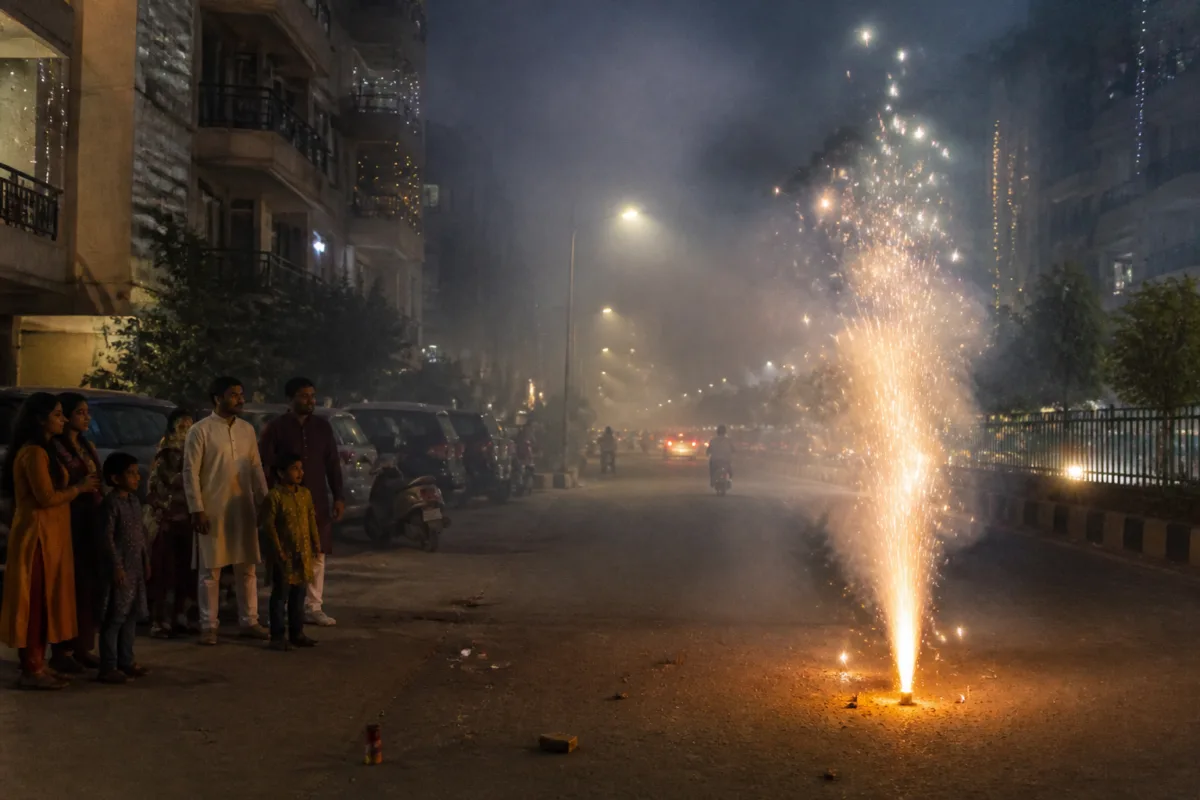
Green crackers are being presented as a less polluting alternative to conventional fireworks, but the evidence available for Delhi points to a narrower conclusion: they can reduce some emissions while still adding hazardous particles to an already stressed urban atmosphere. The distinction matters because the debate is not simply about whether one type of firecracker is safer than another. It is about how courts, regulators, manufacturers and residents manage a short period of intense pollution in a city where air quality repeatedly becomes a public-health concern.
The Supreme Court has allowed the bursting of green crackers in Delhi between 6am and 7am and between 8pm and 10pm on November 7 and 8. The permitted windows create a regulatory framework around when fireworks can be used, but the reported data shows that the effectiveness of such restrictions depends on both the emissions profile of the products and compliance on the ground. Delhi’s experience over the past decade indicates that rules have often existed alongside widespread violations.
What green crackers actually change
Green crackers are designed to produce significantly lower air and noise pollution than conventional fireworks. According to the reported technical description, they aim for a minimum 30% reduction in particulate matter emissions and at least a 10% reduction in gaseous emissions. Their noise output is designed to remain below 125 decibels at a distance of four metres from the point of bursting.
Their composition is also different. Conventional crackers contain 34% aluminium, 57% potassium nitrate and 9% sulphur. Green crackers contain 29% aluminium, 28% potassium nitrate, 38% of CSIR-NEERI’s proprietary material, identified in the report as Fe₂O₃, and 5% sulphur. On that comparison, aluminium use falls by 14%, sulphur by 44% and potassium nitrate by 50%.
These changes are intended to reduce the volume of pollutants released during combustion. Green crackers are also manufactured without chemicals listed in the report as banned for their production: barium nitrate, lithium, mercury, arsenic and cadmium. Consumers are expected to identify approved products through a green logo of CSIR-NEERI and the Petroleum and Explosives Safety Organisation, along with encrypted QR codes.
The reported cost comparison is unusual because the lower-emission formulation is not presented as more expensive in every respect. The cost of flash powder is given as ₹132 per kilogram for conventional crackers and ₹95 per kilogram for green crackers. However, the presence of an identification system does not by itself establish that every product sold as green is compliant. The material supplied for this analysis does not provide figures on enforcement, counterfeit products or the proportion of fireworks in Delhi’s market that meet the prescribed standards.
The unresolved issue is that lower emissions do not mean no emissions. A study by Delhi Technological University, cited in the report, found that green crackers produce high concentrations of ultrafine particles. These particles are described as more dangerous than PM2.5 and PM10. The finding complicates the idea that a reduction in measured particulate emissions automatically translates into a proportionate reduction in health risk.
That distinction is important for urban pollution policy. Delhi’s air quality problem is measured through pollutants such as PM2.5 and PM10, but the reported study highlights a category of smaller particles that may not be fully represented by the public-facing language around “cleaner” fireworks. The evidence supplied does not quantify the health impact of the ultrafine particles or compare exposure levels between green and conventional crackers. It does, however, establish that green crackers remain a source of pollution.
The scale of conventional firework emissions
The reported measurements illustrate how sharply particulate concentrations can rise near different types of conventional fireworks. Measurements taken within 1–6 feet of bursting recorded PM2.5 concentrations of 64,500 micrograms per cubic metre for a snake tablet, 38,450 for a 1,000-firework garland, 28,950 for a pulpul, 10,390 for a full-hand sparkler, 9,490 for a ground spinner and 4,860 for a flower pot.
These are near-source measurements rather than an estimate of Delhi’s city-wide exposure. They should therefore not be treated as direct readings for every resident or as a complete measure of the festival’s contribution to ambient pollution. Their significance lies in showing the intensity of emissions at the point where fireworks are used, particularly for people nearby and for workers involved in handling or selling them.
The numbers also show why a single category of firecracker cannot represent the entire pollution burden. Different products produce different particulate concentrations, and exposure depends on distance, duration, ventilation and the number of fireworks used. The supplied material does not provide a comparable product-by-product PM2.5 table for green crackers, leaving an important evidence gap in the public debate.
Delhi’s regulatory history shows the limits of rules alone
Delhi’s firecracker policy has moved through bans, time restrictions and limited permissions. In 2015, when no firecracker ban was in place, pollution readings recorded on November 10, 11 and 12 were 353, 343 and 360. In 2016, readings on October 29, 30 and 31 were 404, 431 and 445.
The Supreme Court banned the sale of firecrackers in Delhi for the first time in 2017. The readings on October 18, 19 and 20 that year were 302, 319 and 403. In 2018, the Court imposed a nationwide ban on crackers while permitting only green crackers. Delhi’s readings on November 6, 7 and 8 were 338, 281 and 390.
In 2019, only green crackers were allowed in Delhi within an 8pm-to-10pm window. The readings for October 26, 27 and 28 were 287, 337 and 368. A complete ban was imposed across the National Capital Region in 2020, but it was widely flouted; readings on November 13, 14 and 15 were 339, 414 and 435.
A similar pattern followed in 2021, when a complete ban in Delhi was flouted and readings on November 3, 4 and 5 were 314, 382 and 462. The complete bans imposed in 2022, 2023 and 2024 were also reported as being flouted. The corresponding readings were 259, 312 and 303 in 2022; 220, 218 and 358 in 2023; and 307, 328 and 339 in 2024.
In 2025, only green crackers were allowed between 6am and 7am and between 8pm and 10pm, but the restrictions were widely flouted. The readings on October 19, 20 and 21 were 296, 345 and 351. These figures cannot establish that fireworks alone caused the recorded levels, because the supplied report does not separate their contribution from other sources of pollution. They do show that restrictions have not consistently prevented high readings around the festival period.
The policy challenge is therefore administrative as much as technological. A cleaner product can reduce emissions per unit, but the urban result depends on whether the product is genuine, how many fireworks are used, where they are burst, whether time windows are followed and how enforcement agencies monitor violations. The report provides evidence of repeated non-compliance but does not identify which agency was responsible for each enforcement action or how many cases were registered.
What the evidence confirms—and what it does not
The available evidence supports three clear conclusions. First, green crackers are materially different from conventional crackers in composition and are designed to reduce particulate, gaseous and noise emissions. Second, they are not pollution-free and may generate high concentrations of ultrafine particles. Third, Delhi’s repeated experience with bans and restricted time windows shows that formal rules have often been undermined by violations.
The evidence does not establish that green crackers make Diwali pollution safe, nor does it show that permitting them will produce a specific improvement in Delhi’s overall air-quality readings. It also does not provide a complete comparison between the actual emissions of approved green crackers and conventional products across all categories.
That uncertainty is central to the urban question. Delhi’s regulation of fireworks is not only a choice between a ban and permission. It is a system involving product certification, market surveillance, time-based restrictions, policing, pollution monitoring and public compliance. If any part of that chain fails, the intended reduction may not appear at city level.
For residents, the immediate distinction is between reduced pollution and absent pollution. Green crackers may lower emissions compared with conventional fireworks, but the reported evidence does not support treating them as harmless. For authorities, the next issue is whether the permitted windows and product-identification mechanisms can be enforced. For the public debate, the outstanding need is more comparable data on green crackers, especially on ultrafine particles, real-world use and compliance across Delhi.
The evidence therefore points to green crackers as a pollution-reduction measure rather than a pollution-elimination measure. Delhi’s results will depend not only on the formulation of the fireworks, but also on whether the city can implement and enforce the regulatory conditions attached to their use.

