


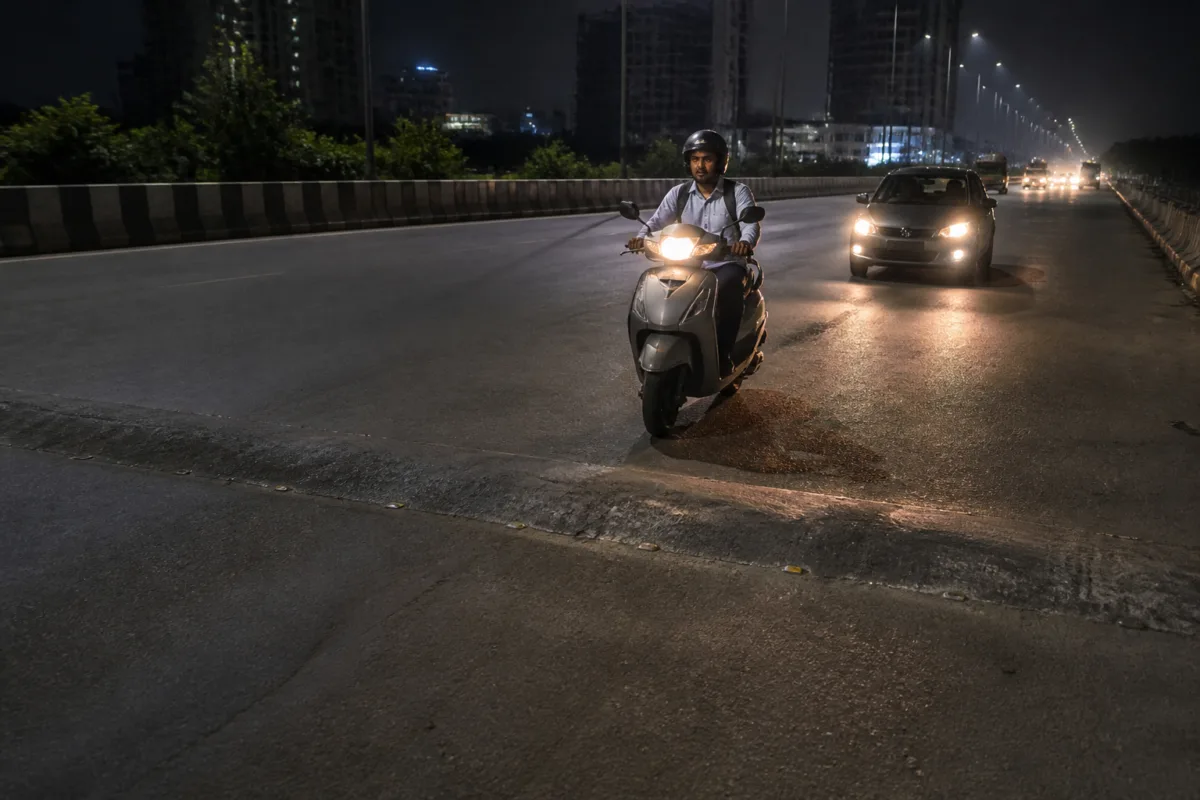
A scooter rider and his pillion passenger were thrown off near an unmarked speed breaker on Greater Noida West Link Road, with the crash captured by a car’s dashcam and later circulated on social media. The incident took place near Bhanota Cut on the 130-metre-wide road connecting Greater Noida East and West.
According to Live Hindustan’s report, the speed breaker had no visible warning sign, white paint or reflector. The obstacle reportedly blended into the road surface, making it difficult for the scooter rider to identify the raised section in the dark and slow down in time.
The dashcam footage shows the scooter becoming unstable as it reaches the speed breaker. The person travelling on the rear seat is thrown onto the road and continues to slide for some distance. The rider also struggles to regain control of the scooter. The report said the injured man was taken away after the incident, but did not provide details about the extent of his injuries or any hospitalisation.
A car travelling behind the scooter managed to brake in time, preventing a second collision, according to the report. The scooter also did not hit the divider, while the rider retained control of the vehicle until the final moments. The footage therefore records not only the initial crash but also the risk of a more serious chain collision on a wide, high-speed urban road.
Residents and road users have tagged the Greater Noida Industrial Development Authority and Noida Traffic Police in social media posts seeking immediate corrective action. Their demands include warning signs before the speed breaker, white road markings and reflective devices that can alert drivers and two-wheeler riders at night.
The location is part of a major east-west connection in the Greater Noida urban area. Roads of this scale carry mixed traffic, including two-wheelers, cars and other vehicles, making the visibility and design of traffic-calming infrastructure important for safe movement. A speed breaker that is not clearly marked can become a sudden obstacle, particularly after dark or when road lighting is inadequate.
The incident also raises a basic maintenance question: whether traffic-calming features are being inspected after installation and whether their paint, signage and reflectors are being restored when they become invisible. The supplied report cited earlier instances of road-maintenance shortcomings in the wider Noida area but did not provide details or official data on the number of such crashes.
No response from the Greater Noida Industrial Development Authority or Noida Traffic Police was included in the report. The next expected step is clarification from the relevant authorities on the condition of the speed breaker and whether warning signs, reflective markings or other safety measures will be installed at the site.

